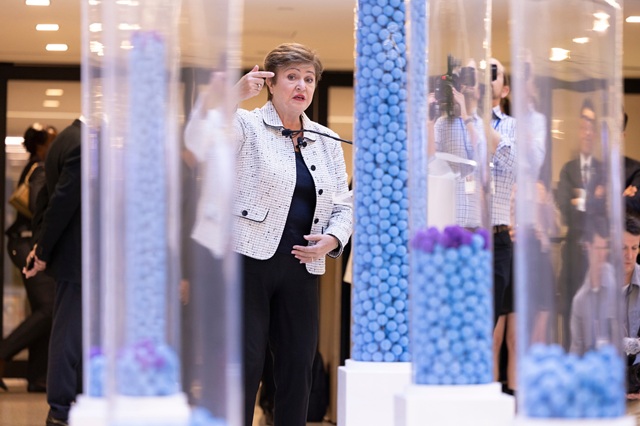
The International Monetary Fund (IMF) has raised alarms over an increasing risk of recession in the United States, pointing to the escalating trade conflict under President Donald Trump’s administration as a key driver of global economic slowdown. In its latest World Economic Outlook, the IMF downgraded its growth forecast for the US and several major economies, including China, India, and Brazil, warning that the ongoing trade war is having a far-reaching impact on global growth.
Pierre-Olivier Gourinchas, the IMF’s chief economist, stated that the US now faces a nearly 40 percent chance of entering a recession, a significant increase from the previous forecast of 25 percent. “The major risk in front of us is that there could be further escalation in tariffs and trade tensions,” Gourinchas said, emphasizing that the disruption in trade could lead to prolonged economic uncertainty and potentially severe long-term effects.
The IMF’s revised forecast has lowered US growth projections to 1.8 percent for 2025, down from an earlier estimate of 2.7 percent. Although the US is still expected to be the fastest-growing G7 economy, the forecast reflects a sharp slowdown from the 2.8 percent expansion predicted for 2024.
In addition to the US, the IMF downgraded its outlook for other G7 nations and major emerging markets, including China, where growth is now expected to slow to 4 percent this year, down from the previously forecasted 5 percent. The report also highlighted that trade tensions are not just affecting economic growth but are also pushing inflation higher in the US, with consumer prices expected to rise by 3 percent this year, a full percentage point more than previously anticipated.
Amid growing concerns over the potential harm to the US economy, the IMF reiterated its support for the Federal Reserve’s current approach to interest rates. Gourinchas defended the Fed’s decision to hold rates steady as it assesses the broader economic impact of rising trade barriers. The IMF’s central forecast assumes two interest rate cuts from the Fed later this year, but Gourinchas emphasized that the current situation requires careful monitoring. “The Fed is sitting at this point and saying, ‘OK, how is this going to play out?’ and waiting and figuring things out seems very appropriate,” he said.
The IMF’s outlook comes as global economic policymakers gather in Washington for the IMF/World Bank spring meetings, where discussions are expected to focus heavily on the global trade conflicts that are fueling uncertainty. In a report referenced by the Financial Times, the IMF warned that the trade war between the US and China could lead to a “major negative shock” for the world economy, with long-term consequences for global competition and innovation.
The IMF has also suggested that the global economic outlook could improve if countries ease current trade barriers and work toward new trade agreements. However, the institution emphasized that the damage from the current tariffs would likely persist, with rising trade barriers continuing to dampen competition and potentially increasing rent-seeking behavior.
As the US-China trade conflict intensifies, the IMF’s warning underscores the mounting challenges for global economies and the potential risks to financial stability. If the situation worsens, the fund cautions, it could lead to broader financial instability, further complicating efforts to manage inflation and sustain growth.
While the IMF’s current forecast includes a significant risk of recession in the US, the fund remains hopeful that international cooperation could help ease tensions and restore some stability to the global economy. However, as the Financial Times noted, time is running out for nations to address the escalating trade conflicts that threaten to derail economic recovery efforts worldwide.