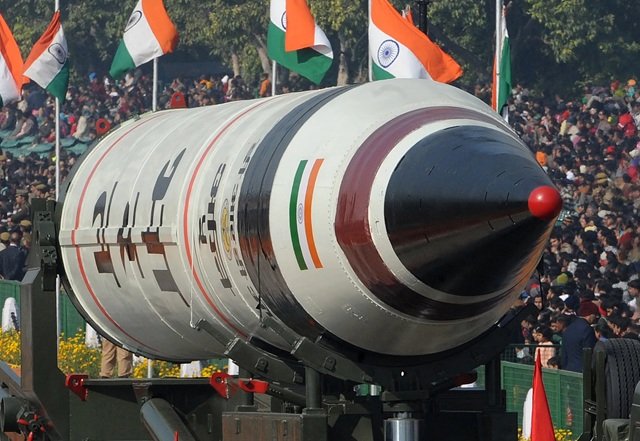
India has operationally deployed nuclear warheads for the first time, marking a significant change in its nuclear posture while maintaining its long-standing no-first-use (NFU) doctrine, according to the Stockholm International Peace Research Institute (SIPRI) Yearbook 2026. The report states that India has deployed 12 nuclear warheads as part of an estimated arsenal of 190 warheads, compared with 180 reported a year earlier.
SIPRI said the deployment represents a departure from India’s previous practice of storing nuclear warheads and their delivery systems separately. According to the assessment, the newly deployed warheads are believed to be assigned to nuclear-powered ballistic missile submarines and potentially underground missile silos, reducing response times and increasing operational readiness.
The report identifies the move as the first time a portion of India’s nuclear arsenal has been classified as operationally deployed rather than stockpiled. It links the development to the maturation of India’s sea-based nuclear deterrent, including the Arihant-class submarine fleet, and to changes in the regional security environment, particularly China’s expanding nuclear capabilities.
According to the report, India appears to have established a continuous at-sea deterrent by deploying a limited number of nuclear warheads aboard a ballistic missile submarine conducting deterrence patrols. Such a posture is intended to ensure that at least one nuclear-armed submarine remains on patrol, providing a survivable second-strike capability.
Despite the operational shift, India’s official nuclear doctrine remains unchanged. The country continues to adhere to its 2003 policy of credible minimum deterrence and no first use, under which nuclear weapons are reserved for retaliation following a nuclear attack on Indian territory or forces. The doctrine also states that India will not use or threaten to use nuclear weapons against non-nuclear weapon states, while reserving the option to respond with nuclear weapons in the event of a major biological or chemical attack.
The report places India’s evolving posture alongside developments in China and Pakistan. SIPRI estimates that China possesses more than 620 nuclear warheads and is rapidly modernising its nuclear forces through expanded missile silo construction, new intercontinental ballistic missiles, ballistic missile submarines and nuclear-capable bombers. The report also notes that some experts believe elements of China’s nuclear forces have moved toward a launch-on-warning posture while Beijing continues to maintain an official no-first-use policy.
Pakistan, according to SIPRI, has an estimated stockpile of 170 nuclear warheads and continues to follow a strategy of full-spectrum deterrence. Unlike India and China, Pakistan does not maintain a no-first-use policy. The report states that Pakistan’s nuclear force includes land-, air- and sea-based delivery systems and that submarine-launched cruise missiles remain under development.
The report also highlights continued expansion of India’s nuclear triad, which became fully operational in 2018. India’s land-based deterrent includes the Agni series of ballistic missiles, while aircraft such as the Rafale, Mirage 2000 and Jaguar are configured for nuclear delivery. At sea, the Arihant-class submarine fleet forms the core of India’s second-strike capability. Following the commissioning of INS Arihant in 2016 and INS Arighaat in 2024, the report says the third submarine, INS Aridhaman, entered service in April 2026 with longer-range K-4 submarine-launched ballistic missiles.
According to the report, Russia has played a longstanding role in supporting India’s nuclear submarine programme through technology transfers, crew training and submarine leasing arrangements. It states that Russian assistance contributed to reactor development for the Arihant-class submarines and helped India develop operational experience in nuclear-powered submarine operations.
SIPRI says India’s Strategic Forces Command remains responsible for managing the country’s nuclear arsenal under the Nuclear Command Authority, with final authority over nuclear weapons resting with the civilian political leadership. While India historically maintained de-mated nuclear weapons stored separately from delivery systems, the report says the deployment of nuclear-armed submarines has required warheads to remain mated during deterrence patrols, reflecting a gradual shift toward greater operational readiness while preserving the country’s declared nuclear doctrine.