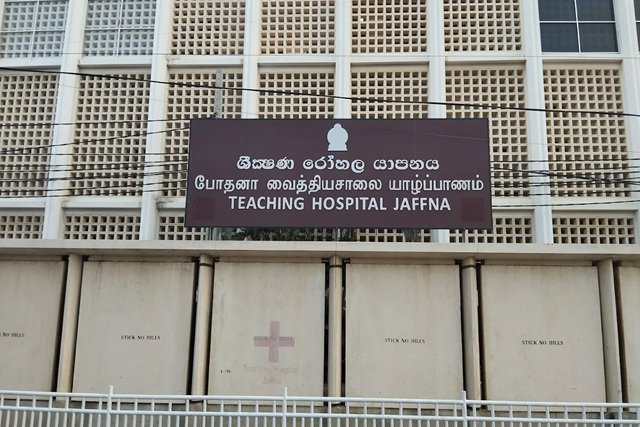
A devastating fire swept through the pharmaceutical warehouse of Jaffna Teaching Hospital early Saturday morning, destroying medicines and medical equipment worth billions of rupees, including life-saving cancer treatment drugs and other critical-care supplies, in one of the gravest medical infrastructure disasters to strike northern Sri Lanka in recent years.
The blaze erupted at approximately 1:30 a.m. and raged for more than five hours before emergency crews succeeded in bringing it under control. Firefighters from the Jaffna Municipal Council, backed by military personnel, air force teams, police officers, and electricity board workers, battled intense flames fueled by highly flammable chemicals and medical liquids stored inside the facility. Witnesses said the fire spread rapidly through the warehouse, engulfing large sections of the building before responders could contain it.
Police have launched a full investigation into the incident, examining whether the fire was the result of an accidental electrical malfunction or an act of deliberate sabotage. Investigators are focusing particular attention on a recently installed refrigeration unit designed to preserve temperature-sensitive medicines. Officials suspect an electrical short circuit linked to the unit may have triggered the disaster, although authorities say no final conclusions will be drawn until a report is completed by the Government Analyst’s Department.
The destroyed warehouse remains under strict police security while forensic examinations continue. Member of Parliament S. Sribhavanandarajah, a former deputy director of the hospital who inspected the site, said many of the region’s most valuable and urgently needed medicines had been stored inside the facility at the time of the fire. “All of these have now been destroyed in the fire,” he said.
Government officials warned that the financial losses could reach several thousand crore rupees. Fisheries Minister Ramalingam Chandrasekar, who toured the site on Saturday morning, described the incident as a massive blow to public healthcare in the Northern Province. Although he said he personally did not believe sabotage was responsible, he stressed that only chemical and forensic analysis would determine the true cause of the blaze. “This disaster is a huge loss for our people,” he said.
Northern Province Governor N. Vethanayahan also visited the destroyed warehouse and received emergency briefings from Hospital Director Dr. T. Sathiyamoorthy regarding immediate recovery operations. Authorities said salvaged medicines had been relocated to secure facilities while urgent coordination was underway with Sri Lanka’s central health ministry in Colombo to arrange emergency replacement stocks.
Hospital officials emphasized that patient treatment services would continue despite the destruction. Medicine distribution operations are being maintained through internal hospital reserves and regional health networks, and officials urged the public not to panic over fears of shortages. Dr. Sathiyamoorthy said the central health ministry had been informed immediately after the fire and had already initiated emergency response measures.
Officials also confirmed that all emergency personnel involved in battling the fire, including firefighters and military responders, would undergo medical examinations, particularly respiratory assessments due to prolonged exposure to smoke and chemical fumes.
Jaffna Teaching Hospital is the largest government medical institution in Sri Lanka’s Northern Province and serves as the primary teaching hospital for the University of Jaffna’s Faculty of Medicine. The destruction of its pharmaceutical warehouse represents a major setback for a region still rebuilding critical public infrastructure decades after Sri Lanka’s civil war ended.
An internal hospital inquiry is now running alongside the police investigation as authorities await the findings of government forensic analysts, who have not yet announced when their final report will be released.