


by Our Correspondent in Doha
As the Village People’s “YMCA” echoed through a glittering ballroom in Riyadh, Saudi Crown Prince Mohammed bin Salman took the stage to join US President Donald Trump, their handshake framed by gigantic American and Saudi flags. Trump, beaming and unabashedly effusive, declared, “I like him a lot. I like him too much.” This moment, filled with theatrical camaraderie and mutual admiration, captured the spirit of Trump’s recent four-day tour of the Gulf — a whirlwind jamboree of pomp, petrodollars and promises that sent ripples through global diplomacy and finance.
A Visit Fueled by Transactional Politics and Petrodollars
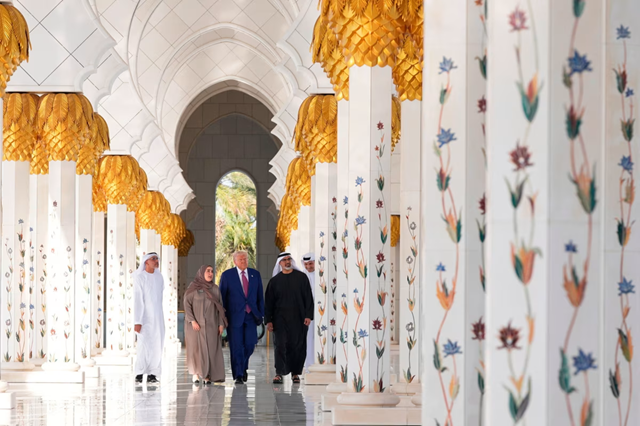
From Saudi Arabia to Qatar and the United Arab Emirates (UAE), Trump’s first foreign trip of his second presidential term was a meticulously choreographed spectacle. It showcased an America-first approach, focused squarely on economic deals and strategic partnerships with some of the world’s wealthiest and most autocratic states. Unlike the frosty reception his predecessor Joe Biden experienced in Riyadh last year — marked by a somewhat awkward fist bump with Prince Mohammed — Trump was greeted with regal honours, including fighter jet escorts and lavish red carpets.
The White House touted a staggering $600 billion in deals agreed during the visit, including a $142 billion arms agreement with Saudi Arabia and investments in cutting-edge sectors such as artificial intelligence and energy. While analysts and media reports, including Bloomberg and others, questioned the accuracy of some headline figures, the deals signed were nonetheless substantial — with just under $300 billion documented in concrete agreements. Prince Mohammed ambitiously suggested that over the coming months, these figures could balloon to $1 trillion, underscoring the Gulf’s hunger for deeper ties with the US.
The Gulf’s sovereign wealth funds collectively manage over $3 trillion, giving Saudi Arabia, Qatar and the UAE significant economic muscle to back their ambitions. These states have long been key US allies, investing heavily in American defence and infrastructure, but they also seek to diversify their economies, pouring billions into technology and new industries to reduce their reliance on oil exports. Trump’s transactional style, with its emphasis on concrete returns and reciprocal deals, resonated with these leaders, even as they remain wary of the unpredictability that has characterised his presidency.
Megadeals and the Gulf’s Global Ambitions
Qatar, with one of the highest GDPs per capita globally, stole headlines with an eye-popping $243 billion deal package. Among these, a historic order for 210 Boeing jets, touted by Trump as the biggest in the American company’s history, symbolised the country’s dual focus on prestige and pragmatism. The White House also announced an “economic exchange” figure between the US and Qatar valued at $1.2 trillion — a figure that, while aspirational, represents the total projected trade, investment and energy sales expected over the next decade. The Qatar Investment Authority (QIA), the country’s $450 billion sovereign wealth fund, aims to invest around $500 billion in the US during that period.
Yet, not all the trip’s details were without controversy. Ahead of the tour, reports emerged about the Trump Organization, managed by the president’s son Eric Trump, launching a hotel in Dubai and securing a real estate deal involving a Qatari state-owned company. Such overlaps between official diplomacy and the Trump family’s business interests sparked concerns over conflicts of interest, domestically and internationally.
Saudi Arabia, meanwhile, demonstrated its commitment to expanding its strategic partnership with Washington. Prince Mohammed’s decision to personally welcome Trump at the airport — breaking with Saudi protocol — was a clear signal of warmth and political signalling. The kingdom’s $142 billion arms deal with the US represents one of the largest in history, covering advanced weapons systems that will enhance Saudi military capabilities amid regional tensions.
In the UAE, Trump was similarly feted by President Sheikh Mohamed bin Zayed al-Nahyan. The Gulf state had already committed in March to invest $1.4 trillion in the US over the next decade, an eye-watering figure amounting to over 250% of the country’s annual GDP. During his visit, deals worth $200 billion were announced, spanning Boeing jets, energy projects and technology investments. Trump described the UAE-US relationship as a “magnificent” partnership, underscoring the political theatre that defined much of his trip.
Diplomatic Undercurrents and Regional Context
Beyond the bluster and business, Trump’s Gulf tour also carried significant diplomatic undertones. Notably, he met Syrian President Bashar al-Assad’s envoy Ahmed al-Sharaa — a surprising move given the US’s long-standing sanctions and opposition to the Assad regime following years of civil war and humanitarian catastrophe. The Trump administration announced plans to lift some sanctions on Syria, signalling a potential shift in US policy in the Middle East, although details remained scarce.
The visit occurred amid regional crises, including the ongoing conflict in Gaza. While the Gulf’s leaders made public pleas for peace, such as Qatar’s Emir Sheikh Tamim bin Hamad al-Thani urging Trump to help end the Gaza war during a lavish banquet, these humanitarian concerns were overshadowed by the focus on economic and strategic interests. Trump, ever the dealmaker, focused more on investment prospects and mutual validation than on political or ethical complexities.
Analysts like Emile Hokayem of the International Institute for Strategic Studies observed that Trump and Gulf leaders share a penchant for hyperbole and grandiose promises. “They are good at superlatives, overstating and inflating and promising big,” he noted, “but they achieve results nonetheless and they surprise. A lot of it is for show, but the point is both sides got what they wanted: visibility, exchange of goodwill, mutual validation.” Even if only half of the announced deals materialise, the scale remains a significant win for both the US and the Gulf states.
A Contrast to Western Allies and a Calculated Choice
Trump’s decision to prioritise Gulf states for his first overseas visit in his second term sent a clear message. He opted for predictable partners who eschew public rebukes or trade wars, unlike some Western allies who have occasionally challenged his policies. The Gulf’s enormous financial clout and strategic positioning make them attractive partners for a president focused on transactional diplomacy and boosting American economic interests.
This choice also reflects the Gulf’s evolving aspirations. With fluctuating US policy under successive administrations, Gulf states seek assurances and stable partnerships. Their sovereign wealth funds are investing aggressively in American industries, technology, and infrastructure to anchor their future growth in a world increasingly moving beyond fossil fuels.
However, the tour also highlighted contradictions. While Trump celebrated his close ties with Gulf leaders, questions linger about human rights abuses in these autocratic regimes and the geopolitical risks involved in deepening such alliances. Moreover, the Trump family’s business dealings raised ethical concerns, underscoring how personal and political interests can intertwine in ways that complicate US foreign policy.
The Symbolism of Camels and Country Songs
Throughout the tour, Trump delighted in the extravagant displays of wealth and tradition, at one point marveling at the “perfecto” marble of a palace and the camels ridden by royal guards. “I haven’t seen camels like that in a long time,” he quipped, bringing levity to the proceedings.
The evenings were filled with theatrics, including performances by American country singer Lee Greenwood, whose patriotic anthem “God Bless the USA” is one of Trump’s favourites. These moments of cultural exchange and spectacle further reinforced the personal rapport Trump sought to build with the Gulf monarchs — a blend of old-world grandeur and modern dealmaking.
A Tour of Substance and Spectacle
Donald Trump’s Gulf tour was as much about style as substance — a flamboyant display of diplomacy steeped in mutual admiration, megadeals, and petrodollar largesse. The $600 billion-plus in deals announced, if even partially realised, will significantly deepen economic ties between the US and the Gulf, underpinning strategic partnerships that stretch back decades.
Yet, the visit also exposed the complexities and contradictions of modern diplomacy: the balancing act between human rights and realpolitik, between personal business interests and national policy, and between grand promises and deliverable outcomes. As Trump returns to Washington, the true test will be how much of this gilded vision translates into enduring economic and geopolitical influence for both the US and the Gulf monarchies.




Donald Trump, hated by many for whatever their reasons maybe, is a good man, who does not like to see people die fighting in wars. He has been trying best to stop further confrontation between Russia and Ukraine. Recently, the Indo-Pak war about to flare up, was paused by his efforts.
He has withdrawn troops from Afgan during his last tenure.
This is a man of peace.
Time to face the truth.