For Senior General Min Aung Hlaing, the leader of Myanmar’s military junta, March seemed like a month of triumph and renewal. After years of international isolation and civil conflict, Min Aung Hlaing had managed to reclaim some global attention. He met with President Vladimir Putin in Russia, where he gifted six elephants to the Russian leader. Shortly after, he attended Myanmar’s Armed Forces Day, overseeing massed ranks of soldiers and fighter jets. The week after, he was invited to an Asian leaders’ summit in Thailand. However, the tide quickly turned with the catastrophic earthquake that hit Myanmar last week, as reported by The Times UK.
The 7.7 magnitude earthquake devastated central Myanmar, including the cities of Mandalay, Sagaing, and the capital Naypyidaw, with nearly 3,000 people confirmed dead and the toll expected to rise. This disaster struck at a moment when Min Aung Hlaing seemed to be regaining his international footing after overthrowing the democratically elected government of Aung San Suu Kyi in 2021.
To make matters worse, Min Aung Hlaing, a leader known for his superstition and reliance on fortune tellers, may see the earthquake as a serious blow to his spiritual and political standing. According to The Times UK, Myanmar’s military rulers, including Min Aung Hlaing, have long been known for consulting soothsayers and performing rituals, or yadaya, to avoid bad luck. The general has even collected white elephants, considered lucky in Myanmar, and invested in sunflowers, which are believed to promote longevity—a symbolic gesture toward his desire for a long reign.
However, the earthquake, which damaged his own presidential palace and the government’s infrastructure, seems to be interpreted by many as divine retribution for the junta’s brutal crackdown on pro-democracy forces and resistance militias. “When leaders are bad, people suffer,” one Burmese social media user wrote in a comment that encapsulates the sentiment of many in Myanmar. Some observers, such as Richard Horsey from the International Crisis Group, suggest that Min Aung Hlaing’s refusal to acknowledge the earthquake as a spiritual warning could be seen as hubris, especially as much of the devastation was visible to his inner circle.
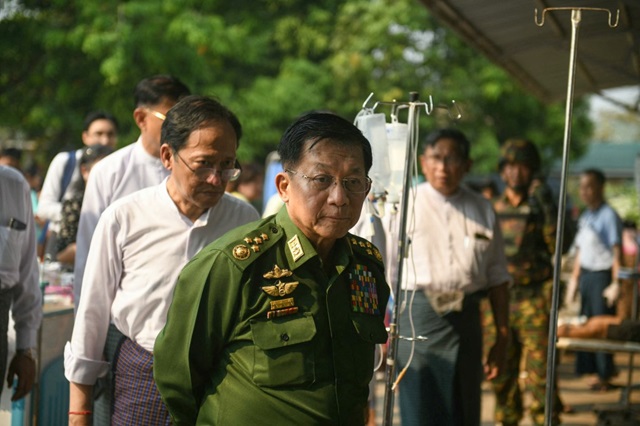
Despite the clear signs of failure, Min Aung Hlaing has been attempting to spin the disaster to his advantage. He has been photographed meeting with earthquake survivors, visiting hospitals, and distributing aid. He also made phone calls to foreign leaders, including the prime ministers of Malaysia and India, as well as President Xi Jinping of China. While some in Myanmar may view his international meetings as an abandonment of his duties during a national crisis, Min Aung Hlaing’s aim is clear: to present himself as a statesman managing the country’s affairs during a difficult moment.
In an unexpected turn, Min Aung Hlaing promised a ceasefire in Myanmar, reversing his previous stance when the pro-democracy government in exile had called for one. The ceasefire will last until April 22, though its effectiveness remains uncertain.
David Mathieson, an independent Myanmar analyst, suggests that Min Aung Hlaing’s efforts to turn the earthquake into an opportunity for international recognition may be an attempt to shore up both his domestic and global image. “Karmic comeuppance must be affecting him,” Mathieson remarked, referring to the growing sense that the general’s actions are being judged not only in Myanmar but across the world. Whether Min Aung Hlaing can turn the aftermath of the earthquake to his political advantage remains to be seen, but the fallout from this disaster is likely to be felt for years to come.