NASA has announced an ambitious $20 billion plan to establish a permanent human presence on the Moon, marking a historic step in space exploration. During a briefing on Tuesday, NASA Administrator Jared Isaacman and program executive Carlos Garcia-Galan outlined a three-phase approach designed to move beyond temporary visits and create a sustainable lunar outpost. The announcement comes just days before the scheduled launch of NASA’s Artemis 2 mission, which will return astronauts to the Moon for the first time in over five decades.
Isaacman emphasized that the goal of the initiative is not symbolic gestures like flags and footprints, but a lasting presence. “This time, the goal is not flags and footprints. This time, the goal is to stay,” he said, detailing NASA’s commitment to sustained lunar operations as part of the National Space Policy.
Phase 1, beginning immediately, will focus on reliability, experimentation, and deploying assets across key lunar locations. Garcia-Galan described it as a period of testing new technologies and starting preliminary infrastructure to support eventual permanent habitation. NASA plans to expand lunar landings, test mobility and power systems, and collaborate with international and commercial partners to develop rovers, communications systems, and scientific payloads. This phase will continue through 2028, laying the groundwork for more advanced construction and exploration.
Phase 2, projected to start around 2029, will transition from experimental operations to semi-habitable infrastructure capable of supporting routine astronaut missions. Isaacman highlighted the involvement of global partners, including JAXA, which will contribute a pressurized rover to aid surface operations. Garcia-Galan explained that this phase will establish core infrastructure such as power, communication networks, surface preparation, and mobility systems, ensuring crews can live and work safely while conducting scientific research.
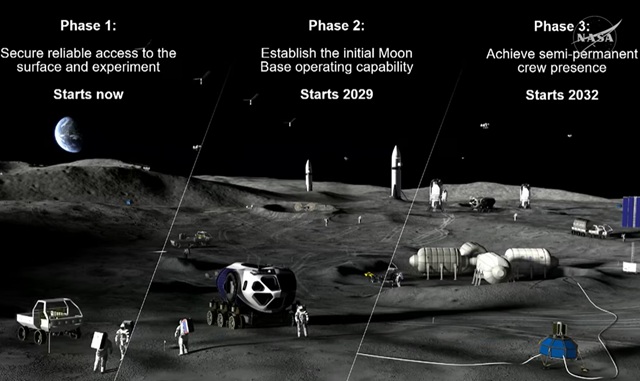
Phase 3 will leverage advancements in cargo delivery and human landing systems to complete the permanent base, incorporating modules such as Italy’s proposed habitation unit. This final phase is intended to solidify the Moon base as a sustainable outpost, capable of supporting ongoing human presence and research far beyond Earth.
NASA plans to execute this vision through dozens of missions, coordinated with commercial and international partners, over the next seven years. Isaacman described the endeavor as “humanity’s first permanent surface outpost beyond Earth,” drawing parallels to the stepwise progression from Mercury and Gemini missions to Apollo. With this comprehensive plan, NASA aims to transform lunar exploration from intermittent visits to a continuous human presence, ushering in a new era of space habitation.