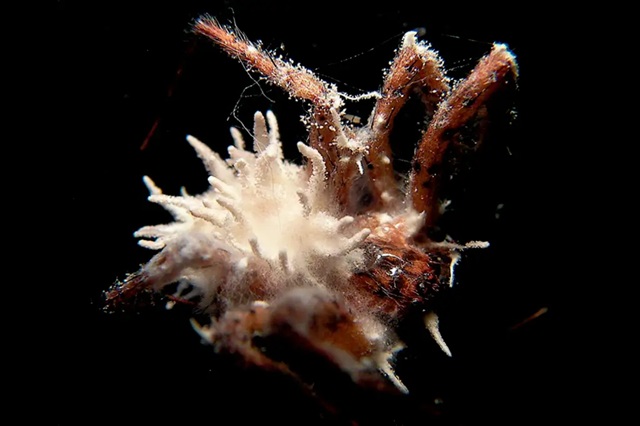
A newly discovered fungus, Gibellula attenboroughii, named in honor of the renowned broadcaster Sir David Attenborough, has been found to infect and manipulate spiders across Ireland, eerily mirroring the “zombie” behavior seen in the hit series The Last of Us.
According to a study published in Fungal Systematics and Evolution, the fungus primarily targets Metellina merianae spiders, altering their behavior before ultimately consuming them. Infected spiders, which typically remain hidden in their webs, start behaving erratically, leaving their shelters and climbing onto ceilings and walls. Once they reach an exposed position, they perish, allowing the fungus to grow out of their bodies and spread spores through the air.
A Real-Life ‘Last of Us’ Scenario
The fungus is a relative of Ophiocordyceps unilateralis, the infamous parasite that zombifies ants in tropical forests. Both fungi manipulate their hosts’ behavior, compelling them to climb as high as possible before dying, ensuring maximum dispersal of spores.
Researchers found specimens of infected spiders in multiple locations across Ireland, including an old gunpowder store where dead spiders were discovered hanging from the ceiling. Scientists suspect Gibellula attenboroughii alters neurotransmitters like dopamine, overriding the spiders’ natural instincts and forcing them into positions that maximize fungal spread.
“The fact that Gibellula-infected spiders are found in prominent positions on the roof or ceiling of their subterranean habitats indicates a behavioral change,” the researchers wrote. “By climbing high, the spiders create the best chance for the fungus on their decomposing corpses to be carried away by air currents, promoting the release and subsequent dispersal of the dry spores through the system.”
A Hidden World of Fungal Parasites
The discovery of Gibellula attenboroughii suggests that there may be a previously unknown diversity of fungal parasites in the British Isles. Scientists believe more species within the Gibellula genus remain undiscovered, potentially playing a key role in controlling spider populations.
However, much about the fungus remains a mystery. Researchers acknowledge that further study is needed to understand the full extent of its impact on spider populations and the specific metabolites it produces to manipulate its hosts.
While the fungus does not pose a threat to humans, its ability to hijack and control its hosts has drawn eerie comparisons to science fiction. As the scientific community continues to explore these mind-controlling fungi, nature once again proves that reality can be just as strange—and terrifying—as fiction.