A study using NASA’s James Webb Space Telescope (JWST) has provided new evidence supporting a radical theory: our entire universe may exist within a black hole.
Researchers at Kansas State University analyzed the rotational patterns of 263 distant galaxies and discovered that the majority were spinning in the same direction. This finding contradicts the long-standing assumption that the universe is isotropic—meaning that galaxy rotations should be evenly distributed between clockwise and counterclockwise.
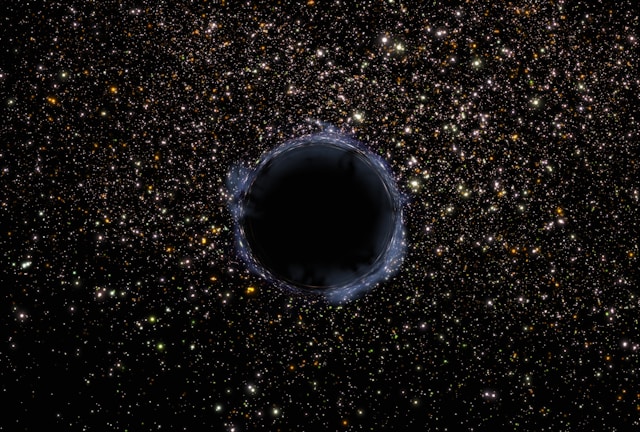
Dr. Lior Shamir, associate professor of computer science at Kansas State University, explained that there are two possible explanations for this anomaly. One is that the universe was born rotating. If true, this aligns with a concept known as black hole cosmology, which proposes that our entire universe is actually the interior of a black hole that formed in a much larger parent universe.
This theory challenges conventional cosmological models, particularly the widely accepted idea that the universe originated from the Big Bang. Instead, it suggests that what we perceive as the universe is just one region within a massive black hole—one that exists inside an even larger cosmos.
If black hole cosmology is correct, it could mean that black holes within our own universe aren’t just gravitational anomalies, but rather cosmic bridges leading to entirely different universes. This concept introduces a new perspective on the possibility of a multiverse—where each black hole might be a doorway to another reality.
While this latest discovery adds credibility to the theory, it does not yet serve as definitive proof. Scientists will need to gather more evidence and refine measurements to confirm or refute the implications of black hole cosmology.
Dr. Shamir pointed out another possible explanation for the unusual galactic rotation data: the movement of the Milky Way itself could be distorting our observations. If this is the case, it could mean our current methods for measuring cosmic distances need to be recalibrated.
“A re-calibration of distance measurements could also help explain several other unsolved mysteries in cosmology, such as the discrepancies in the expansion rate of the universe and the existence of galaxies that appear older than the universe itself,” Shamir said.
The study, titled The Distribution of Galaxy Rotation in JWST Advanced Deep Extragalactic Survey, was published in the Monthly Notices of the Royal Astronomical Society.
Whether or not our universe truly exists inside a black hole, these findings challenge some of our deepest assumptions about the cosmos. If proven correct, black hole cosmology could redefine our understanding of the universe’s origins, structure, and ultimate fate—potentially reshaping the future of physics and astronomy.