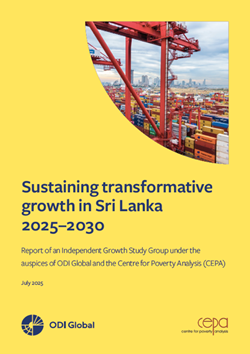
A new report released today lays out a strategic roadmap for Sri Lanka to achieve sustainable, inclusive, and transformative economic growth over the next five years. Titled Sustaining Transformative Growth in Sri Lanka 2025–2030, the study was authored by an Independent Growth Study Group convened by ODI Global and the Centre for Poverty Analysis (CEPA).
Drawing on expertise from nine leading economists and policy specialists with backgrounds across public, private, and international sectors, the report acknowledges the significant strides made in stabilizing Sri Lanka’s economy after its worst crisis since independence. With renewed GDP growth and easing inflation, the country is poised for recovery. However, the report warns that persistent poverty and structural challenges remain critical hurdles requiring targeted reforms.
Dr Ganeshan Wignaraja, Visiting Senior Fellow at ODI Global and convenor of the study group, emphasized the urgency of bold policy actions: “Sri Lanka has shown remarkable resilience in overcoming recent economic hardship, but the journey towards prosperity requires more than resilience – it demands bold action. This report provides a crucial framework, not just for consolidating the hard-won gains of stabilization, but for igniting truly transformative growth that uplifts all Sri Lankans.”
The report highlights six key policy priorities: maintaining macroeconomic stability, enhancing integration into global supply chains, improving factor markets, implementing targeted sector-specific strategies, reducing poverty, and building political consensus. It identifies sectors with strong growth potential, including tourism, the digital economy, niche manufacturing, and agriculture.
Prof. Sirimal Abeyratne, Executive Director of CEPA and co-author of the report, pointed to trade reforms as a cornerstone of economic transformation: “Sri Lanka’s historical under-performance in exports is directly linked to a persistent anti-export bias and cumbersome business regulations. Our findings underscore that strategically opening up to global trade and rigorously streamlining business procedures are essential accelerators to boost exports and investment.”
Prof. Dirk Willem te Velde, Director of the International Economic Development Group at ODI Global, noted the broader significance of Sri Lanka’s experience: “Sri Lanka’s recovery offers a powerful example for other emerging economies facing similar crises. Our study shows how targeted policies on trade, innovation, digital economy, and governance can transform the economic landscape and prevent future macroeconomic shocks.”
The report calls for leveraging Sri Lanka’s strategic geographic position and existing production capabilities to deepen economic integration globally, attract foreign investment, and reduce poverty.
The full report is available for download at ODI Global’s website www.odi.org/publications/sustaining-transformative-growth-in-sri-lanka-odi-cepa-growth-study-report. Printed editions and Sinhala and Tamil translations will soon be accessible throughout Sri Lanka.