Nvidia, the world’s most valuable company, once again outpaced Wall Street expectations in its latest earnings report, underlining the enduring strength of the artificial intelligence boom. But the tech giant’s reliance on China and intensifying U.S.–China chip tensions cloud the outlook for its market dominance.
The California-based chipmaker reported second-quarter revenue of $46.74 billion, a 56 per cent increase from the same period last year, beating analyst forecasts of $46.05 billion. Net income rose 59 per cent year-on-year to $26.4 billion, well above expectations of $24.7 billion.
Despite the blockbuster figures, Nvidia’s shares dipped 3.5 per cent in late trading to $175.25, as its data center revenue of $41.1 billion came in slightly below estimates. Still, the stock has surged 35 per cent year-to-date, giving Nvidia a market capitalization of $4.4 trillion—well ahead of Microsoft at $3.8 trillion and Apple at $3.4 trillion.
Since the release of ChatGPT in late 2022, Nvidia has been the unrivaled supplier of chips powering the global AI revolution. Its GPUs, originally designed for gaming, are now central to the infrastructure investments of tech giants including Microsoft, Alphabet, and Amazon.
However, Nvidia faces mounting uncertainty in one of its most important markets. Sales to China accounted for $17 billion, or 13 per cent of revenue last year, but Washington’s export controls and Beijing’s growing suspicion of foreign chips threaten that business. Earlier this year, Nvidia was forced to write off $4.5 billion in H20 chip inventory after former U.S. President Donald Trump banned its sale to China. The White House later reversed the decision, granting licenses in exchange for 15 per cent of Chinese sales going to the U.S. government. Still, Chinese regulators have raised security concerns, and local tech giants including Tencent and ByteDance have faced scrutiny for their H20 purchases.
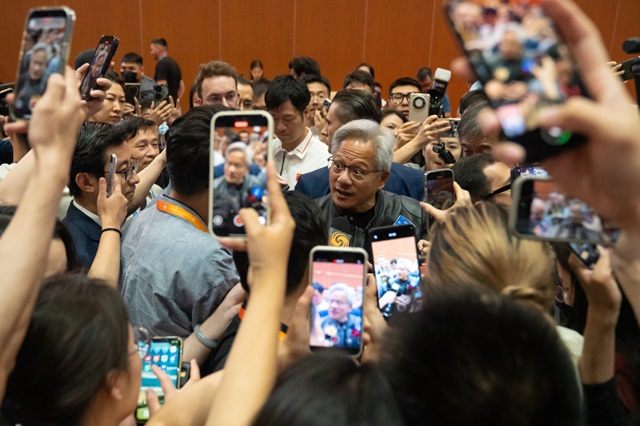
Chief executive Jensen Huang acknowledged the uncertainty, saying the company was in discussions with Washington about offering China a chip more powerful than the H20 but stressed it was too soon to know the outcome.
Meanwhile, Beijing is accelerating its push to build an indigenous AI chip industry. Domestic firms are racing to develop alternatives as regulators discourage reliance on U.S. suppliers. Cambricon Technologies, a Shanghai-listed AI chip startup founded in 2016, has seen its shares more than double this year. Investors see it as China’s best hope to compete in the fast-growing market for inference chips, which are less complex than Nvidia’s GPUs but crucial for running generative AI applications.
Despite rapid sales growth, Cambricon remains unprofitable, burning cash even as it prepares to raise nearly 4 billion yuan ($560 million) for R&D. Analysts say the company’s ability to tap equity markets directly, rather than relying on opaque state-backed funding like failed rival Tsinghua Unigroup, signals a shift in Beijing’s approach to fostering tech champions.
For the current quarter, Nvidia forecast sales of $54 billion, plus or minus 2 per cent, topping analyst estimates of $53.14 billion. The guidance excludes any revenue from the H20 chip, reflecting continued caution around China.
As the global AI arms race intensifies, Nvidia remains far ahead of competitors—Broadcom, AMD, and Intel. But its future in China is far from certain, and Beijing’s push for homegrown solutions could gradually chip away at its dominance. For now, Nvidia is both the symbol and the supplier of the AI revolution. Whether it can maintain that position in a world increasingly fractured by technology nationalism may be its greatest challenge yet.