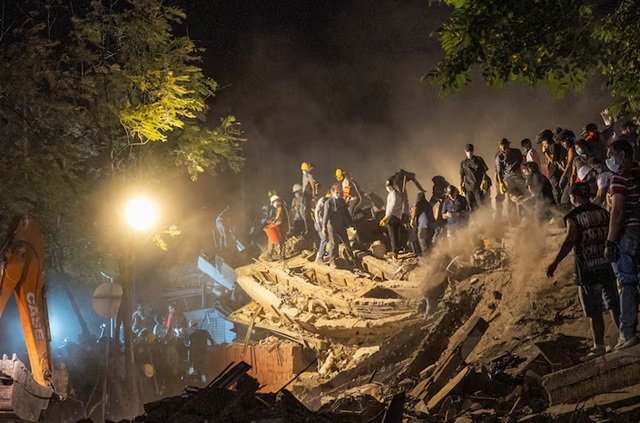
More than 130 people have died and over 2,000 are reported missing after a powerful 7.4-magnitude earthquake struck Colombia, triggering a nationwide emergency and a major search-and-rescue operation across affected communities. The rising death toll has intensified fears that the scale of the disaster could worsen as rescuers continue searching collapsed buildings and damaged structures.
President Abelardo de la Espriella declared a nationwide state of emergency following the earthquake and ordered the mobilisation of all institutional capacities to respond to the catastrophe. The president, who took office only three days before the disaster, said the immediate priority was the rescue of people trapped beneath the rubble.
“At first place stands the rescue of the people buried under the rubble,” De la Espriella said, as emergency teams worked to reach survivors and assess the destruction.
The earthquake affected more than 20 municipalities, according to Colombia’s Interior Ministry, with particularly severe damage reported in the Departamento Risaralda, a region known for coffee production and centred on the regional capital Pereira. The destruction has extended across several major urban areas, including Pereira, Cali and Manizales.
More than 1,500 homes have been reported severely damaged, while around 60 buildings collapsed completely. The disaster has also affected essential public infrastructure, with damage reported at 18 hospitals and 52 schools. The widespread destruction has complicated rescue and emergency operations while increasing pressure on facilities needed to treat the injured and support displaced communities.
The number of people still unaccounted for has emerged as one of the most serious concerns. More than 2,000 people are reported missing, raising the possibility that the death toll could increase further as authorities establish the status of those who remain unaccounted for and continue searches in areas affected by structural collapses. Current reports put the number of fatalities at at least 132.
The earthquake has prompted a growing international response. Mexico, Brazil, Ecuador, El Salvador and the United States were among the countries expressing solidarity with Colombia and offering assistance. The United Nations and the European Union have also indicated their readiness to support the country’s emergency response.
EU Commission President Ursula von der Leyen said the European bloc had already mobilised its Copernicus satellite service to assist rescue operations. “We have already mobilised our Copernicus satellite service to help with the rescue operations,” von der Leyen wrote on X. “And we are ready to provide more support.”
The United States has also pledged assistance, while rescue operations have continued with emergency personnel and volunteers working to locate people trapped or missing. International reporting has described extensive destruction across western Colombia, with communities facing the immediate challenge of finding survivors while dealing with damaged buildings and disrupted infrastructure.
For De la Espriella, the disaster represents the first major crisis of his presidency, coming just three days after he assumed office. His government has placed the rescue effort at the centre of the national response as authorities confront a rapidly changing casualty count and a large number of people whose whereabouts remain unknown.
With more than 130 confirmed dead and over 2,000 people reported missing, the immediate focus remains on search and rescue. As teams continue to work through damaged and collapsed structures, authorities face the difficult task of determining the full human and physical cost of one of Colombia’s most devastating recent earthquakes.