


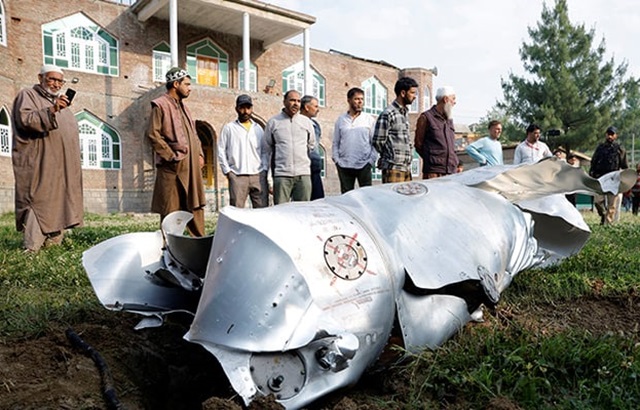
Pakistan announced early Wednesday that it had shot down five Indian fighter jets in retaliation for India’s overnight airstrikes, which targeted six locations inside Pakistan and Pakistan-administered Kashmir. The tit-for-tat military actions have sharply heightened tensions and drawn international concern over the possibility of a wider conflict.
EDITORIAL: Indo-Pak War: Operation Sindoor or Operation ‘Sin-Doors’?
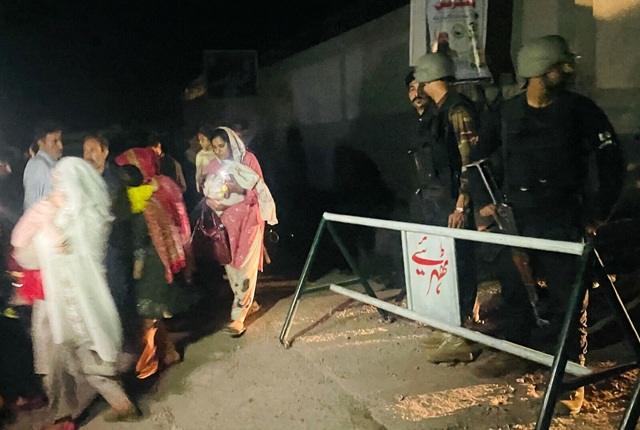
The confrontation began around 1:00 AM, when the Indian Armed Forces launched “Operation Sindoor,” claiming to have carried out “measured and non-escalatory” strikes on alleged terrorist infrastructure in Kotli, Bahawalpur, Muridke, Bagh, Muzaffarabad, and Sialkot. India asserted that the strikes were in response to the April 22 Pahalgam terror attack, which killed 26 people, including tourists. However, Pakistan rejected the justification, calling the strikes a “cowardly and unprovoked attack” on civilian areas, including mosques and residential neighborhoods.
Within hours, Pakistan’s military retaliated. Around 2:45 AM, two Indian jets were confirmed downed by the Pakistan Air Force (PAF). State broadcaster PTV later reported that a third Indian Rafale fighter was brought down near Awantipora, 17 nautical miles from Pakistan’s airspace. By 5:00 AM, both the Defence Minister Khawaja Asif and Information Minister Attaullah Tarar had confirmed that five Indian aircraft were shot down in total—three Rafale jets, one Sukhoi Su-30, and one MiG-29.
The aircraft were reportedly engaged and downed in the skies above Akhnoor, Ambala, Barnala, and Jammu. Pakistan’s military emphasized that its response only began after Indian planes carried out their strikes, maintaining it had acted in self-defense in accordance with international law and Article 51 of the UN Charter.
At a 4:00 AM press briefing, DG ISPR Maj Gen Ahmed Sharif Chaudhry confirmed that 24 strikes had impacted six localities, killing eight civilians—including a three-year-old girl—and injuring 35 others. According to Pakistani officials, three mosques were among the structures destroyed. “This was an attack on innocent civilians, not on terror camps as falsely claimed by India,” the ISPR said.
Prime Minister Shehbaz Sharif convened an emergency National Security Committee (NSC) meeting at 10:00 AM, stating that Pakistan had “no choice but to respond” to what he termed an “act of war.” In a strongly worded statement, the Prime Minister said: “This heinous aggression will not go unanswered. Our military is fully prepared, and the nation stands united.”
Defence Minister Khawaja Asif, speaking on multiple news platforms, said the strikes were conducted from within Indian airspace and accused India of lacking the courage to engage directly. “Let them come out and face us—we will give a far greater response than their cowardly actions,” he said. Information Minister Tarar added that no terrorist infrastructure was hit, and invited international journalists to inspect the sites, insisting that “entire neighborhoods and civilians were targeted.”
Pakistan’s Foreign Office condemned the Indian strikes as a flagrant violation of Pakistan’s sovereignty and international law, warning that such actions risk destabilizing the region. The FO reiterated that Pakistan had offered a neutral investigation into the Pahalgam attack, which India refused. It further accused India of using the attack as a pretext for aggression, despite lacking any credible evidence.
In response to the rising conflict, Pakistan closed its airspace for 48 hours. Islamabad International Airport was shut down, and all incoming and outgoing flights were diverted to Karachi. International airlines, including Qatar Airways, temporarily suspended operations, and global air traffic was rerouted away from the region. British authorities issued a travel advisory, urging citizens to avoid travel to Pakistan.
Global reactions swiftly followed. U.S. President Donald Trump condemned India’s airstrikes as a “shame,” while UN Secretary-General António Guterres expressed deep concern and called for maximum restraint. The UAE Foreign Ministry urged both sides to pursue dialogue and avoid further escalation.
Meanwhile, Pakistan’s opposition and political leadership expressed full support for the military. Former president Asif Ali Zardari and PPP Chairman Bilawal Bhutto-Zardari both denounced India’s actions as “acts of war” and assured the public that Pakistan’s armed forces would respond with full strength. Opposition Leader Omar Ayub called for the release of former Prime Minister Imran Khan, saying he is the only figure capable of uniting the country at this critical moment.
India, for its part, has yet to officially acknowledge the downing of any of its aircraft. Its Ministry of Defence maintains that Operation Sindoor successfully struck terrorist targets in a coordinated campaign involving the Army, Navy, and Air Force. Indian officials insist that no civilian infrastructure was intentionally targeted, and that the operation was “precise, focused, and restrained.”
With both countries now on heightened alert, the international community has urged de-escalation. However, the current military exchange marks one of the most serious confrontations between India and Pakistan since the Kargil War of 1999. The downing of multiple advanced Indian aircraft—if confirmed—would represent India’s most significant military aviation loss in decades, and potentially shift the strategic balance in the region.
As tensions continue to mount, both New Delhi and Islamabad remain engaged through diplomatic and military channels. Whether this crisis deepens or finds a path to de-escalation may well depend on immediate international mediation and restraint on both sides.









