
by Nil
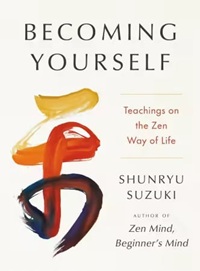
Shunryu Suzuki’s Becoming Yourself: Teachings on the Zen Way of Life, curated by Jiryu Rutschman-Byler and Sojun Mel Weitsman, constitutes a limpid yet provocative compendium of Soto Zen teachings, distilled from Suzuki Roshi’s lectures. This work, suffused with paradoxical wisdom, posits that authentic existence—epitomised by the practice of shikantaza, or “just sitting”—transcends dualistic notions of self and other, good and bad. Suzuki’s aphoristic style, replete with direct quotations, invites readers into a contemplative praxis that is both liberating and disquieting. However, the book’s radical emphasis on non-attachment and its deconstruction of conventional ethics court controversy, challenging Western sensibilities and risking misinterpretation as an apologia for moral relativism. Its erudite tone, enriched by esoteric Zen terminology, renders it a profound yet occasionally abstruse contribution to spiritual literature.
Suzuki’s central thesis is encapsulated in the deceptively simple directive: “The point is to learn how to be yourself, how to be a person in the way that a stone is completely a stone” (p. 10). This notion of “just to sit” as the embodiment of selfhood—free from striving or conceptualisation—forms the bedrock of the text. Suzuki asserts, “Just to be yourself is no problem whatsoever. This is what is meant by ‘just to sit’” (p. 27), urging practitioners to relinquish the “self-centered, limited mind” that seeks to “figure out who you are” (p. 28). This rejection of intellectualisation is both constructive and contentious, as it subverts Western rationalist paradigms, positing that true understanding arises from unmediated presence: “When you just do something, and your mind is acting as it is, that is how you catch your mind” (p. 30). Such teachings invite scrutiny for their apparent eschewal of analytical rigour, yet they compel a reevaluation of selfhood as an experiential, rather than discursive, phenomenon.
The book’s exploration of zazen (sitting meditation) as a holistic practice is both its strength and a point of contention. Suzuki emphasises, “When you become you yourself, at that moment your practice includes everything” (p. 22), suggesting that zazen transcends mere technique to encompass all facets of existence. This is vividly illustrated in his metaphor of Zen art: “In Zen art, full concentration is put on one dot, on one line” (p. 20), where the practitioner’s entire being engages in the act. Yet, this totalising view risks alienating readers who perceive it as an impractical ideal, divorced from everyday exigencies. Suzuki’s insistence that “zazen and everyday activity… are two sides of the one practice, and there should not be any gap” (p. 56) challenges the compartmentalisation of spiritual and mundane life, but its radical integration may seem unattainable, prompting accusations of utopianism.
Suzuki’s treatment of ethics is perhaps the book’s most controversial aspect, as he reconfigures traditional moral frameworks within Zen’s non-dualistic paradigm. He asserts, “Instead of putting emphasis on individual precepts, one by one, we put more emphasis on our original human nature, or Buddha nature” (p. 87), suggesting that ethical conduct flows from authentic being rather than adherence to rules. This is exemplified in his interpretation of the precept “Do not kill”: “When the flies come, you might kill them. But you are always prepared for the possibility that you are doing something wrong” (p. 127). Such flexibility invites debate, as it could be misconstrued as moral laxity. Suzuki’s claim that “even if the form is perfect, if our intention is not right, it is not our way” (p. 110) underscores the primacy of intention over rigid adherence, yet it risks undermining the prescriptive clarity valued in Western ethical systems.
The book’s discussion of desire further amplifies its provocative stance. Suzuki advises, “You should find a wider, unselfish desire which is without limitation and which you can extend forever” (p. 67), reframing desire as a universal force rather than a personal vice. He contrasts this with selfish impulses: “If you forget to polish yourself, that is not real enlightenment” (p. 68). This perspective challenges ascetic traditions, proposing that desires, when aligned with Buddha mind, become vehicles for liberation. However, Suzuki’s assertion that “the only desire that is complete is Buddha’s desire, which includes everything and is for everyone” (p. 68) may perplex readers accustomed to dualistic moral categories, potentially inviting criticism for its perceived ambiguity.
Suzuki’s personal anecdotes, woven throughout, lend authenticity and warmth to the text. Recounting his youth, he shares, “My father was very short-tempered… he untied the hakama and tied it in the formal way” (p. 140), revealing the cultural strictures that shaped his path. His wife, Mitsu Suzuki, adds a poignant dimension, recalling, “Are you looking for a wife? I teased the monk” (p. 134), humanising the revered teacher. These vignettes ground the esoteric teachings, yet the book’s reliance on Suzuki’s idiosyncratic voice—described as “odd sentence structure, false starts, digressions” (p. 148)—may challenge accessibility, particularly for readers unfamiliar with Zen’s aphoristic style.
The book’s radical optimism, encapsulated in the phrase “every day is a good day” (p. 84), is both uplifting and contentious. Suzuki explains, “Whether ‘there is’ or ‘there is not’ doesn’t matter. ‘There is’ is good, and ‘there is not’ is also good” (p. 84), advocating a non-discriminatory acceptance of reality. This stance, while liberating, may provoke unease among those who view moral discernment as essential, as it appears to equate all experiences as inherently valuable. Suzuki’s metaphor of the garuda, which “only picks up and eats living dragons” (p. 80), underscores this discerning yet non-judgmental awareness, but its abstract nature may frustrate readers seeking practical guidance.
Critically, the book’s emphasis on “no self” and the dissolution of ego—“There is no difference between Buddha and you” (p. 47)—challenges Western individualism, offering a profound yet unsettling vision of interconnectedness. Suzuki’s assertion, “When you say ‘my practice,’ the practice is very small” (p. 23), critiques the egoic framing of spiritual pursuit, but it risks alienating those who find identity in personal achievement. The editors’ note that Suzuki’s teachings “point to a practice for us to do” (p. 10) reinforces this active engagement, yet the text’s minimal engagement with broader socio-political contexts may limit its relevance for addressing systemic issues.
Becoming Yourself is a luminous yet provocative exploration of Zen’s transformative potential. Suzuki’s liberal use of quotes, from “When you are simply you yourself, you will find your own way” (p. 27) to “The way to be yourself is to take care of how you treat yourself” (p. 43), anchors the text in his authentic voice. Its radical deconstruction of self and ethics, while intellectually invigorating, courts controversy by challenging conventional moral frameworks. This work demands active engagement, urging readers to embody its teachings through zazen, yet its esoteric style and cultural specificity may circumscribe its accessibility. Suzuki’s legacy, as Guo Gu notes, lies in revealing “the truth that you are already free” (p. 3), a message both liberating and profoundly unsettling.