
by Durga Velayudham in Toronto
In Eva Dou’s meticulously constructed House of Huawei: The Secret History of China’s Most Powerful Company, the narrative is one of dualities: innovation juxtaposed with controversy, ascension tainted by suspicion, and ambition intertwined with secrecy. This book, a magisterial chronicle of Huawei’s labyrinthine trajectory, explores the profound implications of corporate dominance in a globalised yet fractured world. It is as much a tale of technology and business as it is an indictment of the opaque entanglements of state and enterprise. Dou crafts an intricate mosaic, revealing not just the raw ambitions of Huawei, but also the political, economic, and cultural tectonics that enabled its meteoric rise. In so doing, she lays bare the uncomfortable truths of 21st-century geopolitics, where telecommunication networks become battlegrounds and companies transform into pawns of statecraft.
A Monument to Innovation or a Trojan Horse?
Dou begins her exploration with the story of Ren Zhengfei, Huawei’s enigmatic founder, whose transformation from a modest military technocrat to a titan of global commerce is depicted with unflinching detail. “Ren embodied the paradoxes of modern China,” she writes, “an engineer in uniform turned capitalist visionary, crafting bridges between seemingly irreconcilable worlds” (p. 15). Yet, the “bridges” Dou refers to become a recurrent motif in the book, as they also serve as metaphors for Huawei’s straddling of ideological and ethical fault lines.
Throughout the book, Dou refrains from overtly condemning Huawei but leaves the reader in no doubt about the gravity of the accusations leveled against the company. She recounts, in clinical prose, allegations of intellectual property theft, accusations of espionage, and Huawei’s ambiguous relationship with the Chinese Communist Party (CCP). Huawei’s meteoric rise, Dou posits, is not merely a testament to Ren’s business acumen but a chilling exemplar of what happens when technological innovation is harnessed to serve the interests of authoritarian governance.
“Wolf Culture”: Huawei’s Ferocious Creed
Dou’s analysis of Huawei’s internal corporate ethos—the so-called “wolf culture”—is both fascinating and unnerving. Described as a brutal Darwinian creed where loyalty and productivity are rewarded but dissent is quashed, this ethos reflects the broader societal dynamics of contemporary China. “To succeed at Huawei was to survive a crucible of relentless ambition,” Dou observes, “where the wolves at your back constantly reminded you of the stakes” (p. 87). This ruthless philosophy, while instrumental in the company’s success, raises troubling questions about the ethical cost of such a culture. Is progress sustainable when it comes at the expense of individual autonomy and moral integrity?
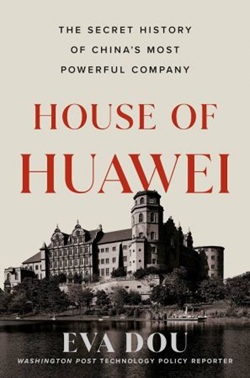
Dou masterfully intertwines this examination of corporate culture with a broader critique of the Chinese economic model. Her portrayal of Huawei’s operations—from its R&D campuses styled as “miniature European cities” to its aggressive global expansion campaigns—paints a picture of a company that is both profoundly visionary and deeply unsettling. The image of Huawei’s employees as “foot soldiers in a ceaseless campaign for global supremacy” (p. 121) is emblematic of Dou’s ability to capture the tension between aspiration and authoritarianism that underpins Huawei’s success.
A Symphony of Surveillance
Arguably the most chilling sections of the book are those in which Dou delves into Huawei’s role in China’s surveillance apparatus. From its development of AI-enhanced facial recognition systems to its provision of infrastructure for the controversial “Safe City” initiatives, Huawei emerges not just as a participant but as a linchpin in China’s expansive surveillance state. Dou’s tone here is measured yet incendiary, as she describes the “dystopian potential” of these technologies. “Huawei’s triumph in the global tech race,” she warns, “comes with a Faustian bargain: unparalleled connectivity at the cost of privacy and freedom” (p. 205).
The geopolitical dimensions of this surveillance are explored with equally unsettling clarity. Dou recounts the allegations of Huawei’s complicity in espionage, particularly in countries where its technology underpins critical infrastructure. She does not shy away from the political ramifications of these allegations, citing them as evidence of a “new Cold War” waged not with missiles but with algorithms and data streams. The Snowden revelations, the U.S.-China trade war, and the contentious detention of Huawei CFO Meng Wanzhou are all meticulously chronicled, creating a narrative that is as compelling as it is disconcerting.
The Ethics of Empire
What makes House of Huawei truly exceptional is Dou’s ability to elevate her subject matter beyond the confines of corporate history. This is a book that forces readers to grapple with the ethical quandaries of technological advancement and the moral compromises of modern capitalism. Dou’s prose, rich with aphoristic flourishes and incisive observations, often reads more like a philosophical treatise than a business exposé. “Every megabyte of progress,” she writes, “contains within it a kilobyte of complicity” (p. 267).
Her critique is not confined to Huawei or China but extends to the global systems that enable and perpetuate such corporate hegemony. She highlights the hypocrisy of Western nations that decry Huawei’s practices while simultaneously engaging in their own forms of surveillance and exploitation. This broader perspective lends the book a moral gravitas that is often missing in discussions of corporate ethics.
The Road Ahead
In her closing chapters, Dou reflects on the future of Huawei and the broader implications of its rise. She describes the company as a “black swan,” a phenomenon that disrupts the established order and forces a reevaluation of fundamental assumptions (p. 311). Yet, her vision of the future is far from sanguine. She warns of a world where technological monopolies wield unprecedented power, where the lines between state and enterprise blur to the point of indistinction, and where the pursuit of progress eclipses the preservation of fundamental freedoms.
Despite its exhaustive detail and incisive analysis, House of Huawei leaves the reader with more questions than answers. And perhaps that is Dou’s greatest achievement. By refusing to provide easy resolutions or moral platitudes, she compels readers to confront the uncomfortable realities of our interconnected world. Are we willing to sacrifice privacy for convenience? Should we celebrate innovation when it is underpinned by exploitation? And, most crucially, can we trust a company that operates in the shadows of an authoritarian state?
Conclusion: A Necessary Provocation
House of Huawei is not merely a book; it is a provocation, a clarion call to rethink our assumptions about technology, progress, and power. Dou’s masterful storytelling, combined with her unflinching critique of Huawei’s practices, makes this a work of profound importance. It is a book that should be read by policymakers, technologists, and anyone concerned with the future of our digital age.
But be warned: this is not a comfortable read. Dou’s narrative is as relentless as the company it chronicles, and her conclusions are as disquieting as they are inescapable. Yet, in a world increasingly defined by technological dominance, it is a discomfort we cannot afford to ignore.
As Dou herself so aptly puts it, “The greatest threat to freedom is not oppression but apathy” (p. 329). With House of Huawei, she has ensured that apathy is no longer an option.