
by Eric
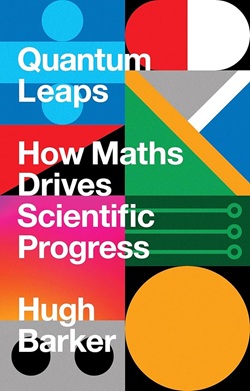
Hugh Barker’s Quantum Leaps is an ambitious, sprawling text that aims to bridge the esoteric world of theoretical mathematics with the tangible advancements in modern technology. However, in its effort to present an accessible yet profound discussion, the book often falls into the trap of sweeping generalisations, uncritical acceptance of speculative theories, and an oversimplification of deeply intricate concepts.
Barker’s enthusiasm for quantum mechanics and its applications in computing, cryptography, and theoretical physics is evident throughout the text. He posits that “quantum computing is a particle physics problem, which could theoretically be solved in a variety of physical contexts” (p. 134). Yet, he conveniently sidesteps the current monumental challenges facing quantum computing, particularly in relation to error correction and decoherence. While acknowledging that “we are nowhere near having an actual fault-free quantum computing device and probably won’t for decades to come” (p. 136), Barker still engages in speculative optimism about its potential. This paradox weakens his argument, as he simultaneously acknowledges limitations while fueling a sense of inevitability around quantum breakthroughs.
The book’s foray into quantum cryptography is equally riddled with contradictions. Barker describes the process of quantum key distribution (QKD) in some detail, explaining that “Alice and Bob use beamsplitters to ensure a secure transmission, with any eavesdropping attempt immediately detectable” (p. 189). However, he neglects to discuss the real-world security vulnerabilities in QKD, such as side-channel attacks and the reliance on trusted hardware—a crucial omission that leaves an uninformed reader with a skewed perception of the technology’s infallibility. In this way, Quantum Leaps exhibits a pattern of selective presentation, elevating the theoretical elegance of concepts while underplaying their real-world imperfections. He goes on to claim that “quantum cryptography will ultimately replace classical cryptographic methods entirely” (p. 192), yet this assertion is not substantiated with a discussion of the challenges of scalability or integration with existing digital infrastructure.
The book also wades into the speculative territory of black holes and string theory, positing that “space–time itself is a code” (p. 215) and suggesting that the universe might be governed by quantum error correction principles. Barker asserts that “the holographic principle is more than just a fascinating idea; it is the best framework we have for unifying gravity and quantum mechanics” (p. 220). While these ideas are tantalising and certainly worth exploring, Barker treats them as if they are on the brink of empirical validation. This raises the fundamental issue with the book: it does not clearly demarcate between well-substantiated scientific theory and speculative hypotheses. Barker’s reliance on theoretical physicists such as Almheiri and Harlow is commendable, yet he fails to convey that these ideas remain largely within the realm of abstract mathematical conjecture rather than established physics.
Further, Barker’s treatment of blockchain and artificial intelligence feels tacked on, as if he were attempting to capitalise on buzzwords rather than providing substantial insight. The discussion of blockchain’s cryptographic principles is competent, yet when he claims that “it may be that the future of banking will involve an expansion of cryptocurrencies by governments and banks” (p. 243), he ignores the regulatory and scalability issues that continue to plague the industry. Similarly, his assessment of AI is shallow, relying on standard narratives about machine learning without critically engaging with its ethical and mathematical limitations. He writes that “AI systems can already outperform humans in numerous domains, and soon, we may see true artificial general intelligence emerge” (p. 265). This sweeping statement glosses over the immense philosophical and computational challenges that remain unsolved in AGI research.
Perhaps the book’s greatest failing is its lack of epistemic humility. While it discusses various ‘quantum leaps’ in understanding, it rarely acknowledges the sheer speculative nature of many of its claims. For instance, the chapter on graphene presents the idea that it could potentially allow experimental validation of the Klein paradox, where “graphene’s electrons behave as though they have no mass” (p. 277). While intriguing, the book fails to convey that such experimental validations remain distant possibilities rather than imminent breakthroughs. Elsewhere, Barker states that “quantum teleportation may one day allow for the instant transmission of information across vast cosmic distances” (p. 308), an assertion that disregards the fundamental constraints imposed by quantum entanglement and causality. This pattern of overconfidence in speculative ideas permeates the book, leaving the reader with a distorted view of both the current state and future trajectory of quantum science.
However, it would be unfair to dismiss Quantum Leaps entirely. Barker possesses a talent for making complex mathematical ideas palatable, and his enthusiasm for the subject is undeniably infectious. His explanation of exponentiation by squaring in cryptographic algorithms (p. 198) is lucid and informative, as is his breakdown of the mathematical foundations of RSA encryption (p. 211). When he remains grounded in well-established mathematics, his exposition is both engaging and insightful. His discussion of Fourier transforms and their role in signal processing (p. 156) is particularly well-articulated, demonstrating his ability to explain intricate mathematical tools with clarity.
Yet, this does not compensate for the book’s larger conceptual flaws. Quantum Leaps often conflates mathematical elegance with empirical reality, presenting hypotheses as if they are foregone conclusions. Barker’s discussion of topological quantum computing (p. 252) is another example—while he describes its theoretical advantages over conventional quantum computing, he does not adequately address the experimental difficulties that have so far hindered its progress. In doing so, it does a disservice to readers who may walk away with an exaggerated sense of how close we are to realising the more radical implications of quantum mechanics and mathematical physics.
Ultimately, Barker’s work is thought-provoking but flawed. It is a book that excites but misleads, educates but omits, and speculates without sufficient restraint. It succeeds in sparking curiosity but fails in fostering a truly critical understanding of the mathematical and scientific landscapes it attempts to traverse. For the casual reader, Quantum Leaps offers a thrilling ride through the frontiers of modern mathematics. For those with a more critical eye, it is a reminder that not every quantum leap lands on solid ground.