by Eric
Galder Gaztelu-Urrutia’s Rich Flu (2024), an audacious meditation on wealth’s terminal decay, emerges as a glistening, if occasionally hollow, critique of contemporary society’s slavish devotion to affluence. There is a kind of insidious charm in its premise: a virulent disease that targets the world’s richest, compelling them to relinquish their fortunes in order to survive. A satirical fable dipped in dystopian dread, the film explores the unsettling symbiosis between class, power, and the ravaging influence of an insatiable economic order that perennially elevates a few while starving the many.
From the outset, Rich Flu casts its net over a grotesque parable of the social hierarchy, a world where the wealthy are not immune to the fragility of life. This concept—riveting in its audacity—offers fertile ground for a profound exploration of inequality. The virus, as a metaphor for the unyielding grip of capitalism, acts as a perverse equaliser, striking down the billionaires first before descending to less opulent tiers of society. As the virus spreads, forcing the affluent to divest themselves of their ill-gotten gains, one cannot help but sense the gleeful subversion of the established order. In this regard, Gaztelu-Urrutia, with his characteristic fervour, has crafted an unsettling panorama that resonates with echoes of The Hole (2019), his earlier dissection of social stratification.
The film’s opening scenes thrust us into a world where power dynamics—long impervious to change—are rendered shockingly fragile by a viral catastrophe. As the richest of the rich succumb to an indiscriminate fate, the casual detachment with which they begin shedding their empires is at once both darkly comic and profoundly tragic. In one particularly unsettling scene, Mary Elizabeth Winstead’s character, Laura—a Hollywood executive—watches as the once-untouchable structure of her life comes crashing down, forcing her to confront an existential dislocation that is as much social as it is personal. Winstead delivers a performance that, while compelling, sometimes feels less like an emotive cry of desperation and more like a victim caught in the machinery of an apocalyptic farce.
In the narrative’s first hour, the film hits its stride, employing taut dialogue and a sharp rhythm that primes the viewer for an exploration of the collapse of power, privilege, and security. Gaztelu-Urrutia’s vision is undeniably striking: Rich Flu becomes, in its early stages, a scathing lampoon of the wealthy’s entitlement, as they scuttle about in a desperate attempt to offload their assets before the deadly contagion consumes them. As one character quips, “What do you do when the wealth you’ve hoarded for a lifetime is suddenly worth less than the air you breathe?” Here lies the film’s biting critique—a system that has built vast fortunes on inequality now crumbles beneath its own weight, unable to survive the very social fissures it helped to create.
But this satirical verve falters as the film progresses, devolving into a bloated second act where the narrative’s incisiveness is dulled by a glut of heavy-handed moralism. The film teeters into the realm of the absurd, becoming more of a political commentary on social collapse than a coherent thriller. The second half struggles to maintain its earlier tension, with characters pivoting awkwardly between survival instinct and moral introspection. One might almost feel as though Gaztelu-Urrutia has lost his earlier focus, abandoning the urgent critiques of the first hour in favour of melodramatic familial reconciliations and convoluted survival tropes. At one point, Winstead’s Laura is forced to abandon her luxuries, now relegated to the status of a ‘refugee’ in a world where power structures no longer serve her—an ironic inversion that, though potent in its thematic implications, devolves into trite melodrama rather than intellectual clarity.
This tonal shift undermines the film’s larger ambitions. Where The Hole kept its focus on the suffocating pressure of socio-economic divisions, Rich Flu veers dangerously close to the tired tropes of post-apocalyptic thrillers. The social allegory, once sharp as a scalpel, becomes blunt and unsatisfying as the film’s pace slows to a crawl. The script’s tendency towards grandiloquent speeches—delivered with unshakable earnestness—feels at times like a dire disservice to the intricate world-building that had so captivated the audience at the outset. As one character forlornly observes, “When the rich beg, the world shifts; but the world will never return to where it was before.”
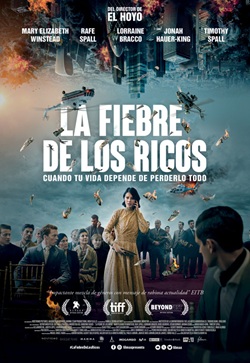
Nevertheless, there is something undeniably captivating about Rich Flu’s visual style. Shot in English, with an international ensemble led by Winstead, Rafe Spall, and Lorraine Bracco, the film is undeniably crafted with ambition and skill. The cinematic palette, though occasionally lacking the dystopian grandeur of similar works, evokes a sense of creeping unease that mirrors the social unrest it seeks to depict. The production design, lush in its depiction of opulent wealth turned to ash, reflects the crumbling edifices of a once-thriving global system. Yet, despite the technical prowess on display, the film occasionally feels as though it is trying too hard to be profound, without fully delivering the necessary philosophical weight.
Ultimately, Rich Flu is a cinematic feast for those who savour social commentary wrapped in apocalyptic fever dreams. It may not possess the same searing clarity of The Hole, but its attempt to dissect the hollowed-out carcass of global capitalism is nonetheless a daring and provocative gesture. As the rich are dragged down into the muck they’ve long ignored, Gaztelu-Urrutia compels us to ask: What happens when the very system that allows some to thrive is revealed to be the cause of their undoing?
In its best moments, Rich Flu serves as a mirror held up to the glittering, self-satisfied face of wealth, a reminder that the virus of inequality will eventually claim even its most untouchable victims. In its less successful moments, it is a film whose message, once so thrillingly clear, becomes diluted in the morass of melodrama and missed opportunities. It is, in the end, a film that asks all the right questions but falters when tasked with offering meaningful answers.
The question remains: as the fever of the rich burns hot, who will be left to put out the fire?