
by Eric
Padraic X. Scanlan’s Rot is a searing examination of the corruption, exploitation, and decay inherent in colonial and imperial structures. With meticulous historical analysis and sharp prose, Scanlan dismantles the myths of benevolent empire, exposing the moral and material rot at its core. His argument is not simply that empire was violent or oppressive—an assertion already well-established in historical discourse—but that its very foundations were built on a system that was always self-destructive.
From the opening pages, Scanlan establishes the central thesis: “Empire did not decay—it was rot from the start” (p. 3). This provocative claim frames the book as more than a historical account; it is a philosophical and political indictment of imperialism itself. The book systematically unpacks how corruption, rather than being a late-stage disease of empire, was a fundamental feature from its inception.
Decay as a Structural Condition
One of Rot’s greatest strengths is its ability to show that moral and institutional decay were not accidents or unforeseen consequences of empire but intrinsic to its functioning. Scanlan argues, “Corruption is not the failure of empire, but its standard mode of operation” (p. 29). This assertion is reinforced through case studies spanning centuries and continents, demonstrating that empires—from the British to the Dutch, from the Spanish to the Portuguese—operated through coercion, plunder, and deceit.
A particularly damning section examines how imperial officials personally profited from the very laws they claimed to enforce. Scanlan writes, “Regulations existed not to curb excess, but to ensure that excess was profitable for the right people” (p. 71). This analysis extends beyond individual corruption to systemic exploitation, where governance itself was structured to enable and protect profiteering at every level.
Scanlan does not merely focus on the moral or political dimensions of empire but also dissects its economic contradictions. He highlights how imperial economies were dependent on extraction rather than sustainable growth, ensuring their eventual collapse. He argues, “An economy built on theft is not built to last. It enriches the thief, impoverishes the victim, and leaves nothing but dust in its wake” (p. 112). This claim undercuts the popular historical narrative that empire brought economic development to colonised regions, instead asserting that imperial economies were inherently unstable, feeding on destruction rather than production.
The discussion of labour exploitation is especially striking. Scanlan exposes how colonial administrators justified forced labour under the guise of “civilisation,” writing: “To civilise was to exploit, and to exploit was to justify itself through the language of uplift” (p. 157). This framing reveals how economic and ideological corruption were deeply intertwined—imperial powers did not just extract wealth but also sought to control narratives to legitimise their plunder.
One of Rot’s most unsettling sections details how imperialism required not just physical coercion but also moral self-delusion. Scanlan captures this contradiction when he writes, “The imperialist is a man who murders and calls it mercy, who steals and calls it salvation” (p. 189). Here, the book moves beyond historical critique into an analysis of ideology, showing how empires survived not just through force but through a system of moral justifications that allowed atrocities to be reframed as acts of benevolence.
This theme is particularly evident in Scanlan’s discussion of the abolition of slavery. He argues that the British Empire did not end slavery out of moral conviction but as a strategic move to maintain control. “The empire did not abolish slavery; it rebranded it. The plantations did not close—they changed management” (p. 224). This assertion challenges traditional historical narratives that present abolition as a triumph of British morality, instead exposing it as a calculated shift that continued to exploit formerly enslaved populations under new legal frameworks.
While much of Rot is focused on historical analysis, Scanlan also draws clear parallels to contemporary structures of power. The book closes with a reflection on how imperial patterns of exploitation persist in modern capitalism. He writes, “The empire is gone, but its bones remain. The logic of rot outlives the structures that first built it” (p. 289). This claim suggests that colonialism did not end but evolved, adapting its methods of exploitation through multinational corporations, financial institutions, and global political alliances.
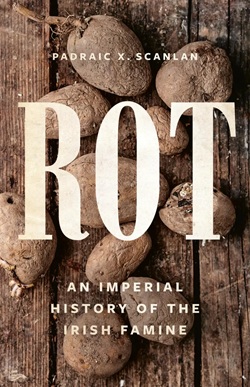
The book’s final chapter leaves the reader with an unsettling realisation: the rot of empire was never contained within history. Instead, it has seeped into present-day economic and political systems, shaping the modern world in ways that are often invisible but deeply ingrained.
Scanlan’s Rot is not a book for those seeking comforting narratives of imperial decline. It is a relentless, uncompromising examination of how corruption was not an aberration but the essence of empire itself. The book is deeply researched, yet its argument is presented with a clarity that makes it accessible even to those unfamiliar with academic histories of colonialism.
At times, the book’s unflinching critique may feel overwhelming, but that is precisely the point. There is no redemption arc, no suggestion that empire might have been salvaged if only it had been managed differently. Instead, Scanlan forces the reader to confront an uncomfortable truth: “There was no golden age of empire. There was only rot, dressed in gold” (p. 310).
By the time the final page is turned, the reader is left not with a sense of resolution but with a challenge—to recognise the ways in which the logic of empire continues to shape the world today, and to question whether the structures we accept as inevitable are, in fact, already rotting from within.