
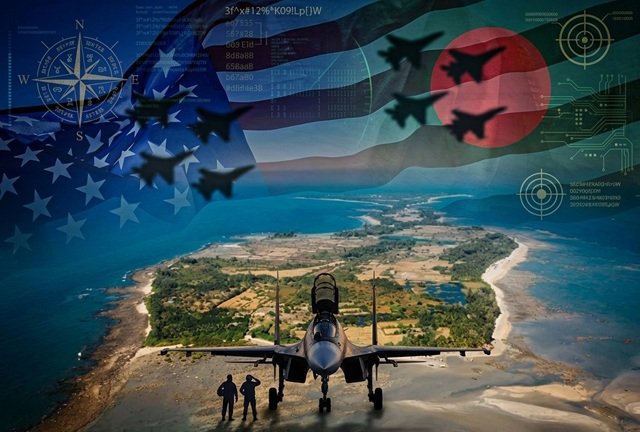
Saint Martin’s Island, a diminutive coral isle in the north-eastern Bay of Bengal, lies nine kilometres south of the Cox’s Bazar–Teknaf peninsula, marking Bangladesh’s southernmost edge. Barely three square kilometres in area, it remains unique. Nearby, Chhera Dwip emerges with the tides near Myanmar’s coast, at the mouth of the Naf River. It is the country’s sole coral island.
But a grave peril now looms over Bangladesh.
It gathers not in thunder—but in silence.
Behind veils. Beneath waters. Around a small, fragile island—Saint Martin’s.
Is this tranquil coral isle destined to become the epicentre of a future global conflagration? The question no longer feels speculative; it feels imminent. For the world’s most formidable powers—the United States, China, and India—have cast their calculating gaze upon this modest fragment of land in the Bay of Bengal. And in that gaze lies ambition, anxiety, and an unspoken contest for dominance.
The geopolitics of the Bay of Bengal has entered a phase of acute tension. It is no longer a passive maritime expanse; it is a theatre of strategic rivalry. On one side stands the United States, advancing its Indo-Pacific Strategy—a doctrine designed to secure influence, ensure maritime supremacy, and counterbalance emerging powers.
On the other side rises China, driven by its existential “Malacca Dilemma,” a strategic vulnerability rooted in its dependence on narrow sea lanes for energy and trade. Between these two giants lies a tightening corridor of contestation.
And within that corridor—Bangladesh.
China seeks assurance. It seeks access. It seeks permanence in the Bay of Bengal to secure its lifelines. The island of Saint Martin’s, though small in geography, is immense in strategic value. It commands proximity. It offers surveillance. It promises leverage. For China, it is not merely land—it is insurance against encirclement.
The United States, however, sees the same island through a different lens. It sees positioning. It sees containment. It sees a node within a broader Indo-Pacific architecture designed to maintain a balance of power favourable to its interests.
Thus, Saint Martin’s becomes more than an island—it becomes a potential pivot on a larger strategic chessboard.
India, too, cannot remain indifferent. Its security calculus is deeply intertwined with the region. The narrow Siliguri Corridor—often termed the “Chicken’s Neck”—is a vulnerable artery linking mainland India to its northeastern states. Any foreign military or strategic presence in the Bay of Bengal, particularly near Bangladesh’s coast, carries implications that India cannot ignore. Saint Martin’s, therefore, enters India’s sphere of acute concern.
Compounding this already volatile equation is the internal turmoil in Myanmar. The ongoing civil war has fractured authority and destabilised borders. Amid this chaos, the rise of the Arakan Army introduces a new and unpredictable dimension. Its growing strength along the coastal belt adjacent to Bangladesh raises unsettling questions. Could instability spill over? Could non-state actors exploit strategic vacuums? Could Saint Martin’s become exposed—not only to great power rivalry—but also to regional insurgent dynamics?
Thus, the island stands at the intersection of three converging pressures: global power competition, regional security anxieties, and proximate instability.
For Bangladesh, the challenge is profound. It must navigate a triadic pressure system without surrendering sovereignty, without provoking hostility, and without compromising its long-term national interests. This requires not merely diplomacy—but strategic clarity. Not merely caution—but calculated resolve.
The stakes are immense. A misstep could invite external entanglement. An overcorrection could alienate partners. Neutrality itself becomes a delicate art when all sides seek alignment.
Yet, within this peril lies a test of statecraft. Bangladesh must assert its agency. It must refuse to be reduced to a passive terrain upon which others project power. Saint Martin’s must remain what it rightfully is—a part of Bangladesh’s sovereign domain, not a bargaining chip in a global contest. In this fraught and delicate hour, Sheikh Hasina may stand as the rightful stateswoman—capable of steering Bangladesh clear of the rivalries of three dominant powers and of securing for the nation a bastion of stability within the region.
The waves around the island may appear calm. But beneath them, currents collide.
History has often shown that great conflicts do not erupt suddenly. They gather—quietly, invisibly—around places underestimated.
Saint Martin’s may be one such place.