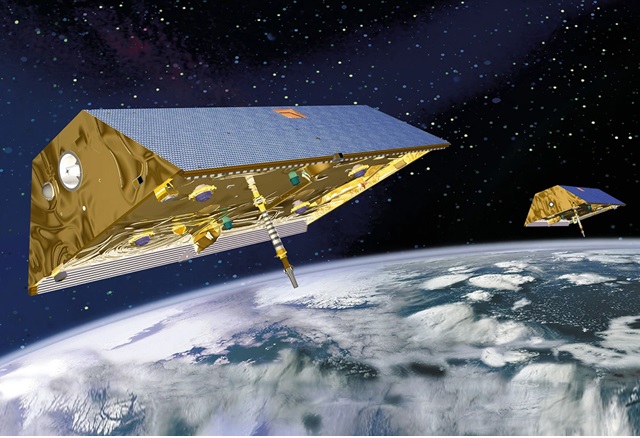
Scientists have detected a surprising geological shift thousands of kilometres beneath Earth’s surface, near the boundary between the planet’s core and mantle. The change, which occurred between 2006 and 2008, was only recently uncovered through data from the US–German Gravity Recovery and Climate Experiment (GRACE) satellites, which measured tiny variations in Earth’s gravity.
The team, led by Isabelle Panet of the University Gustave Eiffel in Paris and Charlotte Gaugne Gouranton at Paris City University, reports in Geophysical Research Letters that the shift may have been caused by a structural transformation in deep rocks, increasing their density and slightly altering the distribution of mass. This, in turn, could have influenced the flow of liquid in the underlying core, potentially linking the gravitational anomaly to previously observed geomagnetic changes in the same region around 2007.
“It’s a really new observation,” says Panet. “At least part of the signal has to come from very deep within Earth.” Using the GRACE satellites, which flew in tandem and measured minute changes in the distance between them caused by gravitational variations, the researchers could detect this subtle shift nearly 2,900 kilometres below the surface, off Africa’s Atlantic coast.
The discovery offers scientists a rare glimpse into dynamic processes at the base of the mantle. Barbara Romanowicz, a seismologist at the University of California, Berkeley, says it provides “convincing evidence of dynamic processes at the base of the mantle” occurring quickly enough to be studied in real time.
Nature highlights that such observations not only deepen our understanding of the interactions between Earth’s core, mantle, and crust, but could also improve knowledge about phenomena like earthquakes and the maintenance of Earth’s protective magnetic field. Panet and her colleagues plan to continue monitoring these deep signals using GRACE’s successor satellites, in hopes of identifying further mysterious changes occurring inside our planet.