The killing of Oaxaca journalist Francisco Alejandro Leyva Aguilar has become the latest in a string of murders that, according to press freedom organisations and reporting by El País, reveal a persistent pattern of violence, intimidation and impunity against journalists across Mexico. As local reporters continue exposing corruption, insecurity and organised crime, many remain vulnerable despite previous threats and, in some cases, official protection measures.
Francisco Alejandro Leyva Aguilar was eating when he was killed. Sitting with his back to the street, the 60-year-old journalist never saw the gunman who approached and shot him in the head. His murder on 22 July in San Pablo Etla, Oaxaca, made him the seventh journalist killed in Mexico this year, adding another name to a growing list of media professionals whose deaths have intensified concerns about the safety of the country’s press.
As first reported by El País, authorities responded in a now familiar manner. Officials stated that the case would be investigated, while President Claudia Sheinbaum said she had instructed her cabinet to address the matter. Yet the seven killings share a common feature that has become central to the debate surrounding attacks on journalists in Mexico: impunity.
Mariana Suárez, protection coordinator for Artículo 19 in Mexico and Central America, argues that the issue extends far beyond the number of journalists killed. She describes a broader environment in which threats, physical attacks, disappearances and stigmatisation campaigns persist without meaningful accountability. According to Suárez, these crimes are not isolated incidents but part of a recurring pattern that conveys the message that attacking journalists carries few consequences.
Many of the victims had received threats before they were killed. Some had even been granted protective measures after reporting earlier incidents, yet those precautions ultimately failed to save their lives. Most were engaged in exposing political corruption, organised crime or deteriorating public security in their local communities.
Leyva Aguilar had spent decades working in Oaxaca’s media and was known for his outspoken criticism of governments led by Morena. He wrote the column El zumbido del Moscardón, which he also promoted through his TikTok account. In November 2025, he used the platform to declare that if anything happened to him or his family, responsibility should fall on Oaxaca Governor Salomón Jara, Government Secretary Jesús Romero and the state’s legal adviser Geovany Vásquez Sagrero.
His final video promoted his latest column, in which he said he would present information concerning what he described as Governor Salomón Jara’s “permisibilidad” in institutionalising crime through his brother, Noé Jara, and the ASAEO, Alianza de Sindicatos y Asociaciones del Estado de Oaxaca, over alleged extortion. In previous videos he had accused the governor of allowing organised crime to infiltrate his administration and had linked this to increasing violence in the state. He had also criticised the organisation of the traditional Guelaguetza festival, its low attendance and what he alleged were connections between the state Tourism Secretariat and organised crime.
Governor Jara said he was willing to provide testimony if summoned by the Oaxaca prosecutor’s office. Addressing Leyva Aguilar’s allegations, he stated that there was no evidence supporting accusations capable of assigning criminal responsibility and said the prosecutor’s office should determine any liabilities. Local authorities later released surveillance footage showing at least three men and a motorcycle involved in the attack. One of the suspects appeared to make a mobile phone call immediately before the shooting.
Reporters Without Borders (RSF) documented that Leyva Aguilar had sought assistance from the Oaxaca Human Rights Ombudsman’s Office on 14 July 2025 after receiving death threats. He subsequently filed a complaint with the Federal Attorney General’s Office (FGR) against the governor and the two officials he had named publicly.
Only days before Leyva Aguilar’s murder, another journalist was killed in Puebla. Josué Martínez Contreras, 39, was shot outside his home on 16 July in front of his mother and his 13-year-old son, who called emergency services. Director of the digital outlet Noticias San Martín Texmelucan, Martínez Contreras was also a lawyer and academic who regularly covered local security issues, public services and municipal affairs.
Known as “El Jaguar”, he openly supported Carlos Manzo, the mayor of Uruapan, Michoacán, who was himself shot dead on 1 November 2025. Months before his own death, Martínez Contreras had published a video describing alleged harassment by local authorities after reporting illegal water connections and questioning the management of public funds collected through water charges. Although he presented receipts proving his payments, he said he was nevertheless forced to pay what he described as a 6,000-peso fine. He concluded the recording by declaring that it was better to die with the strength of the people than to die on one’s knees. Days after his killing, San Lucas Atoyatenco deputy municipal president Javier Montalvo was arrested on suspicion of attempting to bribe police investigating the murder.
In Guerrero, Manuel Alejandro Mora Serna, widely known as Alex Serna, built his journalism around environmental issues, particularly water management, environmental damage and alleged corruption involving businesses, politicians and suspected organised crime figures in Zihuatanejo. His reporting frequently involved visiting remote locations to document environmental concerns on camera.
According to the Committee to Protect Journalists (CPJ), Serna published a screenshot in March showing a death threat allegedly sent by a relative of Zihuatanejo Mayor Lizette Tapia Castro, whom he frequently accused of corruption. Citing an anonymous official from the Federal Protection Mechanism for Human Rights Defenders and Journalists, CPJ reported that Serna had never been admitted into the federal protection programme. His family reported him missing after his final social media post on 20 June. On 3 July, the Guerrero Human Rights Commission confirmed that his body had been found. Some local media reported that it bore signs of torture.
Veracruz, long regarded as one of Mexico’s most dangerous states for journalists, has continued to witness repeated attacks on the press. Independent journalist Carlos Leonardo Ramírez Castro, director of Código Norte Veracruz, was shot dead in Poza Rica on 8 January. He had previously reported threats, had received protection from the State Commission for the Care and Protection of Journalists (CEAPP) since 2024 and had also experienced intimidation by municipal police. After his murder, the criminal group responsible reportedly circulated video footage of the attack, an act local media said reflected the level of impunity under which criminal organisations operate.
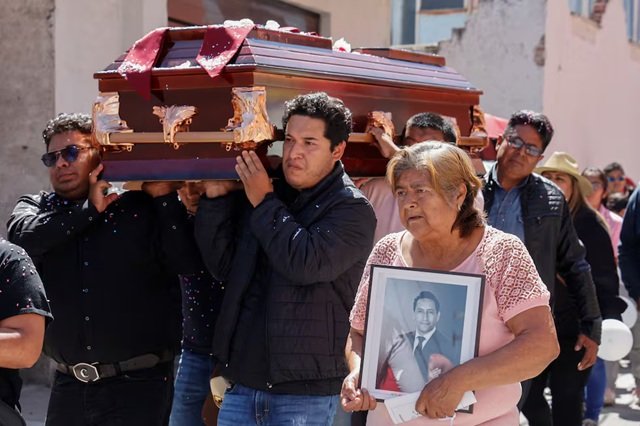
His killing was followed by another unresolved tragedy. During Ramírez Castro’s funeral on 10 January, his partner Wendy Arantza Portilla Ramos and her friend Karime Monserrat Murrieta Reséndiz disappeared. They remain missing while relatives continue searching for answers and authorities have issued two arrest warrants linked to the journalist’s murder investigation.
Five months later, Veracruz journalist Luis Ángel López Valdez, a reporter for Vanguardia de Veracruz, was also shot dead. An engineer as well as a journalist, he had previously sought protection after receiving threats. Colleagues speaking at his funeral described him as deeply committed to police reporting despite the absence of adequate guarantees for journalists working in the field. Vanguardia de Veracruz, citing state Government Secretary Ricardo Ahued Bardahuil, reported that investigators were examining a complaint López Valdez had filed alleging harassment by officers from the State Public Security Secretariat.
Perhaps the most shocking case has been that of Roxana Berenice Guzmán, founder of Pulso Informativo del Sureste. On 2 June, she documented masked men forcing entry into her home in Nanchital before abducting her. Her remains were discovered on 3 July, and authorities later announced the arrest of eight suspects, including four municipal police officers from neighbouring Ixhuatlán del Sureste. Prosecutors have since requested that Veracruz’s Congress remove immunity from the municipality’s mayor, alleging he ordered the kidnapping and murder because investigators say Guzmán possessed a photograph showing him carrying a long firearm.
The seventh victim, Juan David Gámez, directed the online outlet Táctica SS, specialising in coverage of policing, drug trafficking and local corruption in Nuevo León. He deliberately kept his identity private, publishing reports on robberies, kidnappings, armed attacks and security operations without revealing personal information or photographs. One of his final social media posts, published two days before he was shot dead in García, asked a stark question: “¿Por qué en Nuevo León no podemos hacer periodismo de investigación sin recibir amenazas?”
For Artículo 19, the answer has become painfully familiar. After more than two decades monitoring press freedom in Mexico, the organisation concludes that journalists are killed because impunity allows it to happen. Its research shows that reporters covering corruption and politics account for 55% of recorded attacks, followed by those reporting on security and justice at 24%, human rights at 12%, and those covering the private sector, land and territory. As Mariana Suárez explains, impunity is not merely the absence of justice. It is also a condition that enables repeated violence, ensuring that while those responsible face no consequences, the risks confronting journalists across Mexico remain unchanged.