Editorial
As the world assembles to commemorate World Health Day 2025, today, April 7, we are told to celebrate the virtues of healthcare, to extol the progress made, and to cherish the hope of a future in which maternal and newborn health no longer carries the tragic toll of preventable deaths. The theme this year, “Healthy Beginnings, Hopeful Futures,” calls upon governments, healthcare systems, and the global community to intensify their efforts to avert maternal and newborn fatalities. Yet, as the rhetoric of this campaign rolls out across conferences and social media platforms, one cannot help but ask: are we truly advancing? Or is this yet another hollow performance, a facade designed to divert attention from the grotesque reality of a system riddled with corruption, exploitation, and a grotesque disregard for human life?
Each year, nearly 300,000 women die from pregnancy-related complications, and over 4 million babies either perish in the womb or within their first month of life. These are not numbers merely on paper—they represent the most basic, fundamental human rights denied: the right to life, the right to health. The numbers are stark, but they tell only half the story. For what of the thousands of women who do survive childbirth, only to be left to suffer in a healthcare system ill-equipped to support them physically and emotionally? What of the untreated mental health conditions, the unaddressed non-communicable diseases, and the stigmas surrounding family planning? World Health Day 2025 comes as a cruel reminder that we continue to fail these women, and the unborn children whose lives are extinguished before they have a chance to take their first breath.
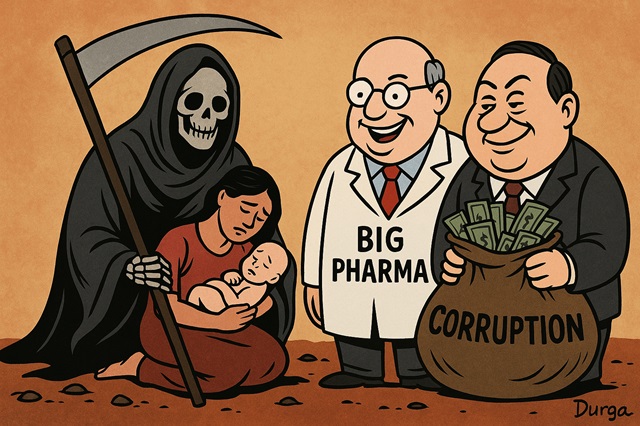
Let us pause for a moment and confront the grotesque truth that pervades every corner of our so-called “health systems.” The notion that maternal and newborn health can be safeguarded through goodwill and noble speeches rings hollow when we recognise the institutional rot festering beneath the surface. Governments, medical institutions, and pharmaceutical giants are complicit in a symbiotic web of corruption that strangles any meaningful progress. This is not a conspiracy theory; it is the grim reality for the millions whose deaths and suffering are deemed acceptable in the pursuit of profit and power.
In the dark recesses of this vast industry, the health of women and children is reduced to a commodity. The pharmaceutical giants that drive the healthcare industry wield an unfathomable amount of influence, bribing officials, doctors, and hospitals with lavish perks and kickbacks. They create dependency, manipulating research and clinical trials to promote drugs that either don’t work or come with dangerous side effects. Worse still, they hike prices for life-saving medications to astronomical levels, ensuring that women in impoverished communities are left to perish simply because they cannot afford the exorbitant cost of treatment. Big Pharma is not merely an industry—it is a monstrous entity, manipulating not just market forces, but the very lives of those it purports to serve.
It is no secret that doctors—those who should stand as guardians of health—are often no better than their corporate overlords. Far too many medical professionals are financially incentivised to overprescribe, to favour the treatment options that offer the fattest payoffs rather than those that offer the best chances of survival for their patients. When was the last time you heard of a doctor convicted for their role in contributing to the opioid crisis, which has claimed the lives of hundreds of thousands of people, predominantly women and children, who were prescribed these drugs under dubious pretenses? The over-prescription of painkillers, antidepressants, and other pharmaceuticals, all in the name of profit, is but one example of how the system has betrayed those it should serve.
Let us be clear: maternal and newborn deaths are not merely an issue of medical failure. They are a symptom of a much larger, more insidious issue: the intersection of gender, class, and race. The women who die giving birth are disproportionately from marginalized backgrounds—poor, rural, often living in developing countries where health infrastructure is underfunded, undertrained, and overburdened. World Health Day fails to address this inconvenient truth. It is not enough to discuss “quality care” without confronting the economic and political systems that ensure that this care is a privilege, not a right.
Western nations often portray themselves as the paragons of healthcare, but let us not ignore the racial and ethnic disparities that persist even within their borders. In the United States, Black women are three to four times more likely to die during childbirth than their white counterparts, even when accounting for factors such as income and education. In the United Kingdom, maternal mortality rates for Black women have surged by over 40% in recent years. These are not isolated incidents; they are the predictable outcomes of a system that views certain lives as less valuable than others, and of a healthcare infrastructure designed to reinforce societal inequalities rather than heal them.
In many parts of the world, maternal mortality is not just a tragic event but a social injustice, driven by poverty, racism, and a failure to acknowledge women as full citizens with rights to healthcare, safety, and dignity. To discuss maternal health without engaging with these systemic issues is to miss the forest for the trees.
It is easy to criticise governments, pharmaceutical companies, and individual doctors, but let us not forget the crucial role played by health institutions—the very entities responsible for the management and delivery of healthcare. For too long, they have been either passive bystanders or active participants in the corruption and failure that define the global health landscape.
Hospitals, the institutions meant to nurture life, have become rife with fraud, inefficiency, and neglect. In some countries, medical facilities operate with outdated equipment, lack trained staff, and have long waiting lists for essential treatments. And yet, these very institutions often operate in ways that prioritise profit over patient care. Financial incentives, whether in the form of insurance reimbursements or private sector involvement, often determine what treatments are offered, not the needs of the patient.
What is most alarming, however, is the complicit silence within the healthcare system. It is not just that individuals within these systems fail to act—far worse, they often actively shield the corrupt structures in place, perpetuating a vicious cycle of negligence. Regulatory bodies tasked with overseeing these institutions are often captured by the very interests they are meant to regulate, allowing practices that should be criminal to go unchecked.
On this World Health Day, we are told to look to the future, to envision a world where every woman and child has the chance to survive and thrive. The WHO and its partners urge us to raise our voices for better postnatal care, for the prioritisation of women’s health, and for the elimination of preventable deaths. But as we reflect on the actual state of maternal and newborn health, the question arises: what is the true cost of this vision? How many more women and children must die before we can admit the ugly truth—that the systems we have built to protect them are inherently flawed, corrupt, and exploitative?
There is no easy solution to the crisis in maternal and newborn health. But until we confront the systemic corruption at the heart of global healthcare, any celebration of World Health Day will ring as hollow as the promises made by those in power. Until we demand a complete overhaul of the institutions that perpetuate inequality and profit from death, our celebrations will be nothing more than a farce, an insult to the women and children who continue to die while we look the other way.
World Health Day 2025 may call for healthy beginnings and hopeful futures, but we must be brutally honest: until we dismantle the corrupt systems that profit from death, there can be no real hope.