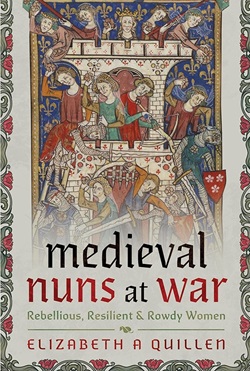
Elizabeth A. Quillen’s Medieval Nuns at War distinguishes itself through a deliberate attempt to redress what the author calls the “frequent erasure” of women whose lives surface only in “a singular mention, often their deaths.” The book’s guiding ambition is made clear in the introduction, where Quillen openly frames her work as a counterweight to the dominance of “well-behaved nuns” in the historical record, observing that “it is actually quite the opposite in the history of religious women,” for it is the compliant figures who have been “canonized, chronicled, and used as exemplars down through the centuries” while rebels, runaways, and resisters have been “treated as fascinating, if cautionary, tales.” This initial jurisprudential gesture—marking an imbalance in historical precedent, identifying a class of under-represented subjects, and announcing a corrective interpretive intention—establishes the quasi-forensic tone that endures throughout the text.
Quillen’s methodology is rooted in precise textual interrogation, particularly of cases where sources are fragmentary, partisan, or coloured by ecclesiastical authority. She notes with scholarly frustration that Gregory of Tours left untranslated the very account of the Poitiers rebellion that triggered her interest, lamenting that “this story of two illegitimate princesses leading a revolt over an election had been consigned to summary.” Her narrative stance is reminiscent of a jurist revisiting an incomplete evidentiary record: a demand to restore suppressed testimony and re-examine the interpretive biases that enshrined one version of events over others. The introduction asserts this intention plainly when she writes that the stories she collects “have been sorely neglected,” not through lack of significance but because “writing a history of women, particularly religious women,” inevitably confronts a scarcity shaped by “erasure” and selective preservation by male scribes and ecclesiastical institutions.
The opening chapter on the rebellion at Sainte-Croix demonstrates how effectively Quillen adopts a legal-historical mode of reconstruction. She treats the convent not merely as a religious institution but as a juridical battleground, asking pointedly: “What happens when a queen founds and enters her own abbey? Can princesses be bound under the authority of a common woman…? When nuns lead a violent rebellion, to which judicial authority should they answer?” The questions resemble issues of jurisdiction, competency, and conflicting sovereign claims—issues central to medieval governance but rarely interrogated through a gendered lens. Her reconstruction of the crisis, particularly the night raid in which mercenaries “stormed Sainte-Croix in the middle of the night” and the prioress Justina “extinguished the candles… and threw a blanket over the abbess” to conceal her, reads almost like the factual narration section of a legal opinion, where the evidence must be laid out with precision before interpretive analysis can occur.
A key strength of the book lies in its attention to competing authorities, a tension repeatedly highlighted in the sources. Quillen highlights the complexity of Radegund’s status as deaconess—“not required to be either a virgin or a widow” and freed from the constraints normally placed on enclosed women—which allowed her to wield both royal and ecclesiastical influence without being fully subject to either. The author herself foregrounds this ambiguity, observing that Radegund “invoked her powers both as a queen and as a deaconess… wielding one against the other” to secure autonomy for the convent. Quillen correctly identifies this as a legal anomaly with far-reaching consequences: the very absence of clear jurisdictional boundaries makes the later conflict between Abbess Leubovera, Clothild, and Basina less an aberration than the inevitable result of institutional ambiguity. Her reading of Radegund’s letter, in which the queen entrusts the convent not to bishops but to kings—“that they permit nothing… be harmed, or disturbed, or diminished”—further demonstrates how political authority could be invoked to circumvent ecclesiastical oversight.
Throughout the narrative, Quillen highlights the incongruence between the ideal of enclosure and its lived impossibility. The introduction already warns that enclosure “was not a realistic expectation… particularly in times of crisis or expansion” and that its strict enforcement was “almost always to the detriment of the women living inside the convent walls.” The Poitiers episode provides empirical substantiation: when rebellion erupted, both sides engaged in flagrant violations of enclosure—princesses marching “out of their abbey, even out of the city,” bishops entering forcibly, mercenaries breaching walls—yet only the women were judicially censured for their infractions. The bishops’ final judgment, where Clothild and Basina are condemned for having “broken locks, burst open gates, started a revolt, and then escaped,” reveals not only legal inconsistency but the gendered selectivity of ecclesiastical discipline. Quillen is careful, however, not to overstate her case; instead she allows the primary sources—particularly Gregory of Tours’ phrasing—to demonstrate how legal rhetoric served to police female autonomy even in circumstances where men were equal or greater offenders.
A particularly incisive moment of analysis occurs when Quillen acknowledges the uneven reliability of her sources. Gregory of Tours’ perspective is treated neither as objective nor dismissible; rather, Quillen reads him as a legal witness whose testimony must be scrutinized against its context. His disapproval of the nuns’ actions, such as his lament that they “had gone outside the walls of their abbey,” is presented as evidence not of their moral failure but of the bishop’s own juridical priorities and political loyalties. Similarly, his depiction of Basina’s remorse—“I committed a sin… I am in revolt against my Abbess all right”—is interpreted not as an admission of guilt but as a crafted moment of moral narration, shaped by the ecclesiastical purpose of the text. In this sense, Quillen demonstrates a commendable juristic reflex: the evaluation of testimony not merely for what it asserts, but for how, why, and under what institutional pressures it asserts it.
One might observe that Quillen’s admirable determination to restore agency to her subjects occasionally inclines the narrative toward the dramatic at the expense of sustained theoretical framing. The prose is vivid—describing, for instance, the abbess “laid out on a blanket… suffering from gout” as armed men “burst into the room”—but some readers may desire a more explicit discussion of how such episodes illuminate broader legal, gendered, or institutional patterns across medieval Europe. While the author gestures toward these themes in the introduction, the analytical framework sometimes remains implicit, embedded in narrative rather than argument. Yet this stylistic choice may also be defended as methodologically appropriate: Quillen’s project is to restore detailed historical experience, not merely to summarize it within abstract theoretical categories.
Still, the book’s most compelling contribution remains its insistence that religious women were not passive subjects of ecclesiastical governance but active negotiators of political, social, and legal structures. Quillen writes that “what unites the nuns here is their devotion to their convents,” but her narrative demonstrates that such devotion frequently coexisted with conflict, resistance, and assertion of rights—in short, with agency recognizable even within a juridical framework. The final reflection of the introduction captures this ethos succinctly, proposing to shift the evaluative “goal posts” of women’s history “not… based on orthodoxy or morality, but on audacity and determination.” In adopting this interpretive stance, the book aligns itself with a historiography that treats women not as exceptions to institutional history but as subjects whose actions must be integrated—sometimes disruptively—into the legal and political narratives of their time.
Taken as a whole, Medieval Nuns at War offers a meticulously sourced and narratively engaging reconsideration of medieval female religious life that benefits from a quasi-juridical approach to evidence, authority, and historical interpretation. Quillen’s use of primary documents, particularly letters, trial accounts, and monastic rules, provides a rich evidentiary basis, while her interpretive commentary displays both scholarly rigor and narrative sensitivity. If the work occasionally privileges vivid storytelling over explicit theoretical argumentation, it nonetheless succeeds in presenting a persuasive corrective to entrenched assumptions about monastic women, demonstrating that they were not merely pious spectators of history but often its most audacious actors.