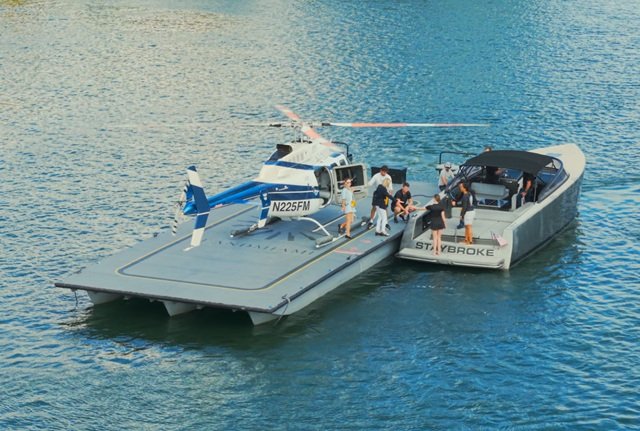
The race for time has found a new frontier in Miami, where the world’s wealthiest are turning to floating helipads to bypass some of the worst traffic congestion in the United States. As billionaires pour into South Florida’s waterfront enclaves, a novel service is emerging to meet their demands: mobile helipads that bring helicopters directly to their backyards.
In recent years, high-profile figures such as Mark Zuckerberg, Larry Page, and Sergey Brin have invested tens of millions of dollars in Miami’s exclusive waterfront properties. This influx of wealth has intensified demand for faster, more private modes of transportation, especially in a city where commuters reportedly spent an average of 93 hours in traffic in 2024.
For luxury real estate agent Angel Nicolas, whose clients routinely spend eight figures on homes, time is not just money — it is a scarce commodity. When one client sought to tour multiple high-end properties across South Florida in a single day, conventional transport options were quickly ruled out. Instead, the journey was made by helicopter, landing seamlessly on a floating platform just off Miami’s coast.
That platform was operated by ILandMiami, a company pioneering mobile helipad services in the region. Founded in 2016 by CEO Adam Terris, the firm spent years developing marine utility vessels capable of supporting large helicopters while meeting stringent Coast Guard certification requirements. The service officially launched in early 2025, just as Miami’s billionaire boom accelerated.
ILandMiami’s concept is simple yet transformative. Its floating helipads can be positioned along waterways, allowing helicopters to land within minutes of private residences on islands such as Indian Creek or Fisher Island. For clients accustomed to landing on superyachts elsewhere, the service offers a workaround to Miami’s tighter waterways, where large vessels often cannot navigate.
The cost, however, underscores its exclusivity. At approximately $1,000 per minute — excluding the helicopter itself — and landing fees ranging between $4,000 and $4,500, the service is firmly targeted at the ultrawealthy. Yet demand is growing steadily. Terris reports around 20 flights per month, with the vast majority catering to private individuals seeking efficiency, privacy, and discretion.
Luxury real estate professionals say the appeal extends beyond convenience. Nancy Batchelor notes that her high-net-worth clients value the ability to arrive and depart without public attention. For many, the helipads are not just a transport solution but a lifestyle statement — one that signals exclusivity and control over time.
Batchelor recently incorporated a floating helipad into a marketing campaign for a $15 million property on La Gorce Island, highlighting how such amenities are becoming intertwined with property value. As buyers increasingly own multiple residences across regions, seamless mobility between them is becoming a critical selling point.
The rise of floating helipads is also influencing broader real estate dynamics. Properties with direct or nearby water access are gaining an additional layer of desirability, as they can integrate more easily with helicopter transport. Developers and agents are beginning to showcase these possibilities, effectively redefining what “prime location” means in Miami’s luxury market.
Despite its promise, the technology operates within a complex regulatory framework. Helipad operations must comply with federal aviation guidelines, Coast Guard maritime rules, and local zoning restrictions. Ensuring safe landings on water-based platforms requires precise engineering, coordination with pilots, and adherence to strict operational protocols.
Environmental concerns are also part of the conversation. Critics point to potential noise pollution, disruption to marine ecosystems, and increased carbon emissions associated with helicopter travel. While ILandMiami has not publicly detailed mitigation strategies, the broader aviation industry is under pressure to address sustainability, particularly as new technologies emerge.
Competition may soon intensify. The recent approval for testing electric vertical take-off and landing aircraft — often described as flying taxis — could reshape urban air mobility in Miami. These quieter, potentially more sustainable vehicles may expand the market beyond billionaires, creating new demand for landing infrastructure like ILandMiami’s platforms.
For now, however, the service remains a niche luxury, driven largely by word-of-mouth among elite circles. Terris acknowledges the challenge of marketing to billionaires, noting that traditional outreach methods are ineffective. Instead, the company relies on referrals and partnerships with luxury real estate firms to reach its clientele.
Industry observers believe the concept could eventually broaden. Beyond private transport, floating helipads may be used for tourism experiences, special events, or emergency services. Yet their current role is firmly anchored in the lifestyles of the ultrawealthy, offering a glimpse into how extreme affluence shapes urban innovation.
As Miami continues to grow, its infrastructure struggles to keep pace. Traffic congestion shows little sign of easing, and city planners face mounting pressure to adapt. In this environment, solutions like floating helipads highlight a widening divide: while most residents remain stuck on crowded roads, a select few are quite literally rising above it.