Commercial nuclear reactors have long followed the same blueprint: uranium atoms split, release neutrons, and set off a chain reaction that generates heat. That heat turns water into steam, spins turbines, and produces electricity. For decades, this approach has delivered reliable, carbon-free power, and in recent years the urgency of climate change and energy security has pushed nuclear back into the spotlight. But the central problem remains unchanged: building large reactors is expensive, slow, and politically fraught. The industry’s promise of clean, abundant power is routinely undercut by delays and ballooning budgets.
A new generation of nuclear technology, however, aims to disrupt that model by shrinking the reactor itself and redesigning how it is built, fueled, and cooled. If successful, these innovations could bring nuclear power into settings and markets that traditional plants cannot reach, while also easing long-standing safety and cost concerns. The question is whether the technology can prove itself safe, scalable, and economically viable.
Small modular reactors (SMRs) represent the clearest attempt to transform nuclear from a bespoke engineering project into something closer to an industrial product. Unlike today’s giant reactors, which are tailored to specific sites and built from the ground up, SMRs are designed to be manufactured in factories and assembled on-site like large machinery. The reactor core can be as small as two meters tall, and multiple units can be installed together to match demand. The smaller footprint and modularity could open nuclear to new applications, from military bases and remote mining operations to disaster-stricken communities in need of reliable power. Even industrial sites that require high-temperature heat for chemical manufacturing could potentially host a small reactor.
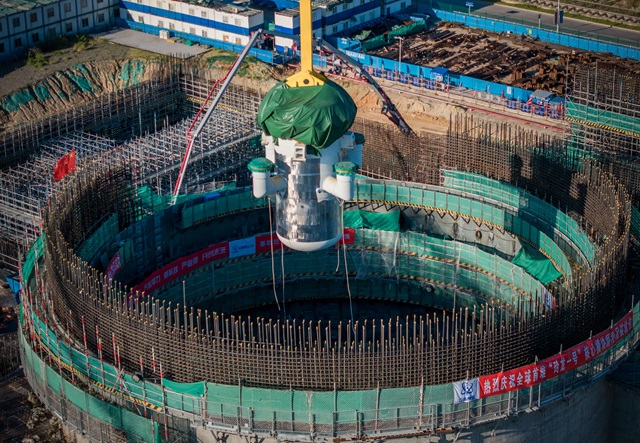
The idea is not theoretical: China and Russia already operate SMRs, and other early units are on track to join them. China’s Linglong One, the world’s first land-based commercial SMR, is under construction and expected to begin operation in 2026, while the United States is moving toward its own small demonstration reactor with regulatory approval granted to Kairos Power for its Hermes 2 project, scheduled to operate by 2030. Yet the most important question is whether the assembly-line model will truly cut costs. Even if reactors are standardized, each installation still must be engineered for site-specific risks such as earthquakes, floods, and extreme weather. That customization could blunt the savings promised by modular construction.
Beyond size, the next generation of nuclear technology is also redefining the fuel that powers reactors. Conventional plants use uranium enriched to about 3%–5% uranium-235, the isotope capable of sustaining a chain reaction. New designs are turning to high-assay low-enriched uranium (HALEU), which ranges from 5% to 20% uranium-235. HALEU can sustain reactions far longer between refueling cycles, making it especially attractive for small reactors and for designs that rely on alternative fuel structures.
One of the most notable innovations enabled by HALEU is TRISO fuel, a radically different approach to containing fission reactions. Instead of relying on long rods of uranium pellets encased in zirconium, TRISO uses microscopic uranium kernels coated in multiple layers of ceramic and carbon. These tiny particles are embedded in graphite pellets, forming a fuel that is inherently resistant to corrosion, oxidation, and extreme temperatures. TRISO fuel is built to contain radioactive byproducts even under conditions that would damage traditional fuel rods, offering a built-in safety advantage that could be critical in advanced reactor designs.
The final piece of the next-generation puzzle is cooling. Today’s reactors use high-pressure water to carry heat away from the core. The system is effective but complex and potentially vulnerable, since maintaining high-pressure containment is crucial to preventing leaks that could trigger a meltdown. Next-generation reactors are exploring alternative coolants such as gas, liquid metals, or molten salt. These materials can operate at much higher temperatures than water and often at much lower pressures, making heat transfer more efficient and potentially reducing the risk of catastrophic failure.
Molten salt reactors, for example, can reach temperatures above 500°C—compared with around 300°C for water-cooled systems—allowing for more efficient steam generation. Liquid metal coolants can similarly carry heat at high temperatures without requiring the same level of reinforced containment. Yet these innovations bring their own challenges: molten salt can be corrosive in the presence of oxygen, and liquid sodium can react violently with water, meaning that containment and material selection become central engineering concerns.
Despite the uncertainties, the momentum behind new nuclear technology is unmistakable. As global energy needs rise, the industry faces a narrow window to demonstrate that advanced reactors can deliver on their promises of safety, reliability, and cost. The future of nuclear power may depend on whether these smaller, hotter, and more modular systems can operate not just for years but for decades, under real-world conditions and with predictable economics. If they can, the next era of nuclear energy could finally live up to the long-held vision of clean, scalable power—delivered not by monolithic plants built over decades, but by flexible, factory-built reactors that can be deployed quickly where they are needed most.