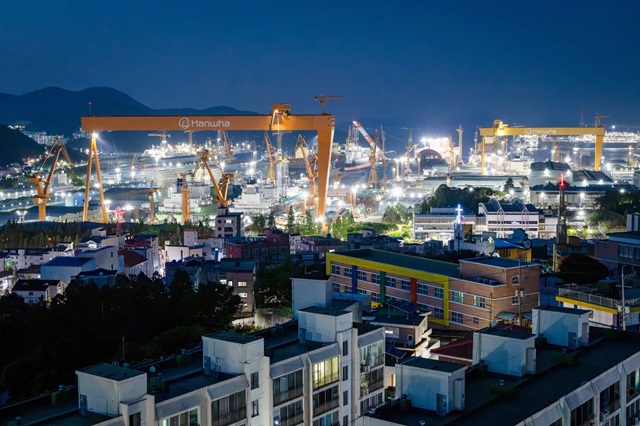
On the shores of Geoje, South Korea, Hanwha Ocean Co.’s vast shipyard is bustling with activity as sparks fly from welding torches and giant steel blocks await assembly into tankers, LNG carriers, and container ships. Once a symbol of South Korea’s dominance in global shipbuilding, the yard now reflects a broader revival driven by shifting geopolitics — and a $150 billion commitment from Seoul to support the struggling US shipbuilding industry, Bloomberg reported.
The investment, announced in July, is part of a strategy to secure trade concessions from the Trump White House and to reposition South Korea as a key alternative to China, which currently builds two-thirds of all vessels under construction worldwide. Three of the nation’s largest shipbuilders — Hanwha, HD Korea Shipbuilding & Offshore Engineering (HD KSOE), and Samsung Heavy Industries — have formed a task force to align with the government’s plans, which are expected to include acquiring or expanding US yards, exporting advanced equipment, and training American workers.
South Korea’s ship exports surged to $26 billion last year, and its yards are booked solid until 2028, according to official data. But the country is betting heavily on US demand as Washington imposes new levies on Chinese-built ships docking in American ports. Initial fears of surcharges as high as $3 million per visit sent shipowners scrambling to secure South Korean slots, though the final fees will be lower when they take effect in October.
“The US realized this wasn’t just about building a few docks, but about creating an entire shipbuilding ecosystem — something they couldn’t afford to miss out on,” Finance Minister Koo Yun-cheol told lawmakers earlier this month.
The initiative also carries political weight. President Lee Jae Myung is set to meet Donald Trump at the White House on Aug. 25, where shipbuilding will be high on the agenda alongside defense cooperation. Seoul views shipbuilding as a strategic industry, alongside semiconductors, nuclear power, and battery materials, where it can serve as a counterweight to Chinese dominance.
The stakes are high. America’s shipbuilding sector, which once produced more than 1,600 vessels a year during World War II, has all but vanished in the commercial space. Hanwha’s acquisition of the Philadelphia-based Philly Shipyard in 2024 marked a turning point, and the yard is preparing to deliver the first LNG carrier built in the US since 1970.
But challenges remain. Analysts caution that South Korea’s shipbuilders, still recovering from years of restructuring after the 2008 financial crisis, face rising wage costs, an aging workforce, and intense competition from China’s heavily subsidized yards. Japan and India are also exploring their own state-backed revival programs, which could squeeze margins further.
“South Korea’s shipbuilding industry spent nearly a decade in critical condition,” said Lee Eunchang, a research fellow at the Korea Institute for Industrial Economics and Trade. “It’s barely out of the ICU, and being asked to represent Korea on the global stage. That’s a big leap.”
Even so, the US shift away from China may provide lasting tailwinds. As Angelica Kemene of Optima Shipping Services told Bloomberg, “By targeting Chinese shipbuilding, the US is underscoring the importance of maritime supply chains as a pillar of national and economic security.”