


Sri Lanka has to navigate its foreign policy within turbulent waters, considering its pivotal location in the Indian Ocean. Being the neighbour to India—a regional power, which some consider an emerging superpower—India shows a kind of political bipolarity, with shifts in mood, energy, and activity levels, often resulting from internal political dynamics, which in turn impacts relationships with its neighbours. Indian investments in Sri Lanka are substantial and growing. Their concerns about their own strategic commercial interests and security concerns are also increasing, on account of the interest shown in Sri Lanka by other players. The MoU they have signed with Sri Lanka is perhaps an indicator of their security concerns.
Being literally only a whisper away from the sea lane pathway of a country which many regard as already a superpower—China—and its Belt and Road Initiative (BRI), China’s influence in Sri Lanka is certainly an irritant and a cause for worry for India.
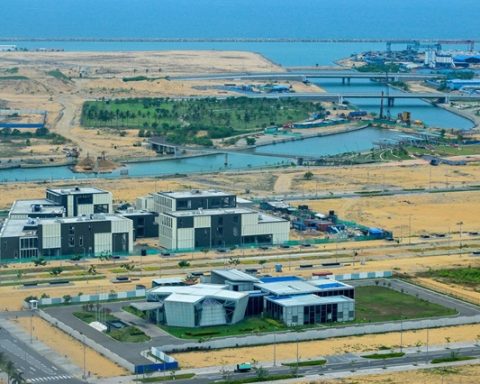
BRI, a Chinese global infrastructure development strategy launched in 2013, aims to connect Asia with Africa and Europe through massive investments in infrastructure projects like railways, roads, ports, and energy pipelines. It has already invested in Sri Lanka. The Hambantota Port project is run by a Chinese company, which has an 85% shareholding, and the Mattala Airport was also built with Chinese funding. The Port City project has granted a 99-year lease for 49 acres of land to China as compensation for reclaiming 660 acres of sea for Sri Lanka to set up its Port City (https://www.bbc.com/news/world-asia-59993386).
Secondly, the influence and interest that the US has in Sri Lanka—perhaps due to the interests that the two major rising powers, India and China, have in Sri Lanka, which could impact the US—perhaps is a strategic concern for the US. It is possible that the recent renewed interest shown by US allies Australia and the UK, as well as Israel, is a move to counter, or at least exercise greater vigilance over, what happens in Sri Lanka arising from Indian and Chinese interests. This perhaps is concerning for India.
The offering of 10,000 jobs for Sri Lankans in Israel, the increasing Israeli presence in the country through tourist businesses reportedly being set up with Sri Lankan partners—some say nominal partners, to meet legal requirements of the country regarding foreign ownership of commercial ventures—and the setting up of Chabad Houses (with reportedly four located in Colombo, Arugam Bay, Weligama, and Ella) is perhaps the establishment of a vigilance strategy at the very least. The approximate number of Jewish nationals visiting the country as short- and long-term tourists is said to be around 25,000 annually—a steady increase over the last few years. Of course, the increasing presence and influence of Israel has been, and continues to be, of concern for many Sri Lankan Muslims and others, who view this as a dilution of the strong and steady support Sri Lanka has always extended to the Palestinians—especially those in Gaza who are being mercilessly persecuted by Israel. No doubt this increasing Israeli presence and influence is a cause for concern for India as well.
In framing Sri Lanka’s foreign policy—specifically its defence policy, which is integral to foreign policy—the signing of the recent MoU with India, and the atmosphere of secrecy surrounding its details, has raised concerns amongst many in Sri Lanka. The unwillingness to be transparent about the entirety of the MoU has added fuel to the fire. It appears to be a short-sighted act by a government that has prided itself on open governance.
Having said this, the MoU also has to be viewed in the context of the other “interests” described above and examined for its strategic content and long-term direction. Although, to the best of the writer’s knowledge, the Sri Lankan government has not released details of this MoU, Economy Next (https://economynext.com/) published what it referred to as the detailed MoU on 15 May 2025. This document, titled Sri Lanka’s Defence Cooperation MoU with India by Shihar Aneez, may be viewed via the link (https://economynext.com/sri-lankas-defence-cooperation-mou-with-india-220788/). Readers are encouraged to view this document as it could have far-reaching implications for Sri Lanka in the long term.
Economy Next states: “It is a very detailed document with 12 articles. According to a text of the document obtained by Economy Next, the nine-page defence cooperation MoU jointly signed by Sri Lanka’s Defence Secretary Sampath Thuyacontha and High Commissioner to India Santosh Jha contains 12 articles ranging from scope of the cooperation to termination clause.
The Indian High Commission in Colombo declined to comment on the text of the MoU and said it ‘cannot confirm the contents of MoU between two States, as that is strictly between official authorities of the two States and is subject to mutual confidentiality.’ Sri Lanka’s Foreign Ministry also declined to comment on the contents of the MoU. But officials from both countries have indicated that the Defence Cooperation MoU has only formalised already existing informal procedures related to the defence of both countries. The MoU includes topics such as the exchange of personnel, training of defence personnel, exchanges other than training, cooperation in defence industry, technology, and research, financial arrangements, and protection of classified information, among many others. It states that the MoU will remain in place for five years, but both countries have the right to terminate the MoU at any time with three months’ advance written notice to the other country.”
While the writer is not conversant with other MoUs between Sri Lanka and foreign countries, the extent of this MoU and its detail does raise some questions and concerns. Besides the 12 articles, there are 55 sub-clauses in the document—perhaps giving it the feel of a document that is more than an MoU, as many understand it. It raises the question of whether the number of sub-clauses gives it the character of something more than a mere understanding. However, Article 1 of the document, titled Scope of Cooperation, lays the basis for the extent of cooperation between the two countries in defence-related matters. It states: “When carrying out cooperation activities under this Memorandum of Understanding, the Parties commit themselves to respect the national and military laws and regulations of the Parties and the relevant principles and purposes of the Charter of the United Nations, which includes sovereign equality of States, territorial integrity and inviolability, and non-intervention in the internal affairs of the Parties, and that neither Party shall allow the use of its territory for activities harmful to the national security of the other.”
The discussion on the MoU and its specifics is one thing, but its impact and implications on Sri Lanka’s foreign policy—vis-à-vis the other “interests” outlined earlier—are another important matter. It is also common-sense prudence to acknowledge that India has originated and signed this MoU with Sri Lanka essentially in its own interest rather than Sri Lanka’s—though there are positives for Sri Lanka too. On the one hand, a positive would be that other interested parties would get a clear message about India’s role in Sri Lankan security and defence in the event of any overt or covert threat. On the other hand, relying solely on India for Sri Lanka’s defence and security—particularly as the MoU is based on the strategic vision of India’s current leadership—could become a liability if India’s political dynamics change within the next five years (the duration of the MoU). Regional political interests could also come into play. Tamil Nadu, for instance, has had, and may continue to have, a significant influence on relations with Sri Lanka, which could affect the MoU, particularly from the Indian side.
While recognising the reality of India—its size, economic and military power, and proximity to Sri Lanka—as well as its cultural links to Sri Lanka, it would be futile to criticise this MoU without considering several other factors that impact the defence and security of Sri Lanka. No doubt, while the country’s foreign policy should be based on a “Sri Lanka First” principle, it is easier said than done, considering the country’s economically weak position, the interests of several other countries, and the geopolitical realities it must consider. A country recovering very slowly from bankruptcy, with a dysfunctional political and administrative system, widespread corruption, and a desperate need for economic growth and equitable wealth distribution—must frame its foreign policy with a futuristic, not nostalgic, lens.
Framing a Sri Lanka First foreign and defence policy will require a substantial balancing act and a cultural shift in how the country perceives its future and its relationships with key players. Past circumstances have changed, and what was relevant then may not be appropriate now. While foreign investments are crucial for economic development, the balancing act between Sri Lanka’s long-term national interests and economic benefits must be carried out within the framework of a strategic foreign policy. The following decisions may have long-term consequences:
- The MoU signed with India. Concerns—aside from politically motivated tirades—need to be addressed. As noted, the MoU could become a double-edged sword if political circumstances in India change.
- The decision in 2017 to grant a 99-year lease to China for 20 hectares (49 acres) of reclaimed land (originally planned to be freehold, later reversed under Indian pressure). Does the country know what China can or cannot do on this land in Colombo? It’s stated that the land is for commercial use only, but there are ongoing concerns about future pressure to allow other uses.
- The 99-year lease for the Hambantota Port and around 15,000 acres of surrounding land granted to a Chinese company, China Merchants Port Holdings, in 2017, as part of a broader special economic zone agreement.
- The 2020 agreement with Israel allowing it to immediately hire 10,000 Sri Lankan farm workers to replace 20,000 banned Palestinian workers, and 8,000 foreign workers who fled due to war. In January 2024, Sri Lanka began talks to send another 20,000 Sri Lankans for jobs in Israeli construction. In a multi-ethnic country where Muslims play a significant role, closer ties with Israel—which is carrying out genocide in Gaza—could destabilise Sri Lanka’s social balance.
Conclusion
The key question is whether these decisions will benefit Sri Lanka in the long term—or burden future generations with the consequences of short-sighted political decisions made today. Such major issues demand scrutiny and bipartisan support. In this context, consideration should be given to making the President the minister responsible for foreign policy and defence, and involving the Opposition Leader in key decisions. A Parliamentary Oversight Committee comprising all parties should be established to ensure accountability.
Foreign and defence policy decisions must rise above partisan politics. Commercial agreements must also be scrutinised through a strategic lens, as they can have far-reaching impacts. Sri Lanka must carefully balance the competing interests of key powers involved in its economic and social revival, to avoid ending up the long-term loser. A modern, strategic, and more inclusive political culture is essential for ensuring the country’s future security, prosperity, and equity.












MOU signed by India and Sri Lanka should be available for public scrutiny. IT IS NOT A PRIVATE MATTER !!!Mr Raj Gonsalkorale has eloquently elaborated on this.Why is the Government so keen on keeping the MOU a secret ??? This raises suspicions. Citizens of Sri Lanka have a right to know the contents.Previous history of the JVP does not helot assuage this suspicion. Dear citizens of Sri Lanka take serious note.