by Durga
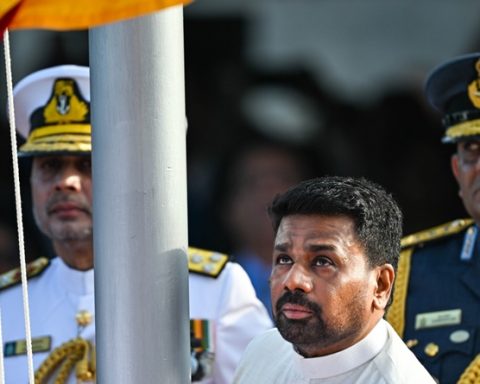
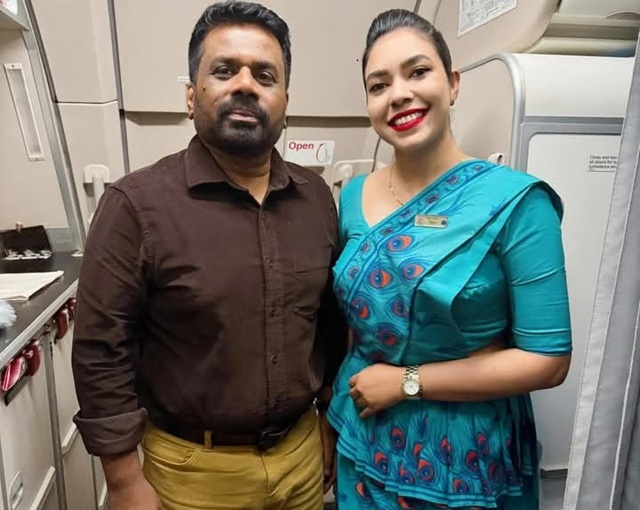
He keeps his simplicity—but even simplicity, when steeped in the rituals of modern politics, becomes charged with symbolism. Before the engines hummed and the skies opened to carry him to Vietnam, President Anura Kumara Dissanayake posed for a photograph aboard the Sri Lankan aircraft, moments after boarding in Colombo.
It was a fleeting moment—almost intimate in its informality—yet the image now hangs in the public imagination like a study in contrasts. Beside him, a Sri Lankan crew member stood in a resplendent blue saree, stitched with peacock feather motifs—one of the most arresting designs ever worn aboard a national flight. Her grace, her poise, and the shimmering dignity of that garment spoke of a country’s aspiration. And there, by her side, stood the President—in a long-sleeved dark brown shirt, barely ironed, sleeves roughly folded, paired with a yellow denim pant that gleamed defiantly under the cabin lights. No tie, no polish, no rehearsed elegance. A leader not draped in tradition, but clothed in contradiction.
It was a first for Sri Lanka—a head of state embracing such colourful, unrefined simplicity at the start of an official visit. In a world where diplomacy is choreographed to the smallest crease of a suit, Dissanayake’s wardrobe choice seemed like an act of rebellion. Or was it strategy? For in this image—now circulating faster than any policy document—simplicity became spectacle, and authenticity became currency. The aesthetic of modesty, consciously or not, had become politicised. A wrinkle turned into a manifesto.
The President arrived in Hanoi on May 4 for a multi-day state visit and participation in the 20th United Nations Day of Vesak celebrations, marking a return to the Southeast Asian stage after sixteen years without a Sri Lankan head of state touching Vietnamese soil. Yet beyond the official itinerary—talks, bilateral agreements, ceremonial bell-ringing—there was an undercurrent that rippled beneath it all: the confrontation between the aesthetics of power and the ethics of it.

Vietnam, unlike many, has earned its authority not through speech-making or sloganeering, but through lived revolution. Its soil is stained not with the rhetoric of resistance but with the blood of those who made it real. Its economic miracle, celebrated and envied, is not a result of capitalist mimicry but a hard-won adaptation built upon collective discipline and sacrifice. This is a country that faced imperialists with rifles and rice bowls, not with campaign jingles and social media filters.
President Dissanayake, for all his rhetoric about systemic change, finds himself in treacherous terrain—where the symbolic power of simplicity risks being unmasked as artifice. The Vietnamese, ever courteous, welcomed him warmly. Deputy ministers, ambassadors, Buddhist leaders—all stood to receive the Sri Lankan delegation. Photographs were taken. Incense was offered at the famed Bái Đính Pagoda. Trees were planted. Speeches delivered. Mutual respect affirmed. Yet behind every handshake lingered an unspoken tension: would the Sri Lankan visitor carry home Vietnam’s example, or merely its veneer?
Because Vietnam’s communism—though evolving and compromised in places—still holds a thread of the authentic. Its Party, for all its contradictions, remains rooted in a foundational narrative of sacrifice and anti-colonial struggle. Its leaders are not play-acting revolutionaries; many have paid in sweat and time and silence. By contrast, Sri Lanka’s political stage is now populated by performers draped in red but living in glass towers. Many invoke the ghosts of Marx and Lenin not to honour their ideals but to mask their own quest for power.
This is the paradox that Dissanayake must now navigate. As a man forged in the fires of the JVP, a party once steeped in youthful radicalism and underground revolt, he must reconcile his revolutionary origins with the demands of executive power. But it is no longer 1971 or 1987. The terrain has shifted. Revolution no longer arrives with rifles and manifestos—it arrives filtered through image, managed by consultants, costumed in casual shirts and untucked defiance. And yet, despite the theatrics, people still hunger for the real thing.
In his meetings with Vietnam’s Party General Secretary Tô Lâm, the symbolism thickened. Here was a man who leads a country that defeated three empires, rebuilt from ashes, and still retains centralised authority over the direction of its national destiny. Tô Lâm congratulated Dissanayake on his electoral victory and praised the people’s trust in his leadership. But trust, like simplicity, is not self-sustaining—it must be earned continuously, in silence and service, not slogans.
Vietnam’s achievements in governance, anti-corruption, and economic transformation were lauded by Dissanayake as models to learn from. He expressed admiration. But admiration is easy. Imitation is harder. Authenticity, hardest of all.
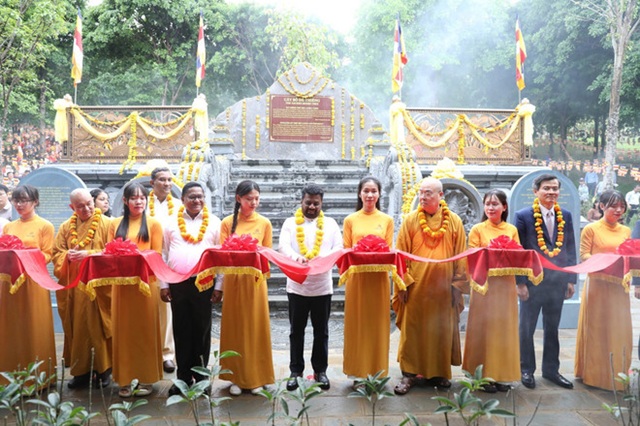
The Vietnamese monks who welcomed him to Bái Đính were gracious. Their smiles were real. Their prayers sincere. But behind the ceremonial incense and serene chanting lies a country that knows too well the danger of counterfeit revolutionaries—men who preach people’s power while living like monarchs, who promise reform while clinging to the very structures they once sought to burn down.
As President Dissanayake continues his visit—attending cultural ceremonies, engaging in bilateral discussions, sharing Buddhist solidarity—he would do well to contemplate what makes Vietnam’s revolution endure. It is not merely policy or GDP figures. It is memory. It is sacrifice. It is a deep, unshakable bond between those who led and those who bled.
Simplicity, in Vietnam, was not curated. It was survival.
And so the question remains: will Dissanayake return to Colombo with more than photographs and agreements? Will he carry back not just the aesthetics of a people’s republic, but the burden of it? Will he distinguish between genuine revolutionaries and the well-scripted propagandists who exploit the iconography of struggle to entrench themselves?
Or will he become yet another figure in a carefully folded shirt—at once too polished to be poor, yet too scruffy to be taken seriously—drifting through history in borrowed imagery? As one Vietnamese party historian wryly put it, “True communists do not need to say they are communists. They build, they bleed, and they are remembered because others say it for them. The rest are just marketing.”