by Luxman Aravind
When dreams crumble, it is not just the political elite who bear the burden of responsibility, but the entire nation. Democracy, that vaunted system of governance where power is supposedly vested in the people, often operates under a delusion. The truth is, when a nation’s dreams are shattered, it is not the few who sit in the echelons of power who suffer alone; it is the collective whole—the electorate, the masses, those who have placed their hopes in the system—who must share the guilt of its failure. The crumbling of Sri Lanka’s government is not merely a misstep of leadership but a profound existential crisis for the entire political and social fabric. When a government begins to collapse, it signals not just a failure of the ruling party, but the failure of a nation to hold its leaders accountable.
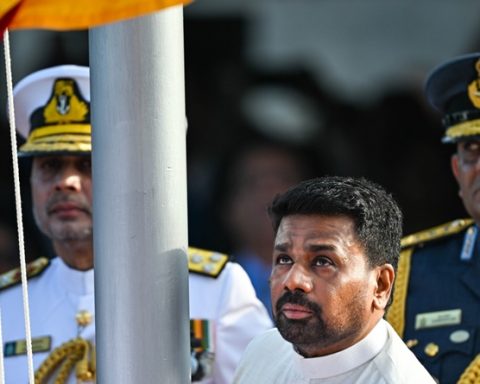
The tragic irony is that the writing was on the wall from the very beginning. The ominous whispers of inevitable failure had been audible to those who cared to listen, yet the masses clung to the promises of change as if they were gospel. And now, in the face of undeniable collapse, those very leaders—President Anura Kumara Dissanayake chief among them—are left fumbling for relevance. This is a government that has been caught in a self-destructive spiral, more concerned with preserving its own power than addressing the monumental crises facing the country. The rhetoric has been nothing more than smoke and mirrors, with the administration scrambling to protect its image while the country disintegrates before its eyes. This is not governance; this is damage control dressed up as leadership.
What we are witnessing today is not a failure of the ruling party alone but a broader, deeper failure of the very democratic ideals that were once the hallmark of Sri Lanka’s political identity. The spectacle of a President who is responsible for taking control of 95 state institutions—by far the largest concentration of state control ever witnessed under any leader in Sri Lanka’s democratic history—yet spends his time preoccupied with trivial issues, is an affront to every citizen. In a nation beset by economic calamity, social unrest, and political disenfranchisement, the leader of the nation cannot afford to waste his hours in fruitless political sparring. Yet, here we are—at a point where the leader of the country seems more interested in self-preservation than in tackling the multiple crises that threaten to engulf Sri Lanka.
The President’s recent pronouncement in Kaluthara that no government will replace the current ruling party for the next 15 years is not just a display of hubris; it is a harbinger of something far more sinister. This statement is the kind of rhetoric we have heard time and again from governments that have no intention of relinquishing power. History has shown us time and again that such words are the precursor to authoritarianism. When leaders begin to speak of an unbreakable hold on power, democracy itself is threatened. The peaceful transition of power, which should be the cornerstone of any democratic system, becomes a distant dream. What is happening now is not simply a government struggling with crisis—it is a government that sees no future for itself beyond its own grasp of power.
If Sri Lanka is not careful, it will soon find itself locked in a political cycle that mirrors the worst examples of authoritarian regimes in the region. The spectre of Bangladesh or Pakistan, where governments are not replaced through democratic means but are instead ousted or held onto through force, looms ever larger. The rhetoric of “no other government” for the next 15 years is a chilling reminder of how easily democracy can be eroded, and how quickly the masses can be lulled into complacency. The people must wake up. They must realise that their hopes and dreams are being crushed under the weight of a government that is hell-bent on maintaining power at any cost.
Perhaps even more tragic is the lost opportunity for the lower middle class—the very group that, for the first time in Sri Lanka’s history, had the chance to rise above its socio-economic conditions. The Rajapaksa administration’s war against terrorism, for all its faults, eliminated one of the primary obstacles to national unity and stability. And now we are having Dissanayake’s administration, which initially seemed poised to capitalise on this rare moment. But instead of working to re-engineer the nation, the government wasted its opportunity, focusing instead on consolidating its own power. The middle class, having finally gained a foothold in the national discourse, now faces the bitter reality of its dreams being dashed. The political elite, those who have long monopolised wealth and power, continue to thrive, while the rest of the country is left to rot in a state of perpetual stagnation.
This is not merely a failure of leadership; it is a betrayal of the nation’s hopes. And the betrayal extends far beyond the confines of the government. The international community, particularly Western powers like the United States, have offered little more than hollow gestures. The notion that American diplomats are “assisting” in recovering stolen assets is laughable when one considers that the very individuals accused of pilfering the nation’s wealth are granted residency in Western countries. If these powers truly had the nation’s best interests at heart, they would not only cut ties with corrupt elites but actively work to ensure their removal. Yet, the West continues to turn a blind eye, tacitly enabling the perpetuation of a corrupt system by welcoming these same figures into their fold.
The question must be asked: what chance does a nation have when it is not just its own leaders, but the global powers, who are complicit in its demise? The opportunity for true change, the chance to break the cycle of corruption and stagnation, is slipping through Sri Lanka’s fingers. Once the lower middle class’s hopes are extinguished, there is little to prevent the nation from descending into a state of irreversible decay.
And yet, even in this moment of despair, the people remain largely passive. Those who are responsible governing continue to debate the petty issues, failing to see the bigger picture—the nation is on the brink of collapse. The political elite, locked in their power struggles, have no interest in finding real solutions. The people, however, are complicit in this mess by allowing themselves to be distracted by the distractions that the government so carefully curates. As long as the focus remains on irrelevant issues—on the status of government properties or the semantics of rent calculations—the real issues facing the nation will remain unaddressed.
The truth is, the current government, regardless of its grandiose promises of reform and change, is nothing more than a continuation of the same deteriorated system that has held Sri Lanka back for decades. The promises made to the people, particularly the promises of anti-corruption reforms, have been nothing more than empty words. There is no commitment to creating a country free from corruption. There is no genuine plan to improve the lives of the common people. Instead, the government has retreated into propaganda, pushing a narrative that bears little resemblance to reality.
And therein lies the most painful truth: Sri Lanka’s democracy, such as it is, has already been hijacked. The very mechanisms of accountability that should exist to challenge those in power have been neutered, replaced with hollow rhetoric and grand promises. It is not just the government that has failed—it is the people, for failing to demand more from their leaders, for failing to hold them accountable when the promises began to fall apart. Democracy, when it crumbles, does so not because of a singular event, but because of years of complacency, of blind faith, of apathy. The tragedy of Sri Lanka today is that it is not merely a government that has failed—it is a nation that has failed itself.
As the nation tumbles towards its inevitable future, the question remains: will the people rise to the occasion and demand the change they were promised, or will they, once again, allow their hopes to be crushed under the weight of a corrupt, self-serving so-called elite? The time for action is now, before it is too late. But history warns us—when democracy crumbles, it is not easily revived.