


Editorial
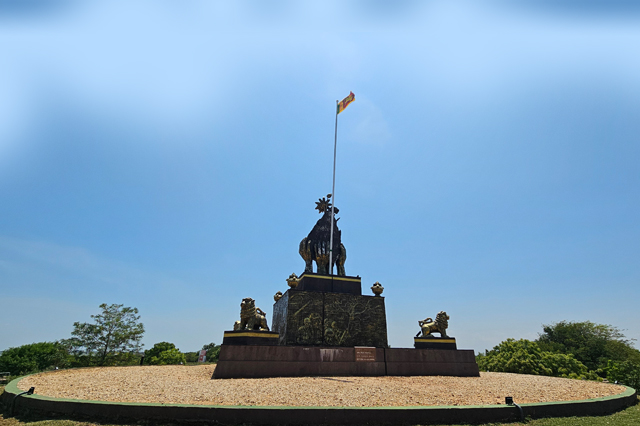
There is no greater condemnation of a nation’s moral collapse than when its leaders refuse to stand among the dead who made their lives possible. On 19 May 2025—when Sri Lanka marks sixteen years since the defeat of one of the world’s most ferocious terrorist organisations—the President will be elsewhere. So will the Prime Minister. They will not stand at the Cenotaph. They will not bow their heads. They will not speak their gratitude. They will not dare to face the ghosts.
This is not absence. This is abdication. It is an unforgivable dereliction, dressed in protocol and stitched with cowardice.
Sri Lanka did not emerge from war by accident. It prevailed because thousands of young men and women—many from the most deprived corners of this island—signed away their futures so the rest of us could have one. They did not fall as heroes for ceremony. They fell in mud, in fire, in silence. They died carrying not glory but grief—grief for the families they left behind, grief for a country they loved more than it would ever love them back. And now, they are discarded by the very state they upheld.
The government has not just been remiss—it has been contemptuous. This year’s National War Heroes Commemoration has been entrusted not to the Prime Minister, not to the President as the Commander in Chief and the full Defence Minister, but to a deputy—Major General Aruna Jayasekara (Retd)—who, notably, commanded security in the Eastern Province during the catastrophic Easter Sunday bombings in 2019. His presence at this sacred event, standing in for the Commander-in-Chief, is not merely inappropriate. It is grotesque. It is a performance of gratitude led by someone under whose command the nation’s security was catastrophically breached.
Let it be said without equivocation: Sri Lanka’s victory over the LTTE was not won in ministries. It was not born in donor reports or foreign diplomacy. It was not delivered by talking heads on television or in UN corridors. It was won in Kilinochchi, in Mullaitivu, in Elephant Pass—by soldiers, many nameless, who marched into the abyss so that others could live.
And yet, today, many of these men and women are forgotten. Some beg on street corners. Others live with amputations and trauma in crumbling houses, while certain high-ranking officers—who conveniently abandoned the battlefield to become millionaires in Colombo—continue to wear their uniforms like golden tickets. There are credible accounts of LTTE assets—vehicles, equipment, luxury items—confiscated and then sold by senior military officers in the South, quietly amassing wealth while their subordinates bled and died. These are not isolated anecdotes—they are systemic rot.
This is not merely a failure of remembrance. It is a failure of justice.
The President’s glaring absence from this year’s ceremony is not an oversight—it is a choice. A deliberate act of political self-preservation wrapped in the language of scheduling. If he could attend the 5 April commemorations honouring fallen JVP members—insurgents who once tried to overthrow the democratic state with bloodied machetes—then what justifies his absence on 19 May? Why is he willing to bow before rebels who waged war on democracy, but not before those who died defending it?
This inversion of reverence is not just insulting—it is a national obscenity.
Let us not mince words. The JVP in the late 1980s was not a social movement. It was a violent, extremist insurrection that decapitated principals, blew up buses, and plunged the country into darkness. The armed forces, though not faultless, crushed that rebellion and preserved the republic. For the current President to honour fallen JVP cadre while shunning the memory of the troops who suppressed them reveals a grotesque distortion of loyalty and an appalling lack of national integrity.
We are told, often by the well-fed and the well-shielded, that reconciliation requires balance. That remembrance must be broad and inclusive. But what balance is this, where terrorists are mourned and protectors are ignored? What inclusivity is served by whitewashing sacrifice? What peace is built on historical amnesia?
This is not about war glorification. No soldier seeks it. True warriors know the horror of war too intimately to romanticise it. This is about duty—to remember, to honour, to stand still for a moment of truth amidst a sea of political lies.
If we are a nation that cannot look its dead in the eye, we are a nation that does not deserve the freedoms they secured. These ceremonies are not merely tradition. They are the spiritual ledger of a people. To commemorate is to reaffirm who we are, and more importantly, what we owe. A nation that ceases to remember those who died for its survival ceases to possess the moral authority to command its future.
The President’s absence is not just a political decision—it is a philosophical rupture. Leadership, in its truest form, is not about titles or timelines. It is about presence. Symbolism. The courage to confront the unbearable. And what could be more unbearable than a field of graves, filled with the dreams of children who became soldiers?
The War Heroes Commemoration is not an Armed Forces victory lap. It is a requiem for a generation lost. It is for the Tamil soldier who died shielding civilians from crossfire. It is for the Sinhalese private who ran through gunfire to rescue wounded comrades. It is for the Muslim intelligence officer who warned his post of an impending LTTE ambush. It is for the mother who raised three sons and buried two. It is for every human life exchanged so this country could breathe.
They did not ask for statues. They did not demand slogans. They only wanted to be remembered. And even that is now too much for those in power to give.
This editorial is not a call to nostalgia. It is a demand for reckoning. There is still time to correct this insult. To show that, even if the executive lacks spine, the people of this country do not lack soul.
Let us not permit a handful of well-dressed cowards to define our national character. Let us not accept a republic in which gratitude is seasonal, remembrance selective, and sacrifice disposable. If we allow this silence to become normal, then we are all complicit.
To those who gave everything—your country may have forgotten you. But we have not. You are the true architects of peace. And though your leaders may shrink from your memory, we will carry it forward.
Your blood is on our soil. Your legacy is in our hands.





Yes, it is an absolute dereliction of duty on the part of the President and Prime Minister to keep away from the cenotaph. Well, it was a mistake of the Citizens of Sri Lanka to vote for and elect this party to govern. DO NOT MAKE THE SAME MISTAKE AGAIN !!!!!!!!!!!!!