by Eric
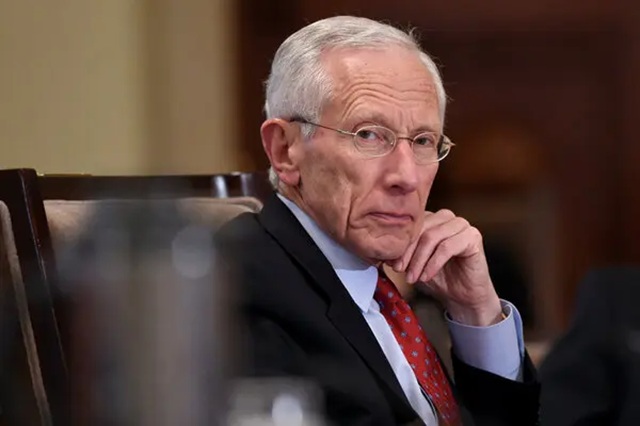
The death of Stanley Fischer on 31 May 2025 does not merely signal the cessation of a long and storied life; it marks the symbolic end of a cerebral era in which technocratic reason briefly held dominion over the capricious tides of global capital. Fischer was not merely an economist—he was a grand architect of a certain order of thought, a quiet but unflinching advocate for the supremacy of structured economic governance over the latent entropy of markets. In an epoch where populism increasingly corrodes the infrastructure of evidence-based policymaking, Fischer’s passing invites more than grief—it demands a reckoning.
Born in 1943 in what was then Northern Rhodesia, Fischer was both a product and a paradox of empire. He carried, for most of his adult life, a serene cosmopolitanism that belied the tumult of his origins. Though trained in Britain and intellectually forged in the hothouse of MIT, he wore no parochial allegiance to nationhood. His intellectual loyalties were to models, equations, frameworks—cognitive instruments crafted not to flatter political sensibilities but to distil truth from chaos.
Fischer’s theoretical work, particularly his seminal 1977 paper that reconciled rational expectations with nominal rigidities, did more than shift the centre of macroeconomic orthodoxy—it attempted a quiet coup against the nihilism of monetarist fatalism. In asserting that monetary policy remained potent even when agents formed expectations rationally, Fischer preserved space for statecraft amidst the prevailing theoretical dogma that markets, left unfettered, self-correct with theological certainty. That nuance—that policies can and must shape macro outcomes even in the presence of forward-looking agents—rescued Keynesianism from the brink and armed a generation of economists with the rationale for activism in monetary affairs.
Yet the true profundity of Fischer’s influence lies less in his scholarly canon and more in the rarefied alumni of his tutelage. His students—Ben Bernanke, Mario Draghi, Olivier Blanchard, Greg Mankiw—would not merely interpret the world; they would, in varying capacities, rule it. That a single mind could cultivate such a coterie of influence reveals something not only of Fischer’s intellectual fertility but also his enduring faith in institutions. He did not sculpt firebrands; he shaped guardians—technocrats steeped in the belief that macroeconomic stability is civilisation’s bulwark against dissolution.
But herein lies the duality, perhaps even the disquiet, at the heart of the Fischer legacy. For all his brilliance and rectitude, he embodied a brand of policymaking that prized insulation over democratic feedback. His ideal economist, much like himself, operated at a remove from the tumult of the demos. As Deputy Managing Director of the International Monetary Fund during the crucible years of the 1990s, Fischer’s interventions—particularly during the Asian and Russian crises—were both praised as decisive and criticised as doctrinaire. His advocacy for capital account liberalisation, while standard for the time, left many developing economies exposed to speculative onslaughts and spirals of austerity.
To his detractors, Fischer represented the apogee of what the anthropologist James Ferguson once dubbed “the anti-politics machine”—a worldview in which economic policy is treated as an exercise in engineering, not ethics. The conditionalities imposed under his IMF stewardship often reflected an axiomatic faith in market liberalisation, privatisation, and fiscal rectitude—policies that, in certain contexts, exacerbated inequality and fuelled social unrest. While Fischer himself was no ideologue, the institution he helped guide wielded his intellect as a scalpel and, occasionally, a bludgeon.
Yet to assign to Fischer the failures of an entire paradigm would be both facile and unjust. He was, above all, a man of his time—a period in which the end of history had been prematurely declared, and the Washington Consensus appeared less like a policy framework and more like revealed doctrine. What is notable is that Fischer, unlike many of his contemporaries, evolved. As Governor of the Bank of Israel from 2005 to 2013, he demonstrated a rare pragmatism. Navigating the global financial crisis with notable adroitness, Fischer used capital controls, countercyclical monetary policy, and aggressive interest rate interventions to insulate the Israeli economy from contagion. In contrast to his earlier IMF posture, Fischer’s tenure in Jerusalem evidenced a maturing of thought—one that recognised the perils of overexposed markets and the necessity of state agility.
His stint as Vice Chair of the Federal Reserve between 2014 and 2017, though less epochal, was no less telling. In an era defined by low interest rates, regulatory rollback, and political polarisation, Fischer served as a sober counterweight. He resisted the siren calls to dismantle the post-crisis regulatory apparatus, warning presciently of the dangers of financial amnesia. When he declared, in 2017, that “rolling back financial regulations would be extremely dangerous and extremely short-sighted,” it was not mere bureaucratic conservatism—it was an indictment of the political nihilism that once again sought to erase the memory of catastrophe in the name of short-term gain.
Yet Fischer’s death should not be a moment merely for hagiography. It must provoke deeper introspection about the moral architecture of economic thought. Fischer, for all his brilliance, was emblematic of a generation of economists who believed that the world could be rationalised, rendered legible through models and technocratic interventions. That belief, though not without merit, has in recent years been subjected to ruthless critique. The failures to predict or forestall the 2008 financial crisis, the rise of anti-globalist populism, and the widening chasms of inequality have all laid bare the limits of technocratic optimism.
The question that must now be asked is this: did the very rationalism Fischer champion unwittingly contribute to the disenchantment of democracy? In exalting expertise and diminishing popular voice, did his generation of economic stewards foreclose the possibility of a more participatory economic order? These are not questions to which Fischer could have answered definitively. Yet they linger, haunting the margins of his legacy like footnotes yet to be written.
Still, to reduce Fischer’s life to a cautionary tale would be grotesquely reductive. He was a man of formidable intellect, unimpeachable integrity, and unrelenting discipline. His public service was guided not by vanity but by an earnest desire to improve human welfare through the only tools he truly trusted: reasoned argument, empirical validation, and institutional coherence. He may not have been a democrat in the classical sense, but he was a democrat of ideas—an interlocutor always willing to engage in spirited but civil disputation.
In one of his more candid moments, Fischer once remarked, “I no longer believe that there is an elixir of growth… I believe that I know the missing ingredient. It is hard work.” The aphorism encapsulates his worldview—hopeful but grounded, aspirational but disciplined. He believed, with near-religious fervour, that the world could be made better if only we studied harder, thought clearer, and governed more judiciously. It is a belief that may now seem quaint, even naïve, in an era where conspiracy often eclipses consensus. But perhaps that is precisely why it matters.
In mourning Fischer, we do not merely lament a man; we mark the passing of a philosophy—one that held that order could be imposed upon chaos, that knowledge could tame volatility, that humanity need not be at the mercy of markets. Whether this philosophy will be resurrected, reimagined, or relegated to the annals of academic idealism remains to be seen.
What is indisputable is that Stanley Fischer left the world more stable, more sensible, and more thoughtful than he found it. In an age increasingly hostile to nuance, his was a voice of tempered wisdom. His death is a silence in the orchestra—a missing note in the concert of global governance. And in that silence, we are left not with answers, but with questions: urgent, unsettling, and, perhaps, necessary.