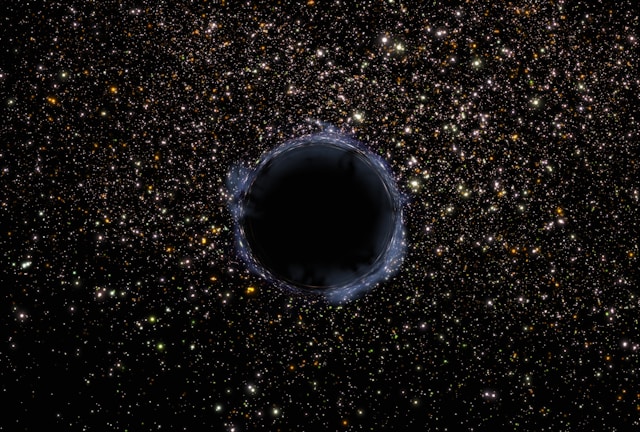
Scientists have observed a supermassive black hole that appears to have reactivated after a nearly 100 million-year hiatus, unleashing powerful jets of plasma once again and reshaping its surrounding cosmic environment. The phenomenon was detected in a giant galaxy at the center of a galaxy cluster, where a fresh analysis of radio emissions revealed a dramatic cycle of jet activity that stopped, then resumed, over vast stretches of time.
Using the Low-Frequency Array (LOFAR) radio telescope network in the Netherlands, researchers identified more than 20 galaxy clusters hosting radio galaxies with irregular jet structures. Among them, one galaxy—named J1007+3540—stood out for its extraordinary “layered” jet history. The study, published Jan. 15 in the journal Monthly Notices of the Royal Astronomical Society, found evidence that the galaxy’s active galactic nucleus (AGN), the region around its central black hole, shut down and later restarted, producing new jets inside older, exhausted plasma lobes.
“It’s like watching a cosmic volcano erupt again after ages of calm — except this one is big enough to carve out structures stretching nearly a million light-years across space,” said study co-author Shobha Kumari of Midnapore City College in India.
The galaxy’s ancient lobes, massive clouds of diffuse plasma, point to previous jet activity dating back around 240 million years. Nested within these are smaller, brighter jets roughly 140 million years old—indicating a restart of the black hole’s central engine. This “layering” is a hallmark of an episodic AGN, a rare type of galaxy whose black hole cycles through periods of dormancy and renewed activity.
Only about 10% to 20% of supermassive black holes generate radio-emitting jets, which arise when matter falling into the black hole forms a spinning disk and produces tangled magnetic fields. Under certain conditions, this can fling material outward at near-light speeds. Changes in the disk can sometimes cause these jets to switch off and on, a process that is still not fully understood.
The surrounding environment also plays a key role in shaping the jets. The galaxy cluster that houses J1007+3540 contains a superheated gas known as the intracluster medium, which interacts with the jets as they expand outward. In this case, the older plasma lobes are being bent and distorted by the hot gas. One lobe is compressed and pushed sideways toward its source, while the other forms a long, kinked tail, suggesting differing interactions with the surrounding medium.
“J1007+3540 is one of the clearest and most spectacular examples of episodic AGN with jet-cluster interaction, where the surrounding hot gas bends, compresses, and distorts the jets,” said co-author Surajit Pal, a physicist at the Manipal Centre for Natural Sciences in India.
The findings provide a rare opportunity for astronomers to study how often AGNs cycle through active and dormant phases and how jet structures evolve over time. The research team plans to pursue higher-resolution observations to map how the jets propagate through the intracluster medium and to better understand the physics driving episodic black hole activity.