



by Durga
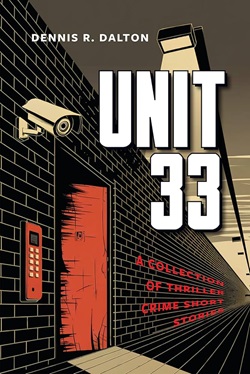
Dennis R. Dalton’s Unit 33 reads like a moral experiment conducted under the cover of a thriller. The book’s sleek façade—its crime scenes, its corporate espionage, its terse dialogue—conceals a philosophical unease about what happens when private institutions absorb the functions of state power. The setting is not the distant dystopia of Orwell or Gibson, but present-day San Francisco, “a city that never sleeps,” where every surface glows with surveillance and every conscience has been outsourced to compliance software. Dalton’s prose is cool to the point of anesthesia; yet the calm is an affectation, a narrative mask over moral panic.
From the opening line—“San Francisco is like any other large city when it comes to never sleeping”—the city itself becomes a sentient witness, “continuously watching … just waiting for something.” The watchers are everywhere, and so are the watched. Into this digitally panoptic landscape step Abbey and Ron, two mid-level operatives in the corporate security department of 2nd National Bank. When they stumble upon what appears to be a kidnapping—“the SUV accelerated towards them, tires screaming”—Dalton opens the moral abyss. The victim is not an innocent passerby but a white-collar thief, Charles Fairfield, being “helped into a car” by the bank’s own security contractors. The perpetrator is their boss, Dan Holmes, who later explains with bureaucratic calm, “They drugged him, stuffed him in a crate, and listed it as a diplomatic pouch to avoid Homeland Security’s searching it.” Dalton’s dialogue is stripped of sensationalism precisely to expose the normalization of illegality. The crime is committed not in darkness but under fluorescent light.
The first third of Unit 33 plays like a noir procedural; the rest becomes corporate theology. Holmes, who is both villain and mentor, reveals the existence of a secret operation beneath the bank’s loading dock—“a steel door … the sign read, simply, Unit 33.” Inside lies the book’s dark epiphany: a private intelligence agency funded by the bank itself. “Essentially, it’s a small IT operation,” Holmes tells Abbey, “but we have the talent and know-how to hack into systems anywhere in the world.” Dalton’s description is clinically precise: “six independent workstations … four processors, each dedicated to a separate function.” The banality of the details—the hum of servers, the biometric scans, the redundancy backups—renders the horror almost invisible. Evil here is not demonic but administrative.
The novel’s philosophical core lies in its portrayal of complicity. Abbey and Ron, initially horrified witnesses, become quiet collaborators. “Perhaps all we saw was a drunk fall down and some friends helped him up,” Ron tells her, rationalizing their silence. The line, chilling in its understatement, encapsulates Dalton’s vision of moral decay: the transformation of ethical crisis into procedural ambiguity. “Maybe, maybe not,” Ron shrugs when Abbey asks if they are accessories to kidnapping. That maybe is the novel’s true antagonist—the euphemism that allows systems to function without conscience.
Dalton’s dialogue reads like minutes from a meeting of the damned. When Holmes instructs his subordinates to delete evidence, he does so with managerial cheer: “Don’t worry, Ron, I was actually glad that you managed to record all or some of what you saw … I had my Admin delete the video.” The casual tone—the corporate idiom of reassurance—turns erasure into routine. Even morality becomes an internal memo. “Right now,” Holmes explains, “this is a matter between Singapore Global, the State Department, and the Bureau.” The sentence performs the abdication it describes: responsibility outsourced upward, ethics dissolved into jurisdiction.
Dalton’s genius is to make this procedural indifference addictive. The reader, like Abbey, is seduced by competence. When Holmes guides her through the labyrinth of the secret facility, the thrill of revelation mirrors our own voyeurism. “This place,” he tells her, “is only known to myself, President Sands, and now you.” For a moment, the reader enjoys the forbidden knowledge, the insider privilege. Then the realization strikes: the thrill is the trap. Unit 33 indicts not only its characters but its audience; our fascination with surveillance is itself a form of participation.
The prose itself becomes a moral device. Dalton writes in the idiom of policy briefings and IT manuals—precise, unemotional, jargon-heavy. “A biometric eye and facial scan locking device,” “offsite redundancy facility,” “dedicated processors”: the language of security displaces the language of empathy. This linguistic drift is the novel’s quiet apocalypse. When Holmes boasts that his analysts can “hack into one agency but make it appear that it was coming from another unsuspecting source,” we hear not triumph but the dissolution of truth itself. The sentence could serve as epitaph for our era of disinformation: the technical capacity to counterfeit reality faster than it can be verified.
Beneath the thriller mechanics, Unit 33 is an essay on the privatization of truth. Dalton’s San Francisco, with its empty streets and glowing screens, is a stage for post-democratic power. The line between bank and state, between profit and law, has dissolved. “Our Board’s directive,” Holmes explains, “was to make sure our skirts are clean and if not, give us enough time to get out.” The phrase “skirts are clean” captures the entire moral lexicon of neoliberalism—purity not as virtue but as plausible deniability. The system does not seek justice; it seeks insulation from consequences.
Abbey’s final “promotion” to command of the secret unit completes the moral parabola. “We want to pass the baton to you to run this operation,” Holmes tells her. The offer is both honor and contamination. The apprentice becomes custodian of the machine she once feared. “You’ve got the people skills and know how to keep your mouth shut,” he adds—a compliment that functions as curse. Dalton ends not with a climax but with inertia: the system continues, unexposed, self-justifying. “For now, if there are no more questions,” Holmes says in the closing pages, “I suggest you get back to work.” It is a line of almost unbearable banality, echoing Kafka’s bureaucrats and Conrad’s imperial accountants. The machine hums on; apocalypse is just another Monday.
What makes Unit 33 intellectually provocative is Dalton’s refusal to moralize. He stages the collapse of ethics not as tragedy but as procedure. There are no speeches about corruption, no melodramatic revelations—only meetings, instructions, and data transfers. This stylistic discipline forces the reader to feel the vacuum directly. When Abbey calls the night security desk to report the kidnapping, the operator replies, “It looks like an intoxicated person was helped into a car.” The sentence, emptied of intention, becomes the novel’s moral zero: the bureaucratic language that metabolizes horror into normalcy.
Dalton’s style invites comparison with Don DeLillo’s Cosmopolis or Joseph Conrad’s Secret Agent, yet his register is more forensic than metaphoric. He writes in the tense of the memo, the syntax of compliance. That choice, paradoxically, gives Unit 33 its literary charge. The coolness of the prose becomes the heat of the theme. When Holmes tells Abbey, “To them, it’s only a job. For us, it is what we live for,” Dalton captures the eroticism of control that defines contemporary power—the way systems of surveillance become not merely instruments but identities.
Unit 33 is not just a thriller about corruption; it is a parable about moral anesthesia. It dramatizes how ordinary professionals—security officers, analysts, managers—become functionaries of impunity, how the architecture of secrecy erodes the very capacity for outrage. Its provocativeness lies not in violence but in its calm assertion that the real violence is procedural, invisible, sanctioned. In the end, the reader, too, has “access clearance.” The door marked Unit 33 opens easily; the hard part is remembering to feel something as we step inside.









