


by Eric
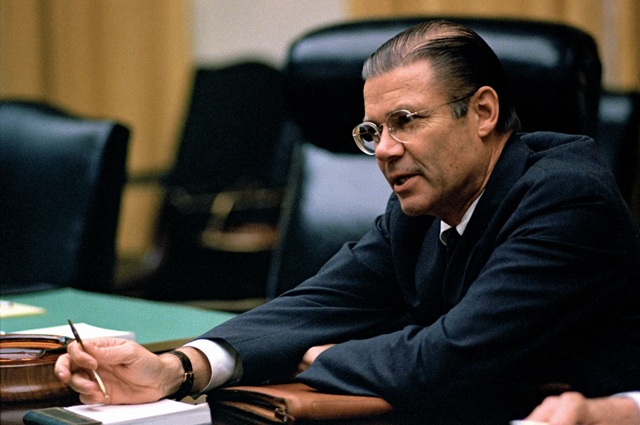
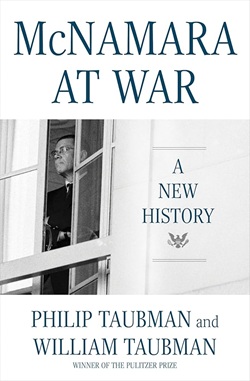
McNamara at War: A New History, written by Philip Taubman and William Taubman, is not merely another biography of Robert S. McNamara, nor is it a conventional re-litigation of the Vietnam War. It is, more unsettlingly, an autopsy of modern technocratic power, written with the cold patience of historians who understand that moral catastrophe often emerges not from villainy but from intelligence, discipline, loyalty, and an almost religious faith in systems. The Taubmans’ McNamara is not redeemed, but neither is he caricatured; instead, he is exposed, layer by layer, as a man whose brilliance became inseparable from his blindness, and whose ethical seriousness ultimately functioned as a form of moral insulation rather than restraint.
From the outset, Philip and William Taubman signal that this is a psychological and political portrait rather than a simple narrative of events. They insist that McNamara’s “personal contradictions are not, of course, the whole story of the war. But it is crucial to comprehend them.” This insistence matters. The Taubmans do not treat Vietnam as an abstract policy failure but as the cumulative result of habits of mind forged long before helicopters lifted off from Saigon. McNamara’s childhood, education, and early professional life are not background colour; they are the architecture of disaster. As one college friend recalled, McNamara judged everything by asking “what was a ‘good’ thing” and approached problems from a “long-term perspective.” That phrase, seemingly virtuous, becomes chilling in retrospect, because it hints at a man for whom ethical deliberation was inseparable from calculation, and calculation could always defer reckoning.
One of the book’s most disturbing achievements is its demonstration that McNamara was neither ignorant nor stupid, nor even, for much of the war, self-deluded. The Taubmans confront head-on the most damning accusation: that McNamara continued to prosecute a war he privately believed was unwinnable. History, they write bluntly, has “properly judged his role in Vietnam as a terrible and costly failure of leadership.” The phrase “properly judged” matters here; the Taubmans do not seek to revise that verdict. Instead, they ask how such failure could coexist with such intelligence. McNamara’s “mechanical prosecution of the Vietnam War,” his “baldly deceptive public reports,” and his “obsessive and misplaced reliance on statistical data” are described as “undeniable and indefensible.” This is not exculpation; it is indictment sharpened by understanding.
The book’s great strength lies in its use of newly available sources to dismantle the myth that McNamara’s later remorse absolves his earlier actions. When McNamara eventually confessed that the war was “wrong, terribly wrong,” critics, the Taubmans note, reacted with fury precisely because the confession implied prior knowledge. One could forgive ignorance; one could not forgive continuation. The Taubmans quote critics who argued that McNamara became “even more ‘evil’” once it was clear that he had sent “thousands more Americans and Vietnamese to their deaths even after he concluded the war was unwinnable.” The word “evil” is not theirs, but they do not shy away from it. They let it sit uncomfortably alongside McNamara’s evident anguish, refusing the reader the relief of easy moral closure.
The Taubmans’ portrait of McNamara’s character is relentlessly unsettling. He was, by nearly all accounts, a man of “absolute, total integrity and morality—without being judgmental about other people’s failings.” Yet this moral rectitude undergirded an extraordinary stubbornness. One colleague recalled that “Bob hated to change the course of action after he got going on something,” and McNamara himself admitted, “After I make up my mind, I don’t have time to go back and keep going through it all again.” In the context of war, this is not decisiveness; it is moral inertia masquerading as efficiency. The very traits that made McNamara successful at Ford and formidable at the Pentagon became lethal when applied to a war rooted in nationalism, colonial history, and asymmetrical resistance rather than metrics.
The Taubmans are particularly incisive on McNamara’s fetishisation of data. McNamara believed deeply that reality could be mastered through numbers, that the fog of war could be dispersed by statistics. Yet, as the book repeatedly demonstrates, this faith was not epistemologically neutral; it shaped what McNamara could see and what he systematically ignored. Body counts, sortie rates, and attrition ratios crowded out questions of legitimacy, popular support, and historical memory. Daniel Ellsberg’s later critique hangs heavily over the Taubmans’ narrative, even when not directly quoted: the war was being “measured” into success while collapsing politically and morally. The authors show how McNamara’s reliance on quantification became a form of self-deception that was socially reinforced by institutional loyalty.
Perhaps the most controversial and revealing dimension of the book is its treatment of McNamara’s emotional life, particularly his relationships with women, including Jacqueline Kennedy. Philip and William Taubman do not sensationalise this material, but they refuse to sanitise it either. The relationship “clearly meant a great deal to them both,” and McNamara’s emotional support for Jackie Kennedy after the assassination is presented as genuine, not opportunistic. Yet the effect is unsettling: here is a man capable of deep empathy in private while presiding over mass death in public. When Jackie Kennedy later remarked that McNamara was “still working out his guilt about Vietnam,” she diagnosed something essential. Guilt did not paralyse McNamara; it haunted him belatedly, after power had already been exercised.
The book’s later chapters, especially those dealing with McNamara’s post-Pentagon years, refuse the temptation of redemption. McNamara’s tears over Andrei Sakharov, his wordless crying as he spoke of “that great moral man” and his own “less-than-noble role in the Vietnam War,” are deeply human moments. But the Taubmans are careful to show that emotional recognition does not equal moral repair. McNamara’s participation in critical oral history conferences, his memoir In Retrospect, and his collaboration with scholars like James Blight and janet Lang represent genuine efforts at reckoning, but they arrive decades too late for those who paid the price.
What ultimately makes McNamara at War so disturbing is its implication that McNamara was not an aberration but a prototype. His story exposes the moral dangers of technocratic governance when insulated from democratic accountability and historical humility. He was, as one observer put it, “so damn smart” that “even when you knew he was wrong, he would plow you under.” Intelligence became authority; authority became destiny. Philip and William Taubman force the reader to confront an uncomfortable possibility: that modern institutions systematically reward the very traits that make catastrophic error most likely.
This is not a comfortable book, nor should it be. The Taubmans’ achievement lies in refusing consolation. McNamara is neither monster nor martyr; he is something more frightening—a decent man who helped engineer immense suffering while believing he was serving the “higher public good.” In exposing that paradox with such documentary care and moral seriousness, McNamara at War becomes not just a history of Vietnam, but a warning about the ethics of expertise itself.











