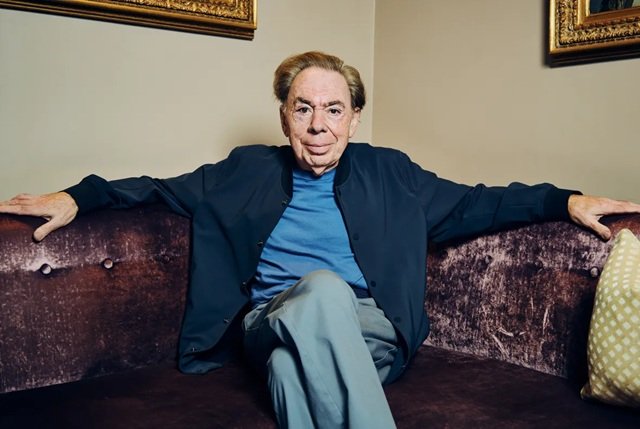
Andrew Lloyd Webber, one of the most influential figures in modern musical theatre, has revealed the depth of his struggle with alcoholism and the dramatic personal and professional transformation that has followed his decision to stop drinking. Speaking in an extended interview with the Times UK, the composer reflects on decades of hidden dependence, the collapse of his relationship with alcohol, and the unexpected resurgence of creativity that has defined his life in recovery. Now 78, he describes himself without hesitation as a recovering alcoholic, marking a decisive break from the carefully curated public image he once maintained.
Lloyd Webber’s connection to wine stretches back to adolescence, when he was introduced to Burgundy by a family relative and began collecting bottles at the age of 15. Over the decades, his cellar grew into one of extraordinary value, containing rare vintages such as Romanée-Conti and Château Pétrus. In 2016, he publicly announced he had given up drinking and auctioned off much of his collection through Sotheby’s, claiming at the time that he had stopped “completely.” He now acknowledges that declaration was misleading, describing it as bravado masking a more complicated reality.
In truth, he explains, he initially stopped drinking for around 18 months during the mid-2010s while working intensively on Broadway productions. That period, however, was marked not by recovery but by what he now calls “white-knuckling,” a form of forced abstinence without support. He recalls a growing fear that sobriety might hinder his creativity, particularly because he had long associated composing with alcohol, especially during the era of long, convivial lunches that accompanied much of his earlier career. That belief eventually led him back to secret drinking, a relapse he concealed even as his public statements suggested control.
The turning point came when the consequences of his drinking began to affect his family life. Lloyd Webber describes a period of crisis in which his wife felt unable to continue in the same way, prompting him to seek help. He first entered a clinic, which he says did not resolve the problem, but it did lead him to Alcoholics Anonymous. What he found there, he admits, surprised him. Expecting something unwelcoming or socially marginal, he instead discovered a community built on equality and shared experience. He describes AA meetings as spaces where status disappears, allowing him to form friendships across social and cultural divides that he would not otherwise have encountered.
He now attends meetings daily, moving between London, Hampshire, and New York. Far from hiding his participation, he says he finds openness about recovery essential. He recounts attending meetings even on days of major professional significance, including the opening of new productions, without feeling the need to conceal his presence. For him, anonymity is not about invisibility but about humility within a structured system of support that he now credits with saving his life.
The composer speaks candidly about the mechanics of his addiction, describing a cycle of delay, anticipation, and relief that structured his daily life for years. He would focus on reaching midday as a threshold for his first drink, framing each day as something to be endured rather than lived. He admits that alcohol became intertwined with his creative process, creating the illusion that it enhanced productivity, when in reality it gradually narrowed his focus and increased his anxiety. He now believes that some of his well-known works may have been influenced by drinking, although he struggles to recall the specifics of that period clearly.
Despite the gravity of his confession, Lloyd Webber is equally reflective about what he has regained since achieving sobriety. He describes a renewed ability to concentrate and a level of productivity that surpasses earlier phases of his career. In recent years, he has overseen acclaimed new productions, including reinterpretations of classic works and the development of new musicals. He speaks of current projects with enthusiasm, including adaptations of historical and cinematic material, which he believes would not have been possible during his drinking years.
One of the most striking elements of his recovery, he says, is the restoration of family relationships. He recounts a moment when his home was filled with balloons marking one year of sobriety, sent by his youngest daughter as a gesture of celebration. Yet this renewal is shadowed by profound loss. Three years ago, his eldest son Nicholas died from gastric cancer at the age of 43. Lloyd Webber speaks of him simply, noting that he had also struggled with alcoholism. The memory remains a source of deep reflection, and he acknowledges the complexity of connecting personal history, addiction, and illness without drawing simple conclusions.
He also considers the possibility that addiction runs through his family. Reflecting on his father and other relatives, he suggests that patterns of alcohol dependence may have shaped previous generations, even when not openly acknowledged. These observations form part of a broader sense of inherited vulnerability that he now views with greater clarity in sobriety.
The shift in his personal life has coincided with continued professional evolution. Lloyd Webber describes a willingness to allow younger directors and performers to reinterpret his work in ways he might previously have resisted. He points to recent productions that take bold stylistic approaches to his musicals, noting that collaboration has become more important than control. While he sometimes disagrees with creative choices, he now sees artistic tension as productive rather than threatening.
This openness has also extended to new writing. He is currently developing several projects, including musicals inspired by historical theft and cinematic narratives. He says some of these ideas came to him during rehabilitation, suggesting that sobriety has not diminished his imagination but instead reshaped it into new forms. He contrasts this phase of his life with earlier years, emphasizing that clarity has replaced the blurred creativity of intoxication.
At the same time, Lloyd Webber is unambiguous about the cost of his addiction. He expresses regret for moments of irresponsibility and uncertainty, acknowledging that memory gaps and near-misses form part of his past. He apologizes for any harm caused during those years, particularly to colleagues and collaborators who may have been affected by his behavior. Yet he resists framing his recovery as erasure of that past, instead presenting it as integration into a fuller understanding of himself.
The sale of his remaining wine collection, expected to raise significant funds for music education charities, represents what he calls a final break with his former identity. While he recognizes the sentimental value of the collection, he says it was also a trigger for relapse and had to be removed entirely. The decision reflects a broader commitment to sustained sobriety, supported by daily meetings and structured recovery practices.
Now approaching the later stage of his career, Lloyd Webber reflects on the paradox of sobriety: that letting go of alcohol has not reduced his life but expanded it. He describes moments of appreciation for performances, collaborations, and family milestones with a clarity he says he previously lacked. Looking back, he frames recovery not as loss but as restoration, even if it required relinquishing a version of himself that once defined his public image.