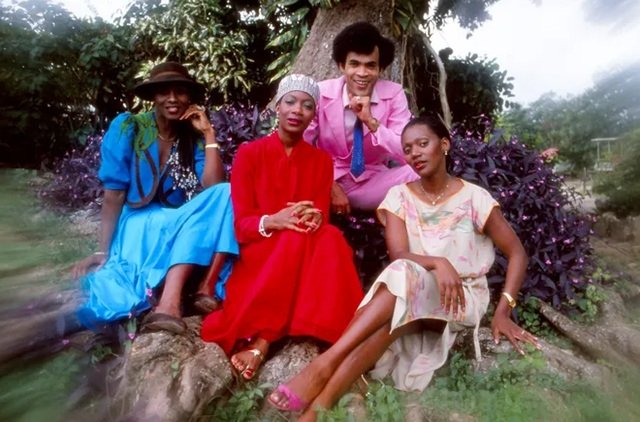
For decades, Boney M. represented glittering disco glamour, infectious dance hits, and the international optimism of late 1970s pop music. Songs like “Daddy Cool,” “Ma Baker,” “Rivers of Babylon,” and “Rasputin” became staples of dance floors from Europe to the Soviet Union, while the group’s vibrant performances turned them into one of the most commercially successful acts of their era. But a new German documentary is forcing audiences to reconsider the legacy of the band, uncovering what critics now describe as one of the darkest chapters in global pop music history.
The documentary, Boney M. Disco. Macht. Legende, directed by Oliver Schwehm for German broadcaster ARD, paints a deeply unsettling portrait of the machinery behind the band’s success. Drawing on archival footage, interviews, and personal testimonies, the film examines how producer Frank Farian built an international music empire by tightly controlling the image, voices, and identities of the four performers who became the public face of Boney M.
According to reporting discussed in Die Zeit, the documentary exposes a music industry environment shaped by exploitation, racial stereotyping, and unequal power structures. Farian, a producer from Saarland in western Germany, created Boney M. in the mid-1970s and effectively dismantled the project a decade later when the hits began to fade. The film argues that the group was always less about the performers themselves and more about the carefully engineered “brand” of Frank Farian.
The documentary revisits a controversial reality that had long been overshadowed by the band’s commercial success: not all of the voices audiences heard belonged to the performers on stage. While singers Liz Mitchell and Marcia Barrett contributed vocals to studio recordings, the deep male voice associated with Boney M. songs was largely Farian himself. Bobby Farrell, the charismatic male dancer and frontman known for his explosive stage presence, often lip-synced during performances. The revelation echoes the later scandal surrounding Milli Vanilli, another Farian-produced act whose downfall in the early 1990s became one of the music industry’s most infamous controversies.
Schwehm previously explored Farian’s methods in his earlier documentary Milli Vanilli: From Fame to Shame. That scandal destroyed the careers of Rob Pilatus and Fab Morvan after it was publicly exposed that they had not sung on their records. While the two performers became symbols of fraud and humiliation, Farian largely escaped lasting professional damage and moved on to new projects. Pilatus later died from a drug and alcohol overdose in 1998.
The new documentary presents Boney M. as a precursor to that scandal, arguing that the exploitation of performers — particularly Black artists — had already been normalized within the European music industry years earlier. The film examines how Farian assembled the group through a casting agency, selecting performers who could project a carefully designed image of “Black music” and cosmopolitan glamour to international audiences.
The members of Boney M. — Liz Mitchell, Marcia Barrett, Maizie Williams, and Bobby Farrell — came from Caribbean immigrant backgrounds connected to Britain and the Netherlands. The documentary explores the wider social context of postwar migration, comparing the experiences of Jamaican communities in Britain with immigrant communities in West Germany. Yet while the group projected confidence and success on stage, the film alleges that the performers themselves were often underpaid and denied control over their own careers.
One of the documentary’s most disturbing themes is the way racialized imagery was used to market the group. Promotional photographs and stage costumes frequently emphasized exoticism and sexualization, reinforcing stereotypes designed to appeal to European audiences. Costume designer Dagmar Engelbrecht recalls rejecting some concepts because, as she states in the film, she “didn’t like anything involving slavery.”
The imbalance of power between Farian and the group extended beyond image-making. Despite selling millions of records worldwide, members of Boney M. reportedly continued living in modest apartments while Farian accumulated wealth and influence. Hans-Jörg Mayer, a longtime friend of Farian interviewed in the documentary, bluntly concludes that “the accounting was not fair.”
The film also suggests that Farian’s obsession with studio control shaped the group’s entire existence. Touring reportedly interested him less than recording because live performances gave the performers independence from his supervision. Yet according to tour manager Bryan Miller, Boney M. were an extraordinary live act — even “better than ABBA,” he claims in the film.
Their concerts also carried political significance beyond entertainment. In 1978, Boney M. became the first Western pop group to perform in Moscow during the Cold War, paving the way for later performances in the Soviet Union by major acts such as the Rolling Stones and Pink Floyd. At a time when cultural exchanges between East and West were highly sensitive, the group became unlikely pioneers of global musical diplomacy.
At the center of the documentary’s emotional core is Bobby Farrell, whose frustrations over unequal treatment increasingly erupted into public conflict. Farrell reportedly became more vocal about exploitation within the group and was eventually replaced by Reggie Tsiboe. One archival scene highlighted in the film shows Farrell openly confronting a lawyer representing Farian during a televised East German youth program in 1990, exposing tensions that had long simmered behind the polished façade of disco stardom.
Farrell’s later life mirrored the tragic arc of several artists caught within exploitative entertainment systems. He died alone in a hotel room in St. Petersburg in 2010, twelve years after Pilatus’s death under similarly tragic circumstances. Schwehm’s documentary treats these stories not as isolated incidents but as evidence of a broader industry culture that consumed performers while protecting those who controlled the business behind the scenes.
One of the film’s most poignant moments involves Farrell’s daughter, Vanessa Breton-Mora, who grew up without her parents. Through careful editing, Schwehm juxtaposes footage of Breton-Mora smiling and taking photographs at an event with old Super-8 recordings of Farrell grinning into the camera decades earlier. The sequence creates a symbolic reunion across time, emphasizing the human cost behind global fame.
The documentary arrives at a moment when the legacy of older pop institutions is increasingly being reassessed through the lens of race, labor, and exploitation. Younger audiences may know Boney M. primarily through social media trends, especially after “Rasputin” experienced a massive resurgence on TikTok, generating billions of views and introducing the group to a new generation disconnected from its complicated history.
But Boney M. Disco. Macht. Legende insists that the story behind the music cannot remain separated from the structures that produced it. The film ultimately portrays Boney M. not simply as a successful disco act, but as a cautionary tale about fame, image manipulation, and the hidden inequalities embedded in global entertainment culture.