
by Satchi
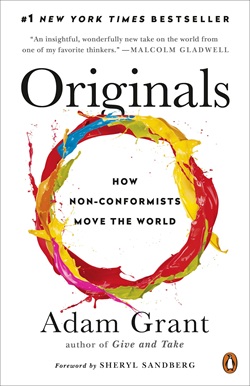
Adam Grant’s Originals: How Non-Conformists Move the World is a book that purports to unravel the mystique of innovation, creativity, and risk-taking. With an academic’s meticulousness and a populist’s flair for storytelling, Grant attempts to dismantle the entrenched myths surrounding originality. Yet, for all its empirical underpinnings and anecdotes, Originals often reads like a manual of contradictions, a work both illuminating and self-defeating.
Grant sets the stage by rejecting the notion that original thinkers are fearless revolutionaries. He insists that those who move the world are not necessarily the audacious mavericks of legend but rather calculated risk-takers. “The greatest creators,” he writes, “don’t necessarily have the deepest expertise but rather seek out the broadest perspectives.” The book aims to demystify originality by offering counterintuitive findings: successful entrepreneurs hedge their bets, procrastination fuels creativity, and non-conformists often work within systems rather than against them.
This is an alluring narrative, but does it truly hold water? Grant’s emphasis on empirical data gives his arguments a veneer of authority, but his methodology often suffers from the same selectivity that he warns against. He cites studies, anecdotes, and high-profile examples—Warby Parker’s founders, Martin Luther King Jr., and Steve Jobs—yet cherry-picks evidence that aligns with his thesis. Consider his claim that entrepreneurs who retain their day jobs have a 33% lower risk of failure than those who quit outright. This statistic, while intriguing, fails to account for broader systemic factors: market conditions, industry type, or the socioeconomic privilege that allows for risk-mitigation strategies. In this sense, Grant’s argument is itself a masterclass in the survivorship bias he so often deconstructs.
The book’s celebration of strategic procrastination is another provocative, if tenuous, assertion. Citing Leonardo da Vinci and Martin Luther King Jr., Grant contends that delaying action can lead to more profound insights. “When people start a business, are they better off keeping or quitting their day jobs?” he asks, before arguing that delayed commitment fosters stronger long-term outcomes. Yet he sidesteps the inconvenient reality that procrastination, for many, is less a strategic choice and more a psychological impediment. The notion that King’s oratory brilliance was enhanced by his last-minute revisions may be compelling, but does it generalise to the average individual juggling deadlines, pressures, and a lack of resources?
Even more problematic is Grant’s treatment of dissent. He argues that successful non-conformists must master the art of the Trojan horse—subtly embedding their radical ideas within palatable, mainstream frameworks. This is a palatable message for a corporate audience, but one that is at odds with historical precedent. Did Galileo temper his ideas to suit the Catholic Church? Did Rosa Parks strategically delay her defiance until the social climate was more receptive? Some of history’s most consequential originals did not ease their way into the mainstream but rather crashed against it with relentless defiance. The implication that true change agents must dilute their message for the sake of acceptance reeks of the very risk-aversion that Grant claims to critique.
Furthermore, Grant’s use of anecdotes occasionally undermines his own conclusions. He highlights cases like Warby Parker’s founders, who played it safe by maintaining traditional career paths while building their business. But for every Warby Parker, there is an Elon Musk—a figure who embodies the very “all-in” risk-taking that Grant seeks to dismiss. In bending history to fit his framework, Grant paradoxically reinforces the very myths he aims to debunk.
One of the book’s more insidious implications is its prescription for social change. Grant suggests that would-be originals should carefully navigate the power structures they seek to disrupt, advocating for incremental change rather than radical upheaval. While pragmatic, this approach fails to acknowledge that many of history’s most transformative figures—Frederick Douglass, Malcolm X, the Suffragettes—achieved progress not through subtle persuasion but through forceful, uncompromising demands for justice. Is Grant’s framework applicable to grassroots activism, or is it merely a guide for corporate professionals looking to shake things up without truly disrupting the system?
Grant’s prose is engaging, his anecdotes entertaining, and his research impressive in scope. Yet Originals ultimately suffers from a failure of its own premise: it seeks to redefine originality while paradoxically urging readers to conform to a new set of predictable behavioural patterns. If originality is to be truly embraced, it cannot be reduced to a formula, a set of strategic moves, or a carefully modulated level of dissent. The most revolutionary figures in history did not hedge their bets or smuggle their ideas into the mainstream—they took risks, often at great personal cost, and faced the full force of opposition.
For all its insights, Originals offers a version of non-conformity that is palatable, safe, and ultimately convenient. It tells us how to fit into systems rather than break them, how to push boundaries without transgressing them too far. It is a book that will delight the ambitious professional but leave the true radical unsatisfied. And therein lies its greatest contradiction: in striving to redefine originality, Originals only reinforces the boundaries it claims to shatter.