
by Luxman
Lixing Sun’s On the Origin of Sex sets itself an ambitious task: to explain one of evolutionary biology’s most persistent puzzles – why sexual reproduction exists at all. The question is deceptively simple. Sex is costly, inefficient and, from a strictly reproductive standpoint, often irrational. Asexual reproduction appears faster, safer and far more productive. Yet sex dominates the living world. Sun’s book approaches this paradox with intellectual curiosity and narrative exuberance, weaving together evolutionary theory, genetics and natural history. The result is an engaging but occasionally overconfident synthesis that seeks not only to popularise a scientific mystery but to recast it as a sweeping story about biological diversity and the fate of life itself.
Sun’s central premise rests on a classic evolutionary puzzle: why organisms reproduce sexually despite the clear advantages of cloning. Asexual reproduction, he reminds us, is faster, allowing for rapid habitat takeover when conditions are favourable. Sexual reproduction, by contrast, is burdened with the well-known “cost of males”, since in most species only females bear offspring while males contribute little more than genetic material. Sun frames this dilemma with a mixture of scientific clarity and rhetorical flair, presenting sex as what evolutionary theorists often call the “queen of evolutionary puzzles”. The book’s narrative momentum arises from the attempt to resolve this puzzle by navigating between competing explanations: mutation management, DNA repair, genetic recombination and ecological competition. Yet even as Sun evaluates these theories, he repeatedly returns to the conclusion that no single answer suffices. The exact origin and evolution of sex remain unsolved, even after decades of research. This admission is both intellectually honest and quietly destabilising, since it undermines the expectation that the book will ultimately deliver a definitive solution.
One of Sun’s strongest contributions lies in his explanation of the evolutionary trade-offs between sexual and asexual reproduction. The book emphasises that the benefits of sex are largely long-term, whereas the benefits of cloning are immediate. The perks of asexual reproduction are mostly immediate, whereas sexual reproduction pays off through countering Muller’s ratchet and mixing beneficial genes over time. This framing effectively highlights a fundamental tension within evolutionary processes: natural selection tends to favour immediate reproductive success, yet long-term genetic resilience may demand strategies that appear inefficient in the short term. Sun’s treatment of Muller’s ratchet – the gradual accumulation of harmful mutations in asexual populations – illustrates this tension vividly. The process operates as a slow-acting poison that gradually erodes genetic viability. By contrast, sexual recombination acts as a corrective mechanism, reshuffling genetic material and restoring diversity. Sun’s explanation here is lucid and persuasive, though it largely follows a well-established line of reasoning rather than offering a radically new interpretation.
Where the book becomes more distinctive is in its embrace of the Red Queen hypothesis, which Sun presents as a central explanation for the persistence of sex. According to this theory, species must constantly evolve simply to keep pace with their enemies – parasites, pathogens and competitors. Sexual reproduction accelerates this evolutionary arms race by generating genetic diversity. As Sun puts it, sex provides a stockpile of weapons enabling organisms to confront an ever-changing ecological battlefield. This argument is developed through examples ranging from microscopic rotifers to predator–prey interactions. Yet Sun’s enthusiasm occasionally borders on intellectual overreach. At one point he claims that the Red Queen principle has spilled into everything from weed management to cancer therapy, technological innovation, organisational behaviour and the arena of business competition. The suggestion that a biological hypothesis can explain phenomena across such disparate domains is provocative but also questionable. It reflects a broader tendency within the book to extend evolutionary metaphors beyond their empirical limits.
The narrative structure of On the Origin of Sex is organised around three thematic arcs: the emergence of sex, the mechanisms of sex determination and the evolutionary dynamics of sexual selection. Sun explicitly frames this structure as an exploration of three dimensions: origin, development and evolutionary path. This tripartite design works well as a pedagogical device, guiding readers from the deep history of early life to the contemporary complexities of sexual conflict and mate choice. However, it also reveals a tension between the book’s popular science ambitions and its scholarly aspirations. Sun frequently shifts between storytelling and theoretical exposition, sometimes within the same paragraph. The effect is lively but uneven. At times the prose reads like a lecture delivered with theatrical enthusiasm; at others it resembles a compressed survey of evolutionary literature.
Sun’s treatment of sex diversity illustrates both the strengths and weaknesses of this approach. The book delights in biological anomalies: hermaphroditic plants, sex-changing fish and mammals with unusual reproductive systems. These examples effectively challenge simplistic assumptions about biological sex. The author insists that nature’s diversity undermines any rigid binary framework, noting that organisms can switch sexes or combine reproductive functions in ways that defy conventional categories. The female mole, for example, possesses ovotestes—organs combining ovarian and testicular tissue—producing what Sun calls a biological rule-breaker. Such cases are presented not merely as curiosities but as evidence that sex itself is an evolutionary strategy rather than a fixed biological identity. Yet the discussion occasionally drifts toward rhetorical spectacle. The book’s fascination with extreme examples risks overshadowing the more statistically dominant patterns of sexual reproduction.
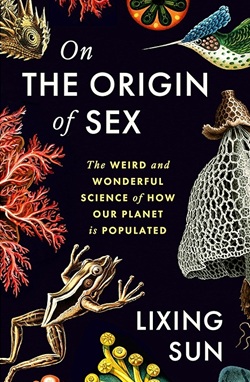
Perhaps the most controversial dimension of Sun’s argument emerges in his discussion of sexual conflict and evolutionary competition between males and females. Here the book dismantles popular clichés about the “battle of the sexes”, suggesting that such conflicts ultimately mask a deeper biological interdependence. In the long run, neither side truly wins; males and females remain different vehicles for genes on their uncertain but intertwined evolutionary journey. This formulation is both elegant and politically suggestive. By framing sexual competition as a temporary evolutionary strategy rather than a permanent biological antagonism, Sun implicitly challenges social narratives that naturalise gender conflict. Yet the book also flirts with evolutionary determinism, occasionally implying that social behaviours can be directly traced to genetic competition. The tension between these positions is never fully resolved.
What ultimately distinguishes On the Origin of Sex is its blend of intellectual curiosity and narrative ambition. Sun repeatedly emphasises that science advances not through definitive answers but through expanding questions. The study of sex remains a frontier precisely because it resists simple explanation. Even the most influential theories—from Muller’s ratchet to the Red Queen hypothesis—illuminate only fragments of a larger evolutionary puzzle. The persistence of sex reflects a dynamic balance between mutation, competition and adaptation. Evolution is not a static process but a perpetual race in which no species can ever truly win.
The achievement of Sun’s book lies less in solving the mystery of sex than in revitalising it. By synthesising diverse strands of evolutionary thought and presenting them through vivid storytelling, On the Origin of Sex invites readers to reconsider one of biology’s most fundamental phenomena. Yet the book’s strengths—its ambition, enthusiasm and willingness to generalise—are also its vulnerabilities. At times it stretches evolutionary explanations into speculative territory or treats metaphor as evidence. The result is a work that is stimulating rather than definitive, provocative rather than conclusive. For readers willing to accept that ambiguity, Sun’s exploration of the origins of sex offers a compelling reminder that the most basic features of life remain among its deepest mysteries.