


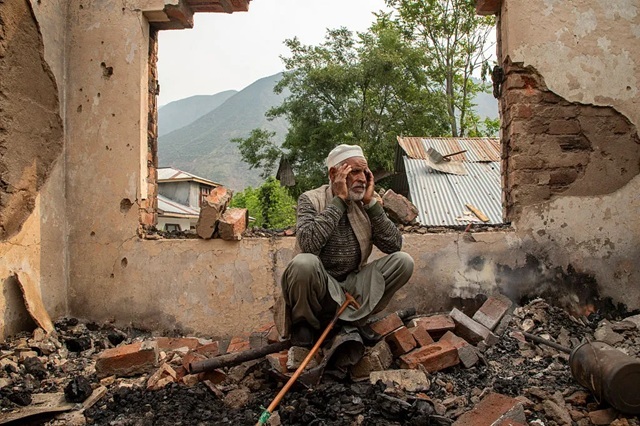
On October 27, 1947, Kashmiris worldwide observe Black Day as the beginning of India’s unlawful occupation of the region. The occupation, which included human rights violations, was imposed under oppressive laws. On July 19, 1947, Kashmiri representatives unanimously passed a resolution calling for the state’s accession to Pakistan. This historic resolution was based on the Indian partition plan, the state’s religious, geographical, cultural, and economic proximity to Pakistan, and the aspirations of millions of Kashmiri Muslims.
Maharaja Hari Singh disregarded popular opinion and caused a reign of terror in Jammu and Kashmir, creating one of the bloodiest massacres to wipe out the Muslims. On August 12, 1947, the Maharaja gave the Maharaja a Standstill Agreement to Pakistan and India, but India declined. In 1947, the Indian government forcefully occupied Jammu and Kashmir with the help of the military and justified the occupation of the place using the Instrument of Accession (IOA). Nonetheless, authoritative sources dispute that Maharaja Hari Singh signed the IOA willingly in October 1947.
Alastair Lamb’s book “Kashmir: A Disputed Legacy” reveals irregularities in the chronology of the Kashmir conflict, including Indian officials moving troops before legal formalities were complete and the Maharaja signing blank accession documents. The Dogra Forces brutally compelled tribesmen from neighboring areas to protect the Muslim population. The tribals entered Kashmir on October 22, 1947, to liberate Azad Kashmir, but the biggest lie is that the Indian Army arrived only after the tribals’ intrusion.
On October 17, 1947, the Indian Army was present in Jammu and Kashmir, with troops of the First Sikh Regiment of Patiala State present in Srinagar, Jammu, and Uri. India landed its army in Srinagar on 27 October, based on an accession deal with Maharaja Hari Singh. To prevent unlawful intervention, Pakistan sent its troops to Jammu & Kashmir, leading to the first Kashmir war between Pakistan and India.
In 1947, Indian Prime Minister Jawaharlal Nehru sought UN assistance to resolve the Kashmir dispute. The UN Security Council (UNSC) Resolution of April 21, 1948, favored a democratic plebiscite for Kashmir’s accession. Subsequent UNSC and UNCIP resolutions reiterated this position. India has not conducted a plebiscite and has ignored UNSC resolutions, instead employing suppression tactics, state-sponsored terrorism, and altering the demography of IIOJK to deny Kashmiris their right to self-determination.
The indigenous freedom struggle for Kashmir, initiated in 1989, began due to transgressions and injustices. Kashmiris are eager to seek freedom, but Indian brutalities intensify, making their lives miserable. India currently maintains nearly 1 million troops in Kashmir, making it the most militarized zone globally, involved in crimes against humanity.
The 2024 Legislative Assembly Election reflects the Indian government’s illegal actions to prolong its occupation of Kashmir, including the abrogation of its special status by the Modi regime in 2019. The election results are seen as a referendum against the federal government’s decision to downgrade Kashmir’s status and impose direct control from New Delhi. India is also altering the demographic landscape of the disputed region by settling non-Kashmiri Hindus and confiscating Kashmiris’ land as part of its settler-colonial strategy.
The termination of Muslim employees, appointment of Hindutva elements to higher ranks, and disenfranchisement of Kashmiri Muslims are threatening their lives, honor, and identity. Expansionist designs, jingoism, and Hindu supremacist policy detract from the region’s peace, and India’s arrogance is leading to a nuclear war. Kashmir is an incomplete part of the partition scheme and a globally recognized conflict, resulting in various wars between India and Pakistan.
The wars that India has fought with Pakistan include the 1947-48 war, the 1965 war, the 1971 war, the Kargil War (1999), and the 2025 Indo-Pak standoff. The recent aggression of India under the false flag operation of Pahalgam emphasizes India’s designs of hegemony. India is still destabilizing the region even after Pakistan’s rapid response, but it fails to learn from defeat.
The Kashmir conflict has been transformed into a nuclear flashpoint, and clouds of war will remain in South Asia until an enduring solution is based on UN resolutions and the desires of the Kashmiri people. Kashmiris share an ideological alignment with Pakistan, and such ideology cannot be extinguished through force.
The Kashmiris will not give up the freedom struggle despite oppression. Since 1947, Pakistan has been in solidarity and in support of the oppressed Kashmiris and will remain so till the dispute is solved according to the resolutions of the UNSC and the desires of the Kashmiri people. In line with United Nations Security Council resolutions, Pakistan maintains that the Kashmir issue should be resolved solely through an UN-supervised plebiscite.










