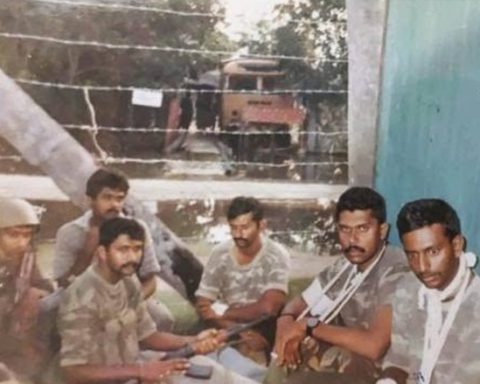
The annual Commemoration of War Heroes was held on Tuesday, and President Anura Kumara Dissanayake, in his address, pledged to fulfill the aspirations of those who had made the supreme sacrifice for the country. He said they had laid down their lives in the hope that their sacrifices would help build a better country. Last year, he drew criticism for avoiding the term ‘war heroes’ when referring to the fallen military personnel, but he used it on Tuesday. However, that commemorative event was like a play without its protagonist. All former war-winning military commanders were there, but ex-President Mahinda Rajapaksa’s absence was conspicuous. When Foreign Minister Vijitha Herath was asked, at Tuesday’s post-Cabinet media briefing, why Mahinda had not been invited to the commemoration, he said no political leaders had been invited. This claim is based on flawed logic.
Mahinda is not just a political leader; he is a former war-winning President and Commander-in-Chief. He and his family politicised and monopolised the war victory, misruled the country and bankrupted the economy, betraying the trust people reposed in them. But the fact remains that it was his unwavering leadership for the war that made the defeat of the LTTE possible. According to Article 33 of the Constitution, it is the President who declares war or peace. Military commanders merely follow orders from the President and Commander-in-Chief. If Mahinda had buckled under western pressure, the war would have ended prematurely and terrorism would have continued to plague the country.
Mahinda did not give in to pressure from the UK, the EU and the US during the final battle in 2009. British Foreign Minister David Miliband and his French counterpart Bernard Kouchner rushed here in a bid to pressure President Rajapaksa to suspend military operations before the decapitation of the LTTE and open an escape route for Prabhakaran. They even tried to visit the war zone. They were not given permission to do so because their presence there would have compelled the government to stop military operations. The Rajapaksa government also denied a visa to Swedish Foreign Minister Carl Bildt, who wanted to join Miliband and Kouchner to save the LTTE leadership.
If Mahinda had bowed down to western powers and left the war unfinished, it would have been impossible to defeat terrorism; the LTTE would have recovered from military setbacks, acquired drone capability, etc., with the help of the western powers, driven by geopolitical interests and the so-called vote bank politics.
Time was when mothers and fathers did not travel together in buses and trains lest their children should be orphaned in case of LTTE bomb attacks. They also had to guard their children’s schools. The LTTE massacred civilians, especially in villages adjacent to the areas under its control. In the North and the East, people were deprived of their franchise, and democratic dissent was suppressed brutally. Forcible child conscription, extortion and political killings were rampant in those parts of the country while the LTTE was around. That reign of terror ended 17 years ago.
So, all those who were instrumental in defeating LTTE terrorism should be honoured. They include the war-time Presidents and defence ministers, members of the armed forces including their commanders, especially those who served during Eelam War IV, the police, and the Civil Defence Force members.
Having demonised the Rajapaksa family, the JVP-NPP government may have decided against inviting Mahinda to the Commemoration of War Heroes to avoid the embarrassment of President Dissanayake having him as a special guest. It is also possible that the government thought Mahinda’s presence would eclipse President Dissanayake. Be that as it may, the JVP leaders cannot deny that they enabled Mahinda to secure the presidency in 2005 and do what he did thereafter. The SLFP did not back Mahinda in the presidential race, and the then President Chandrika Bandaranaike Kumaratunga did her best to queer the pitch for him to settle political scores albeit in vain. The JVP came to his rescue, and led his presidential election campaign from the front. One may recall that the present-day JVP leaders, especially President Dissanayake and Minister Herath, touted Rajapaksa’s election manifesto, Mahinda Chinthanaya, as a panacea, with the same zeal as street vendors. Videos of their snake-oil sales talk, as it were, from Mahinda’s election platform in 2005 are available in the digital realm. So, they can claim part of the credit for Mahinda’s leadership for the successful war on terror, and similarly part of the blame for his alleged wrongdoing should also fall on them.
There is no way the JVP-NPP government can justify the exclusion of Mahinda from the list of guests at the War Heroes’ Commemoration.