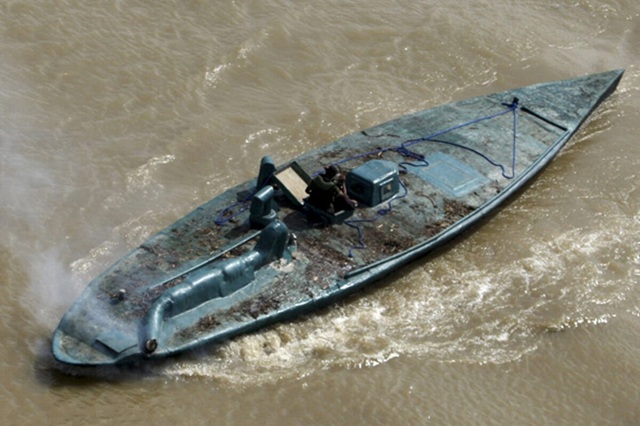
President Trump released dramatic footage of a Tren de Aragua fast boat destroyed somewhere in international waters off the coast of Venezuela. According to the President, all 11 occupants of the boat died when it exploded. One question that lingers over this event, which marked a major policy change by the current administration, is why the fast boat was carrying 11 people. Typically, fast boats are operated by two of three crew members.
A fast boat is usually made from fiberglass. The boats are manufactured under cover, often near the coastline in jungle areas. They are fast because they are equipped with powerful inboard or outboard engines. The destroyed fast boat had three outboard engines. These engines are often from major manufacturers like Yamaha and Mercury, with individual motors capable of 250 horsepower or more. Some fast boats can have as many as five to eight engines with a total output sometimes exceeding 2,000 horsepower. They can be launched from many areas in South and Central America. These boats have high fuel consumption, so they often need refueling as they traverse either the Caribbean, Atlantic or Pacific routes to the United States.
Because of the speed of the boats (over 90 knots in some cases), most conventional military ships can’t keep up with them, necessitating the use of helicopters and RIB boats (Rapid Inflatable Boats). A high performance RIB boat can reach 70 knots speed. Interdictions are likely to be successful when RIB boats for boarding and helicopters work in tandem. The US Coast Guard runs a special program for this purpose called the Helicopter Interdiction Tactical Squadron (HITRON). HITRON has been successful, to a degree, but the Coast Guard ships need to be operating relatively close to a detected target, which is not always the case.
Narco operators also operate aircraft and semi-submersible boats.
President Trump, allegedly in a secret Executive Order, changed US policy on the interdiction of drug vessels. Previously, the US Coast Guard, sometimes in cooperation with other countries, sought to locate, run down and capture fast boats and semi-submersibles. In these missions the objective was to arrest the perpetrators and bring them back to the United States for prosecution.
The old policy was, allegedly, justified as US compliance with the terms of the Law of the Sea Convention. The US Senate has refused to ratify the Law of the Sea Convention (LOS) since 1994 when it was first sent over for approval (US Senate approval requires 2/3rds of the Senate giving its “advice and consent”). Therefore US compliance was a sort of workaround that sought to apply LOS rules, obviously at odds with the Senate’s outlook. In any case, the US previous policy has no basis in US law.
Tren de Aragua” is a transnational criminal organization that originated in Venezuela. The name, which translates to “Aragua train,” is thought to be derived from a union of railway workers in the Venezuelan state of Aragua, where the group was founded.
Tren de Aragua engages in a wide range of illegal activities, including: Human trafficking and smuggling, often preying on Venezuelan migrants; Drug and arms trafficking; Extortion, kidnapping, and robbery; Illegal mining and money laundering and Forced prostitution and sex trafficking. The US has designated Tren de Aragua as an transnational criminal organization and, in the Trump administration says, is supported by the Maduro government of Venezuela.
The US Department of Justice says that “Tren de Aragua is not just a street gang – it is a highly structured terrorist organization that has destroyed American families with brutal violence, engaged in human trafficking, and spread deadly drugs through our communities.” DOJ describes Tren de Aragua as a foreign terrorist organization.
According to the Trump administration, much was known about the fast boat that was destroyed thanks to extensive intelligence including voice recordings. This gives rise to strong suspicions that this was not an ordinary drug run to the United States, but that it was potentially carrying a squad of terrorists with an as yet unknown mission.
There is a lot of speculation on how the fast boat attack developed. In August the US moved a number of naval assets near Venezuela, including the USS Lake Erie, the USS Gravely, the USS Jason Dunham and the USS Fort Lauderdale. The Gravely, Dunham are Arleigh Burke-class destroyers equipped with AEGIS anti-aircraft missiles. The Fort Lauderdale is a San Antonio class amphibious docking ship; the USS Lake Erie is a Ticonderoga-class cruiser. These ships were positioned to deal with any interference that might come from the Venezuelan Navy and Air Force. Venezuela has fighter aircraft including the Su-30 MK2, the US F-16, and the Hongdu JL-8 light attack aircraft. It also has a fleet of drones including from Iran (Quds Mohajer) and others from China.
The Pentagon has not said how the fast boat was destroyed, whether by helicopter, aircraft or drone. A good bet (albeit speculative) is that an MH-60R helicopter launched from USS Lake Erie, firing a Hellfire missile, which incinerated the fast boat. The other US ships close to Venezuela did not have choppers equipped with Hellfire missiles.
It is impossible to say when or even if the Pentagon will tell us more, or give us insight into what the intelligence revealed about this fast boat. The biggest question is what the eight additional occupants of the fast boat were up to.