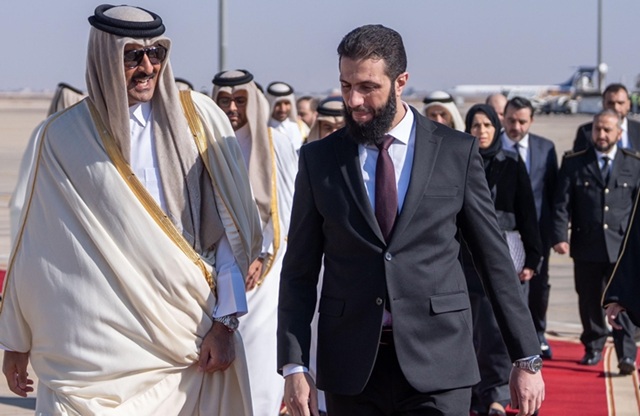
In a sweeping move that signals a dramatic shift in U.S. foreign policy, President Donald Trump has signed an executive order dismantling most U.S. sanctions against Syria, declaring an end to the national emergency first enacted in 2004. The decision opens the door to economic reconstruction efforts in the war-torn nation and sets the stage for a controversial thaw in relations between Damascus and the West.
The order, signed on Monday, comes after months of behind-the-scenes diplomacy involving regional powers including Saudi Arabia and Turkey. Both countries lobbied Washington to ease restrictions following the 2024 ousting of Syrian President Bashar al-Assad by Hay’at Tahrir al-Sham (HTS), a former al-Qaeda affiliate now led by Ahmed al-Sharaa, who has since assumed the presidency of Syria.
“Today marks a new chapter in Syria’s history,” Trump said during a visit to Riyadh earlier this year. “President Sharaa is an attractive, tough guy with a very strong past. He wants peace, and we’re going to help him rebuild his country.”
Despite his militant past, Sharaa renounced ties to al-Qaeda nearly a decade ago and has vowed to build an inclusive government in Syria. However, his leadership remains contentious. HTS is still designated a terrorist organisation by the United Nations, and the executive order directs U.S. Secretary of State Marco Rubio to review its status.
Syrian Foreign Minister Asaad al-Shaibani welcomed the move, calling it a “historic step” that would “lift the obstacle” to economic recovery. Posting on X, he said the decision would “open the door of long-awaited reconstruction and development.”
Photos from Syria showed celebrations erupting in several cities. In Homs, a young girl was pictured waving a Saudi Arabian flag — a symbol of the regional support behind the new regime.
The sanctions, originally imposed to isolate Assad’s government, had crippled the Syrian economy. According to the World Bank, the country’s GDP has shrunk by more than half since 2010, with exports plummeting from $18.4 billion to $1.8 billion. In recent years, the Assad regime had resorted to captagon trafficking and fuel smuggling to sustain itself financially.
White House Press Secretary Karoline Leavitt defended the decision, saying it aimed to support Syria’s “path to stability and peace.” However, not all sanctions can be lifted through executive action alone. Repealing some restrictions, especially those codified by Congress, will require legislative approval.
The move aligns with Trump’s broader strategy in the Middle East. His administration has renewed efforts to expand the Abraham Accords, with sources confirming preliminary talks between the U.S., Israel, and Syria to establish a new security framework. Israel, which has continued striking Iranian-linked targets in Syria even after Assad’s fall, has indicated openness to normalising relations with both Syria and Lebanon.
Still, critics warn that Washington’s embrace of Sharaa is risky. Though he has pledged to protect minorities and moderate governance, signs of authoritarianism remain. Recent decrees banned bikinis on public beaches and imposed conservative dress codes for women, sparking backlash among liberals. Meanwhile, sectarian violence persists, including a suicide bombing at a Damascus church last month that killed 22 people.
Analysts remain divided on the implications. Some see an opportunity for stabilisation in a fractured region, while others fear the U.S. may be legitimising a regime with a violent past and uncertain future.
One former U.S. diplomat called the move “a geopolitical gamble that could backfire if Sharaa fails to deliver on reform and peace.”
For now, reconstruction begins — but with questions looming over Syria’s future and the role Washington will play in shaping it.