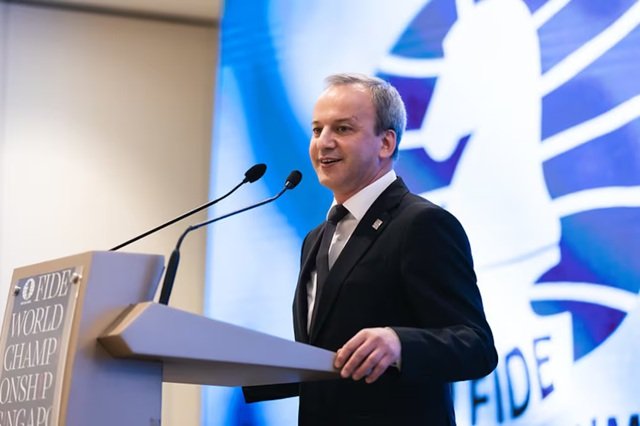
The European Union has imposed sanctions on International Chess Federation President Arkady Dvorkovich, citing actions deemed to undermine Ukraine’s sovereignty, prompting his resignation from the leadership of the global chess body. The move has drawn attention because Dvorkovich publicly condemned Russia’s invasion of Ukraine in 2022 and was subsequently removed from one of his senior positions in Russia, although he continued to receive Kremlin backing as head of FIDE.
Arkady Dvorkovich has stepped down as president of the International Chess Federation (FIDE) after the European Union added him to its sanctions list, accusing him of undermining the integrity, sovereignty and independence of Ukraine. The 54-year-old Russian official announced that he would delegate the presidency to Indian former world champion Viswanathan Anand until September, while challenging the sanctions through legal channels.
The sanctions were announced in the Official Journal of the European Union as part of a package targeting 48 individuals and 168 entities accused of threatening Ukraine’s sovereignty. The document highlights Dvorkovich’s previous positions within the Russian state and, in particular, his role as a member of the board of the Russian Chess Federation, which has been criticised for organising tournaments in Crimea, the territory occupied by Russia and claimed by Ukraine.
However, the sanctions document makes no reference to Dvorkovich’s public opposition to Russia’s invasion of Ukraine in 2022. At the time, he condemned the war both through an official FIDE statement and during an interview with Mother Jones magazine, declaring that “Wars, including this one, are the worst thing one can face in life.” He also expressed equal regret for those who had died during the previous eight years of conflict in the Donbas between the Ukrainian army and pro-Russian militias.
Dvorkovich’s criticism of the invasion carried immediate personal consequences. Shortly after making those statements, he was dismissed as head of the Skolkovo Foundation, Russia’s leading innovation centre often compared with Silicon Valley. Following his removal, he published an article praising the Russian military, although he has never confirmed whether he was compelled to write it. The father of three has since divided his time between Riga, Latvia, and Moscow.
Despite those events, Russian President Vladimir Putin continued to support Dvorkovich as president of FIDE. According to the source material, chess, and specifically Russia’s ambition to regain the world championship title, remains one of Putin’s sporting priorities. Dvorkovich had originally stated after his election at the 2018 FIDE Congress in Batumi, Georgia, that he intended to serve for no more than eight years. However, his personal circumstances led him to seek another re-election at the FIDE Congress scheduled for late September in Samarkand, Uzbekistan. The source suggests that Putin’s protection of Dvorkovich is closely linked to his position as FIDE president.
Responding to the EU sanctions, Dvorkovich described the measures as “illegal and unjust” and announced that he would appeal them “by every possible means”. He declined to make further comments when approached by El País. Anonymous sources close to him argued that the sanctions had been promoted by Ukraine with the support of several European countries, particularly the Baltic states, and claimed their primary objective was to prevent Dvorkovich, who had previously secured backing from many Western countries, from seeking another term as FIDE president.
During Dvorkovich’s eight years in office, particularly following Russia’s invasion of Ukraine, the international chess community has experienced what the source describes as a paradox. Many senior chess officials from numerous countries consulted by El País since 2018 reportedly regard him as perhaps the most capable president in FIDE’s century-long history. At the same time, they acknowledge that his Russian nationality and previous senior government positions have become significant obstacles to attracting major international sponsorship.
If Dvorkovich’s appeal remains unresolved before September, he is expected to enter the presidential election as the favourite because of his experience, extensive knowledge of the organisation and financial backing from the Kremlin. The election is shaping up to be highly competitive, with three confirmed candidates and one potential contender, all of whom are millionaires.
Among those seeking the presidency are German businessman Wadim Rosenstein, the son of a Ukrainian father and Russian mother, who has financed elite chess tournaments around the world this year, and fellow German entrepreneur Jan Büettner, an early Vodafone executive who has funded luxury freestyle chess events supported by leading players but criticised by many fans. Also in contention is Russian businessman Kirsan Ilyumzhinov, described in the source as having served for many years as an unofficial envoy for Putin in countries including Iraq, Libya, Syria and Afghanistan. A possible fourth candidate is Timur Turlov, a Kazakhstan-based businessman of Russian origin who has been sanctioned by Ukraine. Although the Russian Chess Federation has announced its support for Ilyumzhinov, Dvorkovich does not support his candidacy.