


by Our Diplomatic Affairs Editor
U.S. President Donald Trump’s Mideast envoy, Steve Witkoff, warned that the Gaza Strip “will probably be uninhabitable for at least the next 10 to 15 years” and said that Trump’s plan for an American takeover of the territory would “give them hope.”
Speaking to Fox News, Witkoff stated, “[Trump] is telling the Middle East that the last 50 years of doing things was not a correct way of doing things, and that he’s going to change it up because all those iterations have not worked.” He added, “He’s also telling the Middle East that he wants to be transparent with the Palestinian people: Gaza today is uninhabitable and will probably be uninhabitable for at least the next 10 to 15 years. That’s how much work needs to be done.”
“Everybody wants to see peace in the region,” he added. “Peace in the region means a better life for the Palestinians – a better life is not necessarily tied to the physical space that you are in today. A better life is about better opportunity, better financial conditions, better aspirations for you and your family. That doesn’t occur because you get to pitch a tent in the Gaza Strip and you’re surrounded by 30,000 munitions that can go off any moment.”
Historical Context and Foreign Control of Gaza
The Gaza Strip has long been a contested land under foreign control, with historical betrayals shaping its current volatile situation. Under the British Mandate from 1917 to 1948, promises made to both Arabs and Jews through contradictory agreements, such as the Balfour Declaration and the McMahon-Hussein Correspondence, left Palestinians increasingly dispossessed. The 1948 Arab-Israeli War saw Gaza come under Egyptian administration, yet Palestinians were never granted full autonomy. The situation worsened following the 1967 Six-Day War, when Israel occupied Gaza, leading to decades of military rule and resistance.
Palestinians have repeatedly been let down by international agreements that ignored their rights and aspirations. The Oslo Accords of the 1990s, which initially promised a path to Palestinian self-rule, ended up entrenching Israeli control while failing to deliver lasting sovereignty. Trump’s plan, while radical, risks repeating these historic betrayals by imposing external rule rather than addressing Palestinian national aspirations.
Political Reactions and Potential Violence
Republican lawmakers rallied behind Trump’s plan for a U.S. takeover of Gaza, despite the significant risks it presents that tend to go against GOP interests. Jewish groups and Democrats, however, condemned it as “incomprehensible” and “legally and morally unacceptable.”
“The world is looking to the United States for leadership, and President Trump is delivering lasting peace!” said Rep. Beth Van Duyne. “Today’s announcement put Hamas, Iran, and all our enemies on notice – the U.S. will NOT continue the status quo that has empowered terrorists and created a humanitarian disaster.”
Rep. Brian Jack added, “Through President Trump’s leadership, we will finally achieve peace in the Middle East!”
White House communications director Steven Cheung stated that “Trump is 100% correct. The definition of insanity is doing the same thing, expecting a different result. Peace – truly lasting peace – is the ultimate goal. And it can only happen with this President.”
In contrast, Andrew Miller, former State Department point person on Israel-Palestine under Antony Blinken, described the plan as “literally the most incomprehensible policy proposal I have ever heard from an American president. U.S. intervention would needlessly risk the lives of American soldiers and represent a security liability for the United States in a region where we are trying to reduce our presence. Of course, the forcible displacement of Palestinians from Gaza would represent a war crime, exposing the United States to scrutiny by the International Criminal Court.”
Risk of Further Violence
The announcement raises significant concerns that such a plan would ignite further violence. Palestinian factions, including Hamas and the Palestinian Authority, have outright rejected any foreign governance over Gaza, calling it a “neo-colonial” attempt to erase Palestinian identity and sovereignty. The idea of forced displacement is particularly sensitive, as it echoes the Nakba (Catastrophe) of 1948 when hundreds of thousands of Palestinians were expelled from their homes.
The broader Arab world has also reacted with alarm. Even U.S. allies such as Jordan and Egypt, who maintain peace treaties with Israel, have opposed any forced displacement of Palestinians, warning it would lead to severe regional instability. Saudi Arabia, which has been engaged in normalisation talks with Israel, has reiterated its stance that no peace is possible without the establishment of a Palestinian state.
Netanyahu’s Gains and Strategic Calculations
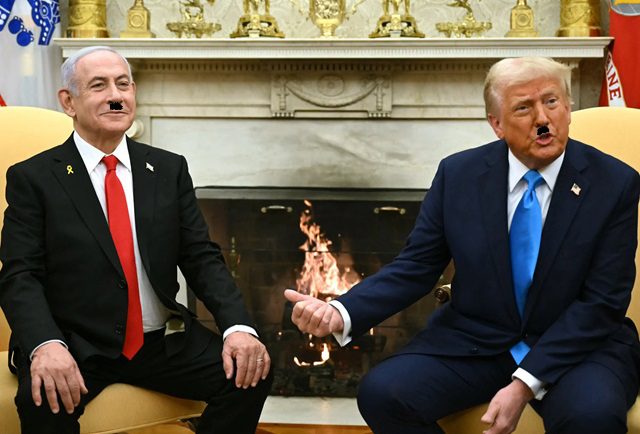
Ahead of Prime Minister Benjamin Netanyahu’s landmark meeting with U.S. President Donald Trump, the primary focus was on how much pressure the American leader would exert on Netanyahu to finalise the ceasefire deal and secure the release of remaining hostages.
However, all of that changed once Trump quickly shifted the goalposts from focusing on the hostages to calling for a U.S. takeover of Gaza, backed by the permanent displacement of every Palestinian in the enclave. This very notion would have been unimaginable weeks ago, yet it now dominates international discourse.
The irony of Trump calling Gaza a “hellhole” while standing beside Netanyahu, who smirked silently, raises the question: Who exactly does Trump think made every building in Gaza uninhabitable and therefore responsible for this required displacement?
Even if Trump considers this proposal as leverage over Netanyahu to end the war, it remains unclear how he expects this to unfold, given the strong opposition from key Arab allies.
The Saudi Stance and Regional Backlash
Saudi Arabia issued a firm response on Wednesday, stating that it would not establish ties with Israel without the creation of a Palestinian state. This contradicts Trump’s earlier assertion that the Saudis were not demanding a Palestinian state.
The Saudi foreign ministry affirmed that Crown Prince Mohammed bin Salman had stated the kingdom’s position “in a clear and explicit manner” that does not allow for any interpretation under any circumstances. The statement also rejected any attempts to displace the Palestinians from their land, adding that Saudi Arabia’s stance on Palestinian rights is non-negotiable.
Speaking to reporters ahead of his meetings with Netanyahu, Trump reiterated his call for Arab countries to take in Palestinians from Gaza, adding that Saudi Arabia was not demanding the establishment of a Palestinian state. However, the immediate backlash from Riyadh demonstrates that Trump’s assumptions about Arab support for his plan are flawed.
Trump and Netanyahu’s Endorsements
“Gaza MUST BE FREE from Hamas. As [US President Donald Trump] shared today, the United States stands ready to lead and Make Gaza Beautiful Again. Our pursuit is one of lasting peace in the region for all people,” US Secretary of State Marco Rubio tweeted after Trump called for the US to “take over” Gaza and clear it up of all Palestinians.
Prime Minister Netanyahu was asked whether he sees Trump’s plan for a US takeover of Gaza as “a way to expand the boundaries of Israel.”
Netanyahu responded, “President Trump is taking it to a much higher level. He sees a different future for that piece of land that has been the focus of so much terrorism, so many attacks against us… He has a different idea.”
Uncertain Future
While Netanyahu can return home with a new proposal to present to his far-right coalition partners, history suggests that any attempt to ignore Palestinian rights in favour of imposed solutions will only lead to more conflict, not peace.








President Trump and Netanyahu – are they going a bit “GAGA” – signs of early DEMENTIA ???? They should know that PALESTINE IS PALESTINE and IS NOT FOR SALE !!!!