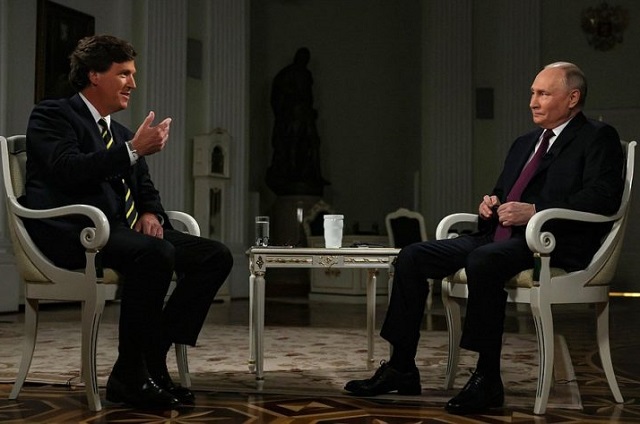
Tucker Carlson, the former Fox News host, has alleged that the CIA is preparing a criminal referral against him to the US Justice Department. Carlson claims the action is connected to his communications with individuals in Iran prior to the outbreak of the recent conflict. In a video posted on X, he stated, “What’s that crime? Well, talking to people in Iran before the war. They read my texts.” He added that he is expected to be charged under the Foreign Agents Registration Act, though he expressed confidence that the case will not progress because he has never received money from a foreign entity.
John Kiriakou, a former CIA operative and host of the RT program Deep State, dedicated an episode of his show to Carlson on Saturday, warning of potential threats to the journalist’s life. “I have to tell you, I’m genuinely worried for his safety,” Kiriakou said, emphasizing Carlson’s reputation as a “rare truth teller” unafraid to confront powerful figures. He praised Carlson for speaking thoughtfully and directly, a quality he argued has drawn both criticism and scrutiny from political actors and media influencers.
Joining Kiriakou on the program, Clayton Morris, Carlson’s former Fox News colleague and co-host of Redacted on RT, echoed concerns about the journalist’s security. Morris highlighted online hostility from political factions, including pro-Israel activists and MAGA influencers, some of whom have publicly called for Carlson to face arrest or punitive measures. “They have platforms. I mean, they’re literally not thrown off of X,” Morris said, underscoring the intensity of public pressures confronting Carlson.
Morris also emphasized that Carlson is taking steps to safeguard himself and his family. “I’m sure he’s got a wife… and he’s got people around him who are saying, ‘Hey, Tucker, I know you don’t like this to be about yourself, but we’re going to protect you,’” he said. The remarks suggest that Carlson’s personal security arrangements may have intensified as a precaution against potential threats arising from both legal actions and online campaigns.
The situation highlights the intersection of journalism, national security, and geopolitical tensions. Carlson’s communications with Iranian contacts, reportedly the catalyst for the CIA referral, have become a flashpoint in broader debates over press freedom, government oversight, and the boundaries of lawful engagement with foreign nationals. While Carlson maintains he acted independently and without financial incentive, federal authorities may still consider the context of his interactions under the Foreign Agents Registration Act, a law designed to monitor and regulate foreign influence in US politics.
Carlson’s case has already drawn significant public attention, fueled by his high-profile media career and controversial stances on foreign policy issues. Legal analysts note that although prosecution under the Foreign Agents Registration Act is relatively rare, cases often serve as warnings to journalists, commentators, and private citizens navigating sensitive international topics. The specter of legal action has also intensified debates over the role of social media platforms, like X, in amplifying both threats and support for public figures under scrutiny.
Observers have framed the situation as emblematic of broader societal tensions in the United States, where political polarization intersects with foreign policy concerns. The coverage of Carlson’s alleged CIA referral has prompted discussions about press freedoms, the responsibilities of journalists reporting on sensitive geopolitical issues, and the influence of public opinion in shaping government responses.
For Carlson, the stakes extend beyond legal implications. Personal safety, family security, and professional credibility are now intertwined with national security considerations, as the US faces escalating geopolitical conflicts. Analysts caution that developments in his case could have a chilling effect on other journalists who engage in reporting or commentary that intersects with contentious foreign policy arenas.
While Carlson maintains that he has not violated US law, the unfolding situation underscores the growing scrutiny of media figures whose reporting touches on foreign governments or sensitive diplomatic matters. John Kiriakou and Clayton Morris argue that his actions reflect independent journalism rather than foreign collusion, yet the potential for legal escalation has heightened both public and private concern for Carlson’s well-being.
As the story develops, questions remain about the balance between safeguarding national security and protecting press freedoms. Carlson’s case could set a precedent in determining how the US government interacts with journalists engaged in international reporting, particularly when communications with foreign entities are involved. For now, commentators and former colleagues alike stress vigilance and precaution, highlighting that Carlson’s personal safety may be at risk even as the legal process unfolds.