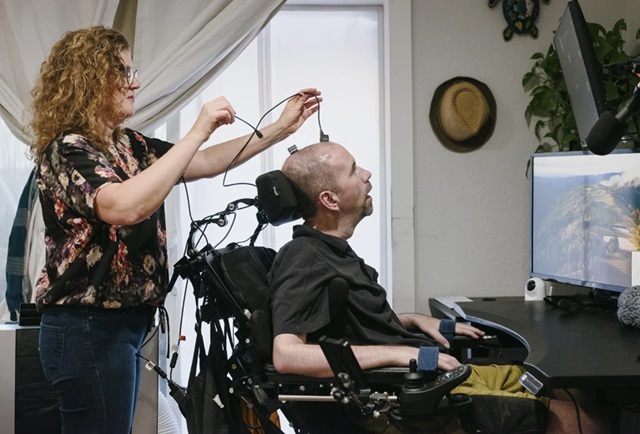
Before a car crash in 2008 left Nancy Smith paralysed from the neck down, she found joy in playing the piano. Years later, she returned to music thanks to a brain–computer interface (BCI) that recorded and analyzed her brain activity. By simply imagining playing an on-screen keyboard, the system translated her intentions into keystrokes, producing melodies such as ‘Twinkle, Twinkle, Little Star’. Yet for Smith, it often felt as though the piano played itself, with the system anticipating her actions hundreds of milliseconds before she consciously intended them, according to neuroscientist Richard Andersen of the California Institute of Technology.
Smith, who passed away in 2023, was among the first to have a dual-implant BCI in both her motor cortex and posterior parietal cortex, a brain region involved in planning, attention, and reasoning. Andersen’s team believes such implants could improve prosthetic control by capturing not just motor signals but also preconscious intentions. Over the past two decades, around 90 people have participated in similar trials, using BCIs to control computers, robotic limbs, and synthetic voice devices.
The experiments illustrate how BCIs can tap into the deepest levels of thought, raising ethical concerns about privacy and the influence of technology on cognition. Consumer neurotech, often less invasive and reliant on EEG rather than implants, can already track brain states such as focus, anxiety, or alertness. AI enhances these systems, turning noisy signals into actionable data, potentially revealing subtle preconscious responses. Experts warn that the combination of AI and neural monitoring could give companies unprecedented insight into people’s internal experiences, and current privacy regulations lag behind the technology.
Despite these concerns, BCIs are moving closer to clinical use. Devices like Synchron’s vascular BCI, which allows users to select on-screen options by imagining foot movements, have shown safety and efficacy, and may soon gain regulatory approval. Neuralink has implanted more complex devices in volunteers to play computer games and control robotic hands, with thousands waiting to participate in trials. Researchers are exploring the parietal cortex and other regions to decode internal dialogue and even preconscious decision-making, opening possibilities for treating psychiatric disorders and customizing neural therapies.
AI is deeply intertwined with these advancements, enabling BCIs to detect errors before users are aware of them, or assist with real-time communication. While this may improve efficiency, it also introduces difficult questions about user agency and consent, especially as AI-mediated BCIs could influence thoughts, intentions, and self-expression. Ethicists like Nita Farahany argue that developers should have a fiduciary duty to act in the best interests of users, extending beyond data privacy to the broader implications of AI-empowered neurotechnology.
The research, reported in Nature, demonstrates a future where the boundary between human thought and machine action blurs, challenging assumptions about autonomy, privacy, and identity while offering life-changing possibilities for people like Nancy Smith.