


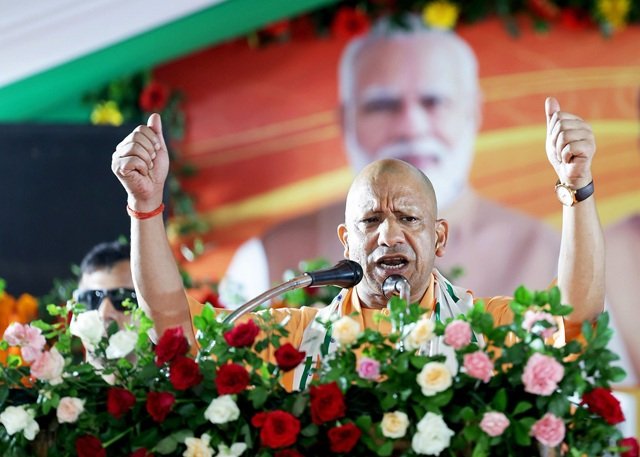
At 4am, Yogi Adityanath rises from a hard wooden bed. Two hours of meditation and prayer follow, then a simple vegetarian breakfast. The routine is austere, but the day that follows belongs to the administration of Uttar Pradesh, India’s most populous state and one of its most politically consequential.
Adityanath has governed the northern state for nine years, developing a reputation as one of the most forceful advocates of Prime Minister Narendra Modi’s Hindu-first agenda. Now, with state elections expected early next year, he is widely regarded in the source material as the favourite to secure a third consecutive term. Such a victory would elevate him into the front rank of possible successors to Modi, who is 75.
“Yogi-ji is a mirror image of Modi,” said a senior national government official, speaking anonymously because of the sensitivities surrounding two of India’s most powerful political figures.
The comparison is revealing. Like Modi, Adityanath comes from humble beginnings and cultivates the image of a disciplined, hardworking leader close to ordinary people. But critics argue that he has gone further in confronting Uttar Pradesh’s large Muslim minority, combining political rhetoric with policies aimed at practices including intermarriage and cow slaughter.
In 2020, Adityanath told the BBC that Muslims “did no favour to India by staying” after the partition of the subcontinent following independence from British rule. His critics have pointed to such remarks as evidence of a political approach centred on Hindu majoritarianism.
Yet Adityanath’s political identity is not confined to rhetoric. He has embraced modern communication with an 80-strong social media team producing clips of the saffron-robed chief minister delivering speeches and inaugurating public works.
“Monastic life is not different from community life,” Adityanath told the Financial Times at his official residence in Lucknow. “It is a medium for us to understand society and its problems.”
The Financial Times report presents a leader who has sought to combine his monastic identity with an emphasis on economic development. Uttar Pradesh was for decades among India’s least developed states. Adityanath, surrounded by figurines of Hindu deities and one of Modi, has highlighted kilometres of roads constructed, investment secured and companies created since he took office in 2017.
Even the cardboard gift boxes offered to visitors at his residence reflect the state’s economic and strategic identity, carrying images of mangoes and the BrahMos cruise missile, co-developed with Russia.
For supporters, the combination of development and stronger law enforcement has changed the image of Uttar Pradesh. Official data shows that the state has generally reflected rather than outperformed national growth, but public sentiment has credited Adityanath with economic transformation and a substantial reduction in crime.
“The chief minister has created such a good investment environment,” said a leading Indian businessman with interests in the state who requested anonymity. “In the past, Uttar Pradesh had law-and-order issues. Nobody talks about that any more.”
Shantanu Gupta, author of an approved biography of Adityanath, highlighted the government’s crackdown on local mafias. That campaign helped produce the nickname “Bulldozer Baba”, after excavators were used to demolish allegedly illegal properties.
“UP was known for its lawlessness,” Gupta said. “I’m from UP. Whenever I went for a job, they would look at me like: ‘Oh my God, he’s from UP, he might be a criminal.’ That was the image.”
Gupta also argued that Adityanath’s embrace of majoritarian politics has strengthened his appeal among Hindu voters. “India was made to feel ashamed of its majority religion,” he said. “Now it’s running the way the world runs . . . America runs on a Christian ethos, India runs on a Hindu ethos.”
Among his supporters is Dharmendar Rajput, a migrant labourer in Greater Noida, the state’s industrial hub adjoining New Delhi. Rajput said Adityanath “really works for the poor and is focused on the development of our state”.
“Most importantly,” Rajput added, “he works for the Hindus. He only goes after those doing wrong.”
But that interpretation is sharply contested. Sushant Singh, a South Asia lecturer at Yale University, described Adityanath as India’s leading advocate of Hindu supremacism. He accused the administration of pursuing policies involving the economic marginalisation of Muslims and their targeting by police.
“That has been his thing throughout, the economic marginalisation of Muslims, the targeting of Muslims by police,” Singh said. “Everything has been directed towards . . . a particular ideology.”
Adityanath rejects accusations of discrimination. “There’s no segregation in implementing welfare schemes,” he told the Financial Times.
His government has nevertheless toughened rules against cow slaughter and targeted what Hindu rightwingers call “love jihad”, a term used to allege that Muslims seek to seduce and convert Hindus as part of a deliberate attempt to alter India’s balance of faiths.
His administration has also deployed “Romeo squads” of police, officially intended to prevent women being molested in public places. Critics contend that thousands of consenting young people have instead been arrested and that interfaith couples have been harassed.
The political appeal of the Hindu-first agenda has also encountered limits. Adityanath won a second term in the 2022 state elections, but Modi’s Bharatiya Janata Party suffered a shock defeat in Uttar Pradesh in the national general election two years later.
Adityanath’s relationship with the BJP has its own history. His political and ideological formation emerged from the Gorakhnath temple near the Nepal border, where he took vows at the age of 22 and where he is now chief priest. His roots therefore lie outside the Rashtriya Swayamsevak Sangh, the powerful Hindu nationalist movement that forms the backbone of the ruling party.
The BJP nevertheless tolerated his independence, analysts said, partly because of his charisma and campaigning ability. He was one of India’s youngest MPs when first elected in 1998 at the age of 26. He subsequently backed his own independent candidates on occasions and, in 2002, formed his own movement, the “Hindu Youth Brigade”.
Today, Adityanath stresses his loyalty to Modi and avoids discussing his own ambitions. Yet his political trajectory has made succession an unavoidable question. Analysts are also watching for signs of rivalry between him and Amit Shah, Modi’s home minister and another potential successor.
A revealing moment came in June, when a scandal erupted over the alleged theft of hundreds of thousands of dollars in donations to the temple at Ayodhya, a flagship Modi project built on the grounds of a razed mosque in Uttar Pradesh. Adityanath was among the first to demand an investigation and punishment.
Singh interpreted the intervention as an attempt by the chief minister to distinguish himself from the political establishment surrounding the temple.
“He had been kept out of this whole temple thing, it had been completely taken over by Modi and people Modi had brought from Delhi,” Singh said. “Adityanath clearly sees this as an opportunity.”
For Christophe Jaffrelot, a South Asia specialist at Sciences Po in Paris, the next Uttar Pradesh election could determine whether the monk’s influence extends beyond the state.
“If he wins for the third time, he’ll be a clear contender for prime ministership,” Jaffrelot said. “If Yogi Adityanath wins UP three times, they can’t ignore him.”










