On a volcanic plateau in central Anatolia, Turkey, some 15,800 years ago, a female dog gave birth to a litter of puppies. The young pups did not survive long, possibly only a few months, yet the humans inhabiting the Pınarbaşı site buried them deliberately in the same area where they interred their own dead. Archaeologists now identify one of those puppies as the oldest genetically confirmed domestic dog, a discovery that rewrites the timeline of human-canine relationships by more than 5,000 years, according to new studies published in Nature and reported by El País.
Previously, the earliest evidence of domesticated dogs dated to roughly 10,900 years ago in Karelia, Russia. The recent research, conducted by scientists from 17 institutions worldwide, demonstrates that dogs were living closely with humans long before the advent of agriculture or the domestication of other animals. Lachie Scarsbrook of the University of Munich, co-author of the primary study, highlighted the magnitude of the finding: “We are talking about 6,000 years before humans began domesticating cows, goats, or pigs, and over 10,000 years before horses.”
The first study, led by William Marsh of the Natural History Museum in London and Scarsbrook, analyzed canine remains from two archaeological sites: Pınarbaşı in central Anatolia and Gough’s Cave in Somerset, United Kingdom. Even though the Pınarbaşı fragments were exceptionally small—described by Scarsbrook as “like freeze-dried coffee”—the researchers successfully extracted nuclear DNA, confirming that the specimens were domestic dogs rather than wolves. The oldest dog was dated to 15,800 years ago.
A second study by Anders Bergström and Pontus Skoglund of the Francis Crick Institute in London examined over 200 European canine remains ranging from 14,000 to 1,000 years old. This study confirmed that a debated specimen from Kesslerloch, Switzerland, dating to 14,200 years ago, was indeed a domestic dog. “We can now confirm it was a dog,” Bergström said.
One of the most striking revelations was that the dogs from Pınarbaşı and Gough’s Cave, separated by more than 4,000 kilometers, were genetically almost identical. Their most recent common ancestors lived around 16,900 years ago, suggesting a highly homogeneous dog population spread rapidly across western Eurasia near the end of the last Ice Age.
Paradoxically, the humans with whom these dogs lived were very different. Gough’s Cave was home to Magdalenian hunter-gatherers adapted to northern European cold, while Pınarbaşı’s inhabitants were Anatolian hunter-gatherers exploiting freshwater resources. “Before this study, we did not know these communities had any form of interaction,” said Marsh. “Yet they shared dogs.” This implies that dogs circulated across culturally and genetically distinct human populations, potentially as tools, companions, or valuable goods.
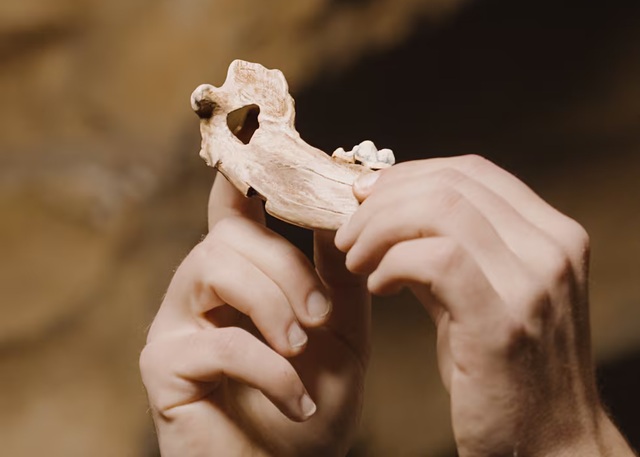
Analyses of the canine bones indicate diets mirroring those of their owners. At Pınarbaşı, dogs consumed freshwater fish, consistent with remains found in human layers, while in Gough’s Cave, human and dog diets were nearly identical. The symbolic relationship was also profound: in Pınarbaşı, the puppies were buried with human-like funerary rituals, and in Gough’s Cave—where humans practiced ritualistic cannibalism—the dog’s jaw displayed deliberate perforations resembling modifications made to human remains. “Already 16,000 years ago, these animals seemed to have symbolic importance for humans,” Marsh said.
The studies revealed yet another surprise: when agricultural populations arrived in Europe from Southwest Asia about 8,000 years ago, they largely replaced the continent’s hunter-gatherer humans, wiping out 80 to 90 percent of the original population. Dogs, however, persisted. Roughly half of the genetic ancestry of modern European dogs derives from these ancient hunter-gatherer lineages. “The hunter-gatherers were nearly erased genetically, but their dogs were not,” said Bergström. This lineage continues today in breeds from German Shepherds to Saint Bernards.
Despite the breakthrough, key questions remain. The exact origins of dog domestication and the wild wolf populations from which they descended remain unknown. The researchers speculate that domestication likely began in western Eurasia several millennia before the Pınarbaşı dog lived. They also caution that the role of these early dogs is still unclear; they may have functioned as hunting aids, alarm systems, or companions, yet children likely played with them, underscoring their integration into daily life.
El País reporting emphasizes that these findings challenge long-held assumptions about the evolution of human-animal relationships. The genetic and archaeological evidence illustrates not only the deep antiquity of dogs as humans’ companions but also their social and symbolic significance across widely separated Paleolithic cultures. For the first time, scientists can trace the enduring bond between humans and dogs to a period when all other domestic animals had yet to enter human societies.