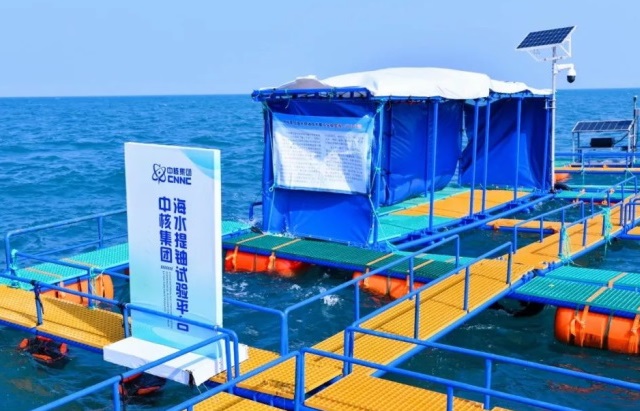
As China continues to expand its nuclear power capabilities, the nation faces an increasing demand for uranium. In 2024, China imported approximately 13,000 tonnes of natural uranium, while domestic production remained at a mere 1,700 tonnes. With local uranium mines unable to meet this growing demand, Chinese scientists are now turning to an unconventional but promising source—the sea.
Oceans are estimated to contain around 4.5 billion tonnes of uranium, a staggering 1,000 times the amount found in terrestrial ore reserves. However, the extraction process remains highly complex due to the low concentration of uranium in seawater—just 3.3 milligrams per tonne—and the presence of vanadium, a chemically similar element that complicates the separation process.
A breakthrough in uranium extraction from seawater has been achieved by researchers at Lanzhou University’s Frontiers Science Centre for Rare Isotopes. Led by Professor Pan Duoqiang, the team developed a new technology that significantly enhances uranium adsorption capacity and improves uranium-vanadium separation efficiency by 40 times. Their findings were published in the prestigious journal Nature Communications on March 10.
The researchers leveraged metal-organic frameworks (MOFs), which offer superior structural flexibility, functional diversity, and high surface area compared to traditional adsorbents. However, existing MOFs presented challenges, as precisely tuning their structure often led to reduced surface area and fewer active sites. To overcome this, the team synthesized molecules of diphenylethylene (DAE) into MOFs, allowing the material to dynamically adjust its pore size under ultraviolet light.
In trials using both simulated and real seawater containing various metallic elements, the DAE-MOF material demonstrated an exceptional uranium adsorption capacity of 588 mg per gram and a uranium-vanadium separation factor of 215. These results surpass all previously recorded performance metrics for uranium extraction materials.
Professor Pan emphasized the significance of this advancement, noting that it represents a crucial step toward practical and scalable seawater uranium extraction. The achievement aligns with China’s long-term strategy to secure a stable and independent uranium supply amid its nuclear energy expansion.
Historically, Japan led efforts in seawater uranium extraction, successfully retrieving 1 kg of uranium concentrate through large-scale marine trials in the 1980s and 1990s. However, China is now pushing forward with an ambitious agenda. In 2019, the state-owned China National Nuclear Corporation (CNNC) joined forces with 14 research institutions to establish the Seawater Uranium Extraction Technology Innovation Alliance. This alliance has laid out a 30-year roadmap to achieve industrial-scale uranium production from seawater by 2050.
The alliance’s first phase (2021-2025) aims to replicate Japan’s kilogram-level extraction achievement. By 2035, China plans to construct a tonne-scale demonstration plant, paving the way for continuous industrial production by mid-century. Given projections by the International Atomic Energy Agency that China’s uranium demand will surpass 40,000 tonnes by 2040, the success of these initiatives could play a crucial role in the country’s energy security and sustainability.