On March 28, 2025, at least two civilians were killed, and 110 persons – 53 Nepal Police personnel, 22 officers from the Armed Police Force (APF) and 35 protesters – sustained injuries, as violent clashes between the security personnel and pro-monarchy protesters erupted during a royalist demonstration in the Tinkune area of Kathmandu District in Nepal’s Bagmati Province. Among the casualties, Sabin Maharjan (29), a protester, succumbed to his injuries at Tribhuvan University Teaching Hospital, while journalist Suresh Rajak was found dead in the burnt remains of Marble House in Tinkune. Rajak was filming footage for Avenues Television from the roof of its building, which protesters had set on fire. The District Police Range, Kathmandu, reported widespread destruction, including arson, vandalism, and looting. According to the Police, 15 private and government vehicles were set on fire, while 14 physical structures were destroyed. Protesters looted 10 locations as they forcibly entered restricted areas, vandalising private property, hospitals, media houses, political party offices, and commercial zones. The rioters set fire to nine government vehicles and six other private or government-owned vehicles. They vandalised nine institutions and looted one location. Following the outbreak of violence, the Kathmandu District Administration Office imposed a curfew in the Baneshwar-Tinkune area of Kathmandu and the surrounding neighbourhood, starting at 4 PM [NPT] on March 28, which was later extended until 7 AM [NPT] on March 29.
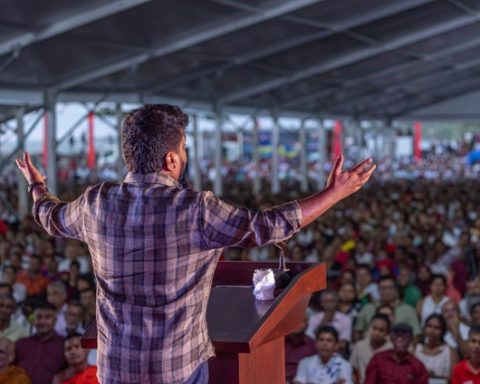
Thousands of supporters of former King Gyanendra Shah had gathered at the eastern edge of Kathmandu for the rally, organised by an alliance of different groups supporting the ex-monarch. The gathering on an open ground near the airport had been planned as a peaceful rally, but trouble began after some protesters in a white pickup drove into a police barricade, colliding with several officers. Police resorted to shooting tear gas shells and spraying the crowd with water cannons. On the other side of the capital city, thousands of people who support the present system of republic nation had gathered for a counter rally. The rally participants were from the opposition parties, led by the Maoist party [Communist Party of Nepal-Maoist Centre (CPN-Maoist Center)], which had fought an armed rebellion between 1996 and 2006 to oust the monarchy.
Security Forces (SFs) indicate that the demonstration, organised by the Joint People’s Movement Committee for the Restoration of Monarchy led by Nabaraj Subedi, escalated into arson, looting and violence. The Subedi-led Joint People’s Movement Committee staged the protest demanding the reinstatement of a Hindu monarchy and abolition of federalism, among other things. Police officials investigating the case claim that the pro-monarchy protesters on March 28, had planned to take control of the Parliament building located at New Baneshwar. They had also aimed at “taking over” the Tribhuvan International Airport in Sinamangal, to underscore the scale and ambition of their protest.
Prominently, a mob, led by businessman Durga Prasai, who has emerged as a key figure in the pro-monarchy movement, targeted Annapurna Media Network (AMN), one of Nepal’s largest media houses. They vandalised and set fire to the AMN’s office in Tinkune, causing significant damage to the building. The protesters also vandalised Kantipur Publications, another major media organisation in Nepal. Prasai, designated as the ‘field commander’, allegedly incited the crowd by entering a restricted area. Multiple videos have surfaced across various social media platforms showing Prasai himself attempting to drive over Police personnel in his car during the unrest.
Taking prompt action to contain the protest, Police arrested 105 agitators who were involved in burning houses and vandalising vehicles during the violent pro-monarchy demonstration.
According to an April 22, 2025, report, as the protest turned violent, SFs arrested two senior Rastriya Prajatantra Party (RPP) leaders, among them Senior Vice-Chair Rabindra Mishra and General Secretary Dhawal Shamsher Rana, accusing them of inciting violence. Later, however, Rana was freed “for treatment” on April 20, as he is reportedly a cancer patient. Meanwhile, Prasai, who fled the scene immediately after the incident, was later arrested on April 11 and was held in custody for 12 days. Police stated that, due to the need for further investigation, he would be presented before the District Court again to seek an extension of his remand period upon the completion of the 12-day in remand.
In the interim, on April 13, 2025, in a video message released on the occasion of the Nepal New Year 2082, former King Gyanendra Shah conveyed his condolences, and expressed sorrow over the violent turn of events. In the video message released to wish the general publica a Happy New Year, Shah stated, “We are deeply saddened to hear of the human and material damage caused by the violence, arson, and vandalism that occurred during the public demonstration a few days ago.”
Shah added, further, that there was no system greater than democracy when it comes to guaranteeing civil liberty. Shah also mentioned that, in places where true democracy exists, there is a tradition and culture of listening to both praise and criticism from the public.
Interestingly, Nepal’s 2024 news headlines were dominated by political instability. The year witnessed two changes of government, first in March 13, 2024, when Prime Minister Pushpa Kamal Dahal aka Prachanda, Chairman of the CPN-Maoist Center, Nepal’s third largest party, exchanged the Nepali Congress for the Communist Party of Nepal-Unified Marxist-Leninist (CPN-UML) as his principal coalition partner. In the second change, in July 2024, CPN–UML Chairman Khadga Prasad Sharma Oli aka K.P. Oli became Nepal’s Prime Minister for the fourth time. Oli decided to end his support for the CPN-Maoist Centre Government led by Dahal, and instead joined hands with the Nepali Congress’ Sher Bahadur Deuba.
Meanwhile, on April 24, 2025, CPN-Maoist Centre decided to hold talks with the Nepali Congress to form a new government. The parliamentary party meeting concluded that the current government led by K.P. Oli would not last much longer. During the meeting, Chairman Dahal stated that discussions would begin as soon as NC President Sher Bahadur Deuba returned from Thailand, where he was receiving medical treatment. As there was an agreement with the UML for a rotating prime ministership, Chairman Dahal hinted at supporting Nepali Congress President Sher Bahadur Deuba as the next prime minister. However, he did not clarify whether the Maoist Centre would join the new government.
However, on April 25, 2025, responding to a question from the media about whether the current government would be presenting the upcoming budget, Prime Minister Oli announced that he would step down from his position in 14 months and added that Nepali Congress President Sher Bahadur Deuba would take over as Prime Minister following his resignation.
- the CPN-Maoist-Chand will seek to address all its political issues through dialogue,
- the CPN-Maoist-Chand will carry out all its political activities in a peaceful manner, and
- the Nepal Government will lift the ban it had imposed on the party’s activities, free all cadres from jail and withdraw court cases against them
Nepal recorded no terrorism-linked fatality in 2024. The killing of a teacher, Rajendra Shrestha, by Netra Bikram Chand-led Communist Party of Nepal-Maoist (CPN-Maoist-Chand) cadres in the Miklajung Rural Municipality in Morang District of Province No. 1 on December 8, 2020, was the last terrorism-related incident of the country. There were 13 fatalities in 2019 (three civilians, two SF personnel and eight extremists), all linked to CPN-Maoist-Chand. After a nearly six-year hiatus from 2013 to 2018, when Nepal recorded just two fatalities (both civilians, in 2013), violence had resumed in 2019. Significantly, during the insurgency period (February 13, 1996 – November 21, 2006), the Terai region recorded 3,194 fatalities (467 civilians, 724 SF personnel and 2,003 Maoist cadres). On March 4, 2021, the CPN-Maoist-Chand, under tremendous pressure from the SFs, came to a three-point agreement with the Government. Among other things, the agreement stated,
There are no other violent Maoist rebel groups in the country. Further, the Terai insurgent groups have also ceased operations.
Meanwhile, Positive clauses in Nepal’s long-awaited transitional justice law, which the parliament passed in August 14, 2024, may contribute to the advancement of justice, truth-seeking, and compensation for the numerous human rights abuses that took place during the 1996–2006 conflict between Maoist rebels and government forces. But some of its components might make it harder to hold people accountable for major crimes. Human rights, governance, and the rule of law have all been weakened by Nepal’s pervasive impunity dilemma, which has been exacerbated by the lack of justice for crimes committed during the conflict. Moreover, investigations into claims of corruption encountered political meddling, while Police officers accused of recent human rights abuses went unpunished.
While Nepal remains free from terrorism, a latent threat from the unabated activities of radical Islamic elements persists. Activities of Islamist organisations, particularly the Islami Sangh Nepal (ISN), continued to receive financial assistance from foreign donor agencies and support from the Pakistan Embassy in Kathmandu.
On January 28-29, 2025, an Islamic international NGO, “Helping Hand for Relief and Development–US” (HHRD-US), donated medical equipment worth around NPR 17 million to four government hospitals in Jhapa District, in collaboration with ‘Work for Nepal’ (WFN). HHRD-Nepal Programme Manager Irfan Pokharel alias Jiba Prasad Pokharel, and WFN Chairman Tilchandra Adhikari facilitated the donation. HHRD is a US-based global humanitarian organisation, linked with Islamic fundamentalists, including those in Pakistan.
The Jiyaul Haq Memorial Charity Trust, an NGO which is funded by the Pakistan Embassy in Kathmandu, distributed carpets and mattresses at a basic school at Basantpur, Dharan, Sunsari District, in the last week of January 2025. Approximately 125 students were given carpets and mattresses.
On February 6-7, 2025, a two-day Ijtema (religious conference/gathering) was held in Jhapa, and about 2,000 persons participated on a regular basis, while about 12,000 persons attended the concluding jumma namaz (Friday prayers).
On February 8-9, 2025, a two-day jalsa (gathering), titled “Educational Celebration”, was organised by ISN at Madrassa Tableegh-ul-Islam (TUI), Sunsari, Koshi. Aabid Hussain, Chairman, TUI, was the head of the management and organising committee of this jalsa and facilitated the visit of Pakistani and Bangladeshi maulanas.
Further, between February 8 and 10, 2025, an Ijtema of the Tabligi Jamaat was held at Rautahat. Maulana Jakir from Birgunj, Nepal, was among the notable participants.
Between February 10 and 12, 2025, a three-day Ijtema was organised at Dainia, Morang District.
According to a February 22, 2025, report, Nepal has been placed on the Financial Action Task Force (FATF) grey list for a second time during the FATF plenary meeting held in Paris on February 17-21, 2025, indicating the country’s failure to fully implement necessary legal, policy and structural reforms to combat money laundering and terrorist financing. However, by taking the initiative to introduce a Bill to bring the funding of INGOs/NGOs under strict regulation, the Nepalese government is trying to monitor unchecked funding of NGOs/INGOs, particularly those financed by Islamic and Western countries. If such a Bill is passed, it may prove useful in regulating the funding of radical Islamic and other INGOs. Notably, Nepal was given until October 2024 to meet FATF standards following an extension in July 2023. But the international body found the country had not sufficiently addressed these deficiencies by the deadline. Earlier, Nepal had been put on the FATF ‘grey’ list from 2008 to 2014.
The decline of political morality is the primary cause of instability in Nepal. The best system for Nepal remains democracy, despite all its flaws, and more democracy is needed to address its problems. Sadly, political fragmentation and opportunistic power-sharing deals continue to dominate the country’s politics. K.P. Oli is the only leader of the CPN-UML, while Prachanda is in charge of the CPN-Maoist Centre. Sher Bahadur Deuba of the Nepali Congress is reportedly seeking a sixth term as prime minister under his agreement with Oli. Significantly, Nepal has seen 14 governments since the first elected government of the Federal Democratic Republic of Nepal in 2008, and the indications are that this game of musical chairs between the three main players will continue. Not only has this undermined institutional integrity and the pace of development, it has the potential of spiralling out of control, to threaten the hard-won peace in the country.