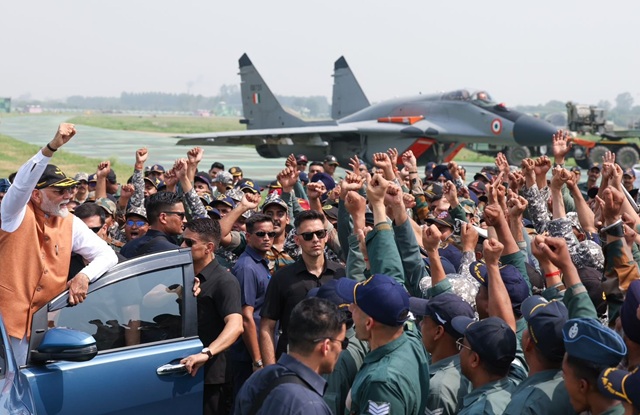
India and Pakistan are actively preparing for the next possible military confrontation, stockpiling weapons, adopting emerging technologies, and leaning heavily on their foreign defence partners — a development that analysts say raises the risk of another dangerous escalation in South Asia. The full report, originally published by the South China Morning Post (SCMP), sheds light on how both nuclear-armed neighbors are shifting their military doctrines and rearming in the wake of their most recent skirmish.
The recent five-day aerial conflict, sparked by India’s Operation Sindoor — a retaliatory strike following a deadly terrorist attack in Kashmir — has left a precarious calm along the volatile Line of Control. India claims the operation is “far from concluded,” while Pakistan has responded by promoting its army chief Asim Munir to field marshal, touting a successful defence between May 7 and 11.
Despite the clear nuclear stakes, both countries are moving ahead with preparations for future conflict. Analysts cited by SCMP say a future war may unfold across new domains, including cyber, space, and advanced drone warfare, potentially pushing traditional armies and navies to the sidelines.
“Conventional forces did not play prominent roles” in the latest flare-up, said Joshua White, a former White House adviser on South Asian security. But future conflicts, he warned, could involve broader fronts and deeper military engagement.
Drone Swarms, AI, and Hybrid Warfare
Military analysts say India is likely to double down on autonomous swarm drones and AI-powered systems to target hidden threats in Pakistan-controlled Kashmir, following the loss of several aircraft, including a likely downed Rafale jet.
In turn, Pakistan is expected to adopt hybrid tactics — such as deploying cheap, armed drones along the border and supporting militants with portable anti-aircraft weapons — to counter India’s high-tech edge. “They’ll rely on irregular warfare and asymmetric tactics,” said Boyko Nikolov, editor of defence site Bulgarianmilitary.com.
Global Suppliers Fuel South Asia’s Arms Race
Both nations are preparing to replenish and upgrade their arsenals from their primary arms partners: the U.S., France, and Russia for India; and China for Pakistan.
“Both will go on a shopping spree to be ready for the next round,” said Abdul Basit, a security analyst at Singapore’s S. Rajaratnam School of International Studies. He predicted a surge in purchases of long-range missiles, drones, and electronic warfare capabilities.
India, with deepening ties to Washington and Paris, is likely to benefit from accelerated deliveries of precision-guided munitions and air-to-ground missiles for its Rafale fleet. The U.S. may expedite MQ-9B drone deliveries as part of its strategic effort to contain Chinese influence in the region, SCMP reported.
Pakistan, meanwhile, remains heavily dependent on China, which has shown more caution in the volume of weapons supplied — likely due to its own strategic balancing act between New Delhi and Islamabad. Beijing is expected to provide limited shipments of drones and munitions to avoid fueling regional instability.
A New Fighter Jet Race
The competition extends to next-generation airpower. Pakistan appears poised to become the first foreign buyer of China’s fifth-generation J-35 stealth fighter, with its pilots already training on the aircraft. It is also collaborating with Turkey on the Kaan stealth fighter, signaling an ambition to join the elite circle of countries with low-observable air platforms.
India, meanwhile, is weighing its options between acquiring U.S.-made F-35s or Russian Su-57s, or accelerating its own Advanced Medium Combat Aircraft (AMCA) project. However, as SCMP notes, delays in India’s indigenous Tejas program cast doubt on its timeline for fielding a fifth-generation fighter.
The Strategic Chessboard
As both nations modernize their militaries, they are increasingly caught in the broader rivalry between China and the West. India’s growing alignment with the U.S. could further sour ties with China, while Pakistan’s deepening dependence on Beijing limits its flexibility.
“Washington wants India to stop worrying about Pakistan and focus on China,” Basit told SCMP. “Meanwhile, Beijing doesn’t want the India-Pakistan conflict to pull New Delhi closer to Washington — that would raise fears of a two-front war.”
Despite the growing sophistication of both militaries, analysts caution that the spiraling arms race — coupled with historical enmity and nuclear arsenals — is a recipe for volatility.
As the SCMP report concludes, “These powers may want to sell weapons and influence the region, but they also know that pushing India and Pakistan too far could unleash a catastrophe no one wants.”